Introduction
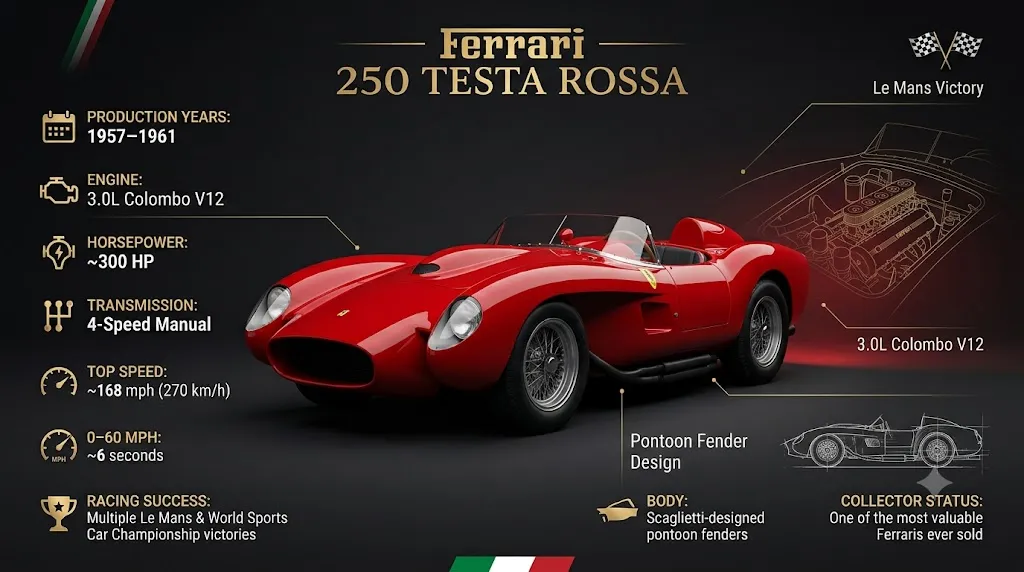
The Ferrari 250 Testa Rossa is widely regarded as one of the greatest racing cars ever created. Combining breathtaking beauty, legendary engineering, and an unrivaled motorsport legacy, it represents the golden era of Ferrari’s dominance in international endurance racing. Introduced in the late 1950s, this iconic sports prototype became famous for its lightweight construction, powerful Colombo V12 engine, and unforgettable victories at prestigious events such as the 24 Hours of Le Mans, Sebring 12 Hours, and Targa Florio.
Today, the Ferrari 250 Testa Rossa is much more than a historic race car—it is one of the world’s most valuable collector automobiles, regularly commanding tens of millions of dollars at international auctions. Whether you’re a Ferrari enthusiast, collector, investor, or simply fascinated by classic racing machines, understanding the Testa Rossa’s history, engineering, market value, and ownership experience offers valuable insight into one of Maranello’s finest creations.
In this comprehensive guide, we’ll explore everything from its development story and technical specifications to racing achievements, auction records, restoration challenges, investment potential, buying advice, and comparisons with other legendary Ferrari models.
Ferrari 250 Testa Rossa Quick Overview
| Specification | Details |
| Manufacturer | Ferrari |
| Production Years | 1957–1961 |
| Body Style | Two-door Sports Racing Barchetta |
| Coachbuilder | Scaglietti |
| Engine | 3.0L Colombo V12 |
| Horsepower | Approximately 300 hp |
| Torque | Around 217 lb-ft (294 Nm) |
| Transmission | 4-Speed Manual |
| Drivetrain | Rear-Wheel Drive |
| Fuel Type | Petrol |
| Seating Capacity | 2 |
| Top Speed | Approximately 168 mph (270 km/h) |
| 0–60 mph | Around 6 seconds |
| Weight | Roughly 800 kg (1,760 lbs) |
What Is the Ferrari 250 Testa Rossa?
The Ferrari 250 Testa Rossa (often abbreviated as 250 TR) was Ferrari’s purpose-built sports racing car developed to compete under FIA’s three-liter racing regulations. Unlike Ferrari’s road-going grand tourers, the Testa Rossa was designed exclusively for endurance competition.
Its name, “Testa Rossa,” meaning “Red Head” in Italian, comes from the distinctive red-painted cylinder heads fitted to its famous Colombo V12 engine.
Only 34 original examples were produced, making it one of Ferrari’s rarest and most desirable collector cars.
Its combination of rarity, racing pedigree, stunning design, and historical importance has made it one of the most expensive automobiles ever sold.
The Story Behind the Ferrari 250 Testa Rossa
During the mid-1950s, Ferrari faced increasingly fierce competition from Maserati, Jaguar, Aston Martin, and Mercedes-Benz in international endurance racing.
New FIA regulations limited engine displacement to 3.0 liters, forcing Ferrari engineers to rethink their successful racing formula.
Chief engineer Carlo Chiti and legendary designer Gioacchino Colombo developed an entirely new racing machine around Ferrari’s proven V12 architecture.
The result debuted in 1957, immediately proving itself faster, lighter, and more reliable than many of its rivals.
Its first appearance marked the beginning of one of Ferrari’s greatest periods in motorsport history.
Development and Design Philosophy
Ferrari’s objective was simple:
- Build the fastest endurance race car possible.
- Improve cooling efficiency.
- Reduce vehicle weight.
- Enhance handling balance.
- Maximize reliability during 24-hour races.
Every component served a racing purpose.
Unlike luxury Ferraris, the Testa Rossa sacrificed comfort for speed, simplicity, and durability.
Its body featured:
- Lightweight aluminum panels
- Aerodynamic profile
- Large front air intakes
- Minimal interior trim
- Excellent engine cooling
Ferrari 250 Testa Rossa Specifications
Engine
Perhaps no component defines the Ferrari 250 Testa Rossa better than its legendary 3.0-liter Colombo V12.
Engine Specifications
| Specification | Value |
| Engine | Colombo Tipo 128 V12 |
| Displacement | 2,953 cc |
| Configuration | Naturally Aspirated V12 |
| Horsepower | Approximately 300 hp |
| Redline | Nearly 7,200 rpm |
| Fuel Delivery | Six Weber Carburetors |
| Cooling | Water Cooled |
Despite modest displacement, the engine produced remarkable power while remaining exceptionally reliable during endurance races.
Transmission
Power was delivered through a robust:
- 4-speed manual gearbox
- Rear-wheel drive layout
- Close-ratio gearing
- Lightweight clutch assembly
The gearbox was optimized for long-distance racing rather than outright acceleration.
Chassis
Ferrari engineers employed a tubular steel spaceframe chassis that balanced rigidity with minimal weight.
Benefits included:
- Improved cornering
- Better durability
- Easier repair during races
- Lower overall mass
Suspension
Front Suspension
- Independent wishbones
- Coil springs
- Hydraulic dampers
Rear Suspension
- Live rear axle
- Semi-elliptic leaf springs
- Radius arms
While primitive by today’s standards, it delivered excellent endurance performance.
Brakes
Stopping power came from:
- Large drum brakes initially
- Later, four-wheel disc brakes
- Improved fade resistance
- Better wet-weather performance
The adoption of disc brakes significantly improved endurance race consistency.
Performance
| Performance Metric | Figure |
| Top Speed | 168 mph |
| Horsepower | 300 hp |
| Weight | 800 kg |
| Power-to-Weight Ratio | Outstanding for its era |
| 0–60 mph | Around 6 seconds |
For the late 1950s, these figures were Extraordinary.
Ferrari 250 Testa Rossa Design Evolution
One of the reasons collectors admire the Testa Rossa is that no single design remained unchanged throughout production.
Ferrari continuously refined the body to improve aerodynamics, cooling efficiency, and race performance.
Major design revisions occurred between 1957 and 1961.
Pontoon Fender Models Explained
The earliest Testa Rossas featured the famous Pontoon Fender design.
These sculpted front fenders:
- Directed airflow toward the brakes
- Reduced front-end lift
- Improved cooling
- Created one of Ferrari’s most iconic silhouettes
Today, Pontoon Fender cars are considered among the most valuable Ferraris ever built.
Later Testa Rossa Versions
Ferrari gradually evolved the design with:
- Lower nose profile
- Fully enclosed front fenders
- Revised rear bodywork
- Improved aerodynamics
- Better weight distribution
These updates enhanced high-speed stability on circuits like Le Mans.
Exterior Design
Even by modern standards, the Ferrari 250 Testa Rossa remains one of the most beautiful race cars ever created.
Key Exterior Highlights
- Hand-formed Scaglietti aluminum body
- Distinctive oval front grille
- Signature Pontoon Fender styling (early models)
- Lightweight racing windscreen
- Wire-spoke racing wheels
- Large brake cooling vents
- Functional aerodynamic curves
- Long sculpted hood
- Twin racing fuel fillers on select chassis
Unlike road-going Ferraris of the era, every exterior element prioritized performance over luxury, resulting in a timeless design admired by collectors, designers, and automotive historians alike.
Interior Features
The cabin of the Ferrari 250 Testa Rossa was intentionally minimalist.
Everything inside served one purpose: winning races.
Interior highlights included:
- Lightweight aluminum dashboard
- Large analog tachometer positioned directly in front of the driver
- Essential oil pressure, water temperature, and fuel gauges
- Three-spoke wood-rim steering wheel
- Lightweight bucket seats
- Simple gear lever with exposed metal gate
- Virtually no sound insulation or luxury trim
Comfort was sacrificed to save weight, making the cockpit feel raw, mechanical, and completely focused on competition.
Comfort & Practicality
By modern standards, comfort is extremely limited.
| Feature | Rating |
| Seating Comfort | ★★☆☆☆ |
| Cabin Space | ★★☆☆☆ |
| Visibility | ★★★☆☆ |
| Noise Isolation | ★☆☆☆☆ |
| Long-Distance Comfort | ★★☆☆☆ |
| Driver Engagement | ★★★★★ |
Collectors appreciate the authenticity of this uncompromising race-focused interior rather than expecting grand touring luxury.
Ferrari 250 Testa Rossa Production Numbers
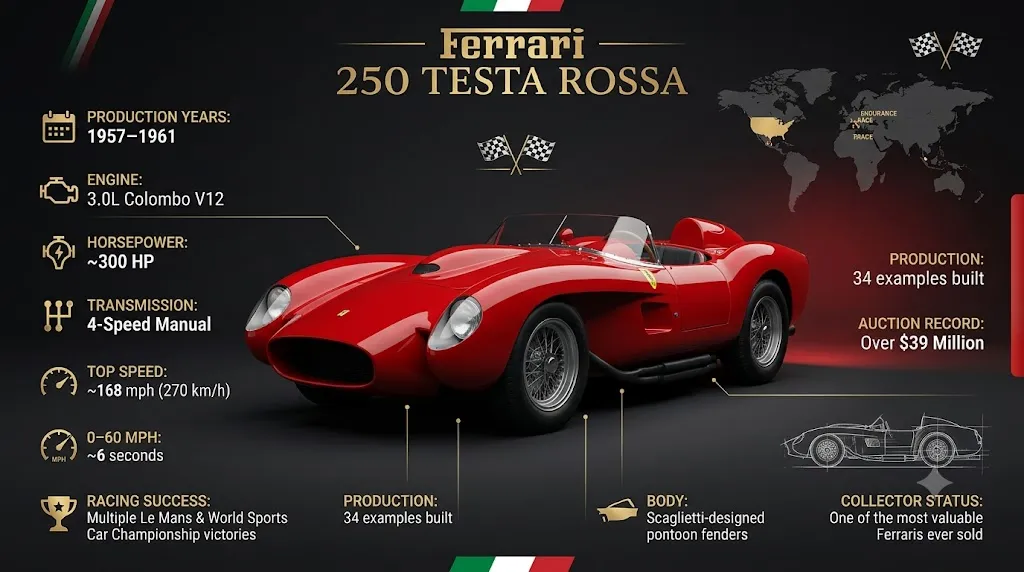
Unlike mass-produced sports cars, the Ferrari 250 Testa Rossa was built exclusively for elite factory-backed and private racing teams. Ferrari produced only a very limited number of cars, making every surviving example exceptionally valuable today.
Most historians agree that 34 original Ferrari 250 Testa Rossa chassis were produced between 1957 and 1961, although slight variations exist depending on how prototype, customer, and factory cars are classified.
Its extreme rarity is one of the primary reasons the model consistently ranks among the world’s most expensive collector automobiles.
Production Summary
| Model | Production Years | Approximate Units |
| 250 TR Prototype | 1957 | 1 |
| Pontoon Fender 250 TR | 1957–1958 | Limited production |
| 250 TR 59/60 | 1959–1960 | Limited production |
| TRI/61 | 1961 | Final evolution |
| Total Production | 1957–1961 | Approximately 34 cars |
Every chassis differs slightly due to continual factory development, racing modifications, and customer specifications.
Chassis Breakdown
One of the fascinating aspects of the Ferrari 250 Testa Rossa is that no two cars share the same racing history.
Each chassis has its own:
- Factory specification
- Competition history
- Drivers
- Restoration story
- Ownership lineage
- Auction record
Many chassis competed in multiple international endurance events before being updated with newer bodywork or mechanical improvements.
Collectors place tremendous importance on:
- Original chassis Integrity
- Matching engine
- Original gearbox
- Factory documentation
- Period race history
- Continuous ownership records
Cars with verified factory histories often command significantly higher values than restored examples with incomplete documentation.
Ferrari 250 Testa Rossa Racing History
The Ferrari 250 Testa Rossa quickly established itself as the dominant endurance racing machine of the late 1950s.
Its combination of:
- Exceptional reliability
- Powerful Colombo V12
- Lightweight construction
- Efficient cooling
- Balanced handling
allowed Ferrari to dominate international sports car racing.
The Testa Rossa became one of Ferrari’s greatest competition successes, helping secure multiple World Sportscar Championship titles and reinforcing Maranello’s reputation as the benchmark for endurance racing.
24 Hours of Le Mans
No race defines the Ferrari 250 Testa Rossa more than the 24 Hours of Le Mans.
The car earned multiple overall victories during one of motorsport’s toughest endurance events.
Its strengths included:
- Outstanding engine reliability
- Excellent fuel efficiency for a racing V12
- Stable high-speed aerodynamics
- Consistent tire wear
- Strong braking performance over long distances
These qualities made it exceptionally competitive against rivals from Jaguar, Aston Martin, Porsche, and Maserati.
Why It Excelled at Le Mans
- Reliable Colombo V12
- Durable drivetrain
- Lightweight aluminum body
- Efficient cooling system
- Predictable handling over long stints
Its Le Mans achievements remain a defining chapter in Ferrari’s racing legacy.
Sebring 12 Hours
The Sebring 12 Hours presented a completely different challenge.
Florida’s rough circuit punished:
- Suspension
- Brakes
- Engines
- Drivers
The Ferrari 250 Testa Rossa proved remarkably durable under these demanding conditions.
Ferrari engineers continuously refined suspension settings and brake cooling, enabling the car to remain competitive throughout the event.
Sebring victories further cemented the Testa Rossa’s reputation as one of the greatest endurance racers ever built.
Targa Florio
The legendary Targa Florio in Sicily demanded agility rather than outright speed.
Its narrow mountain roads featured:
- Hundreds of corners
- Constant elevation changes
- Uneven surfaces
- Minimal room for error
The Testa Rossa’s lightweight construction and responsive steering made it especially effective on this challenging course.
Its success at Targa Florio showcased Ferrari’s engineering versatility across vastly different racing environments.
Nürburgring 1000 km
The Nürburgring Nordschleife tested every aspect of a race car.
Known as the “Green Hell,” the circuit combined:
- High-speed straights
- Blind crests
- Tight corners
- Rapid elevation changes
- Unpredictable weather
The Ferrari 250 Testa Rossa’s balanced chassis and dependable V12 enabled it to compete successfully against Europe’s strongest manufacturers.
Strong performances at the Nürburgring reinforced Ferrari’s dominance in international endurance racing.
Buenos Aires 1000 km
The Buenos Aires 1000 km opened the World Sportscar Championship season and attracted elite teams from around the world.
The Ferrari 250 Testa Rossa adapted well to the circuit’s:
- High temperatures
- Long straights
- Heavy braking zones
Its cooling efficiency and mechanical durability allowed Ferrari to remain competitive throughout lengthy races in demanding South American conditions.
Other Major Victories
Beyond the headline events, the Ferrari 250 Testa Rossa collected victories and podium finishes across numerous international races.
Notable achievements include:
- Goodwood Tourist Trophy
- Spa endurance events
- Various European hill climbs
- International sports car races
- National endurance championships
These successes contributed significantly to Ferrari’s reputation during the late 1950s and early 1960s.
Legendary Drivers
Some of motorsport’s greatest names drove the Ferrari 250 Testa Rossa during its competitive career.
These drivers extracted the maximum performance from the car while helping shape Ferrari’s racing legacy.
Among the notable figures associated with the Testa Rossa are:
- Phil Hill
- Olivier Gendebien
- Wolfgang von Trips
- Richie Ginther
- Dan Gurney
- Carroll Shelby
- Jean Behra
- Stirling Moss (private Ferrari campaigns)
- Jo Bonnier
Their skill, endurance, and mechanical sympathy played a vital role in the Testa Rossa’s remarkable success.
Ferrari Engineering Innovations
Although designed more than six decades ago, the Ferrari 250 Testa Rossa introduced several engineering ideas that influenced later racing cars.
Lightweight Philosophy
Ferrari minimized weight through:
- Hand-built aluminum body panels
- Tubular steel frame
- Compact V12 engine
- Minimal interior equipment
This philosophy improved acceleration, braking, and handling.
Aerodynamic Cooling
The famous Pontoon Fender bodywork wasn’t merely beautiful—it improved airflow to the front brakes, helping reduce brake fade during endurance races.
High-Revving Colombo V12
The Colombo V12 became one of Ferrari’s most celebrated engines thanks to its:
- Smooth power delivery
- Reliability
- Lightweight design
- Excellent balance
- Distinctive exhaust note
Its success influenced Ferrari racing engines for years to come.
Racing Achievements at a Glance
| Race/Event | Achievement |
| 24 Hours of Le Mans | Multiple overall victories |
| Sebring 12 Hours | Multiple wins and podiums |
| Targa Florio | Class-leading performances |
| Nürburgring 1000 km | Championship-winning results |
| Buenos Aires 1000 km | Strong endurance performances |
| World Sportscar Championship | Helped Ferrari secure multiple titles |
Why the Ferrari 250 Testa Rossa Became a Motorsport Icon
Several factors combined to make the 250 Testa Rossa one of the most celebrated race cars in automotive history:
- Exceptional reliability in endurance racing
- Beautiful Scaglietti-designed bodywork
- Powerful and dependable Colombo V12 engine
- Continuous factory development
- Victories at the world’s toughest races
- Legendary drivers behind the wheel
- Extremely limited production numbers
- Strong provenance and historical significance
Its blend of engineering excellence, racing success, and rarity ensures that the Ferrari 250 Testa Rossa remains one of the crown jewels of classic motorsport.
FAQs
A: The Ferrari 250 Testa Rossa is one of the rarest and most historically significant racing cars ever built. With only around 34 original examples, an unmatched endurance racing record, multiple victories at prestigious events like the 24 Hours of Le Mans and Sebring, and exceptional collector demand, it has become one of the most valuable classic Ferraris in the world. Its rarity, provenance, and motorsport heritage continue to drive record-breaking auction prices.
A: Ferrari built approximately 34 original 250 Testa Rossa chassis between 1957 and 1961. Each chassis has its own unique history, race record, and ownership provenance, making every surviving example highly desirable among collectors.
A: The Ferrari 250 Testa Rossa is powered by the legendary 3.0-liter Colombo Tipo 128 V12 engine. It produces around 300 horsepower, uses six Weber carburetors, and is paired with a 4-speed manual transmission. The engine is renowned for its reliability, smooth power delivery, and unforgettable exhaust note.
A: Yes. The Ferrari 250 Testa Rossa played a major role in Ferrari’s endurance racing dominance by securing multiple overall victories at the 24 Hours of Le Mans, along with wins at Sebring, Targa Florio, Buenos Aires, and other international endurance races.
Conclusion
The Ferrari 250 Testa Rossa is far more than a classic racing car—it is a defining symbol of Ferrari’s engineering excellence, motorsport success, and enduring legacy. From its beautifully sculpted Scaglietti bodywork and legendary 3.0-liter Colombo V12 engine to its unforgettable victories at Le Mans, Sebring, Targa Florio, and other iconic endurance races, the Testa Rossa represents one of the greatest achievements in automotive history.
Its combination of extreme rarity, Championship-winning pedigree, timeless design, and proven investment potential has earned it a place among the most valuable collector cars ever produced. Whether you’re a passionate Ferrari enthusiast, a classic car investor, or simply fascinated by historic motorsport, the Ferrari 250 Testa Rossa remains an unmatched benchmark of performance and prestige.