Introduction
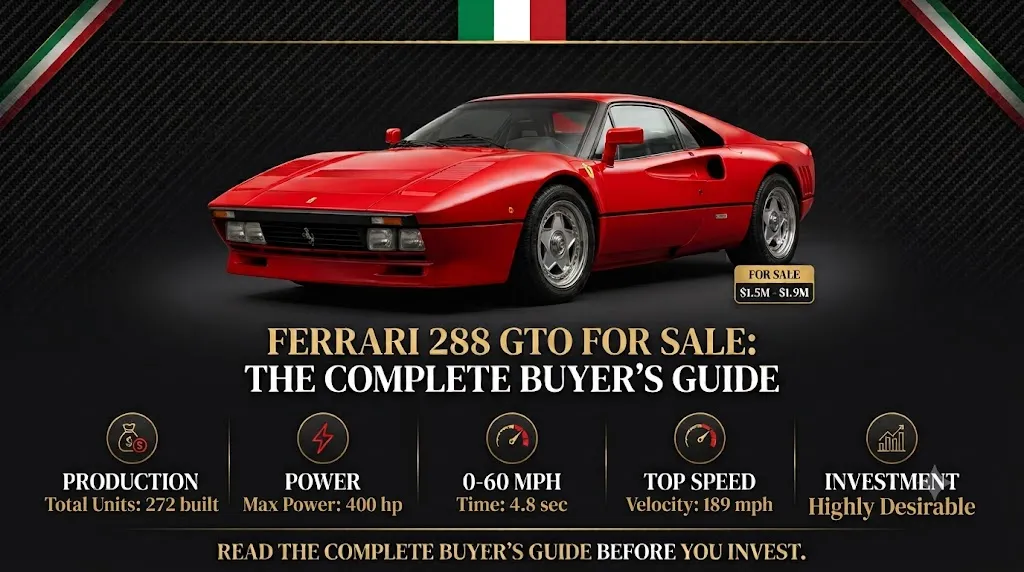
Few collector cars command as much admiration as the Ferrari 288 GTO. Widely regarded as one of the most significant Ferraris ever produced, it combines breathtaking performance, motorsport-inspired engineering, and extraordinary rarity. Originally developed to compete in the FIA’s Group B racing category, the 288 GTO never fulfilled its intended racing destiny after the series was canceled. Instead, it became one of the world’s most desirable road-going supercars and laid the foundation for legendary models like the Ferrari F40.
Today, finding a Ferrari 288 GTO for sale is exceptionally rare. With only 272 production cars built between 1984 and 1987, demand consistently exceeds supply. Whether offered through prestigious auction houses, specialist Ferrari dealers, or private collectors, every available example attracts global attention and multi-million-dollar bids.
This comprehensive guide explores everything prospective buyers and collectors need to know—from the Ferrari 288 GTO’s history, specifications, design, and current market values to ownership costs, maintenance considerations, and long-term investment potential. Whether you’re searching for your dream collector Ferrari or researching one of Maranello’s greatest achievements, this guide provides the knowledge needed to make an informed decision.
Ferrari 288 GTO Overview
The Ferrari 288 GTO occupies a unique place in automotive history. While it shares some visual similarities with the Ferrari 308 GTB, nearly every component was redesigned to create an entirely new high-performance machine capable of competing in international motorsport.
Unlike many collector cars valued solely for rarity, the 288 GTO delivers an exceptional driving experience thanks to its lightweight construction, twin-turbocharged V8 engine, and race-inspired chassis. It represents Ferrari’s first true modern supercar and remains one of the brand’s most collectible road cars.
Production Years
- 1984–1987
- First customer deliveries began in 1985.
- Built primarily for Group B homologation.
Why Ferrari Built the 288 GTO
Ferrari designed the 288 GTO to satisfy FIA Group B homologation requirements. The regulations required manufacturers to produce at least 200 road-going versions of their race cars.
Although the cancellation of Group B racing prevented the competition program from materializing, Ferrari completed production due to overwhelming customer demand.
Ferrari’s Group B Ambitions
During the early 1980s, manufacturers like Peugeot, Audi, Lancia, and Porsche were developing increasingly powerful Group B race cars. Ferrari responded by engineering an entirely new vehicle capable of competing at the highest level.
The result was the 288 GTO—a road car with unmistakable racing DNA.
Production Numbers
| Specification | Details |
| Production Years | 1984–1987 |
| Units Produced | 272 |
| Engine | 2.9L Twin-Turbocharged V8 |
| Layout | Rear Mid-Engine |
| Transmission | 5-Speed Manual |
| Drivetrain | Rear-Wheel Drive |
| Assembly | Maranello, Italy |
Ferrari 288 GTO Quick Overview
| Feature | Specification |
| Engine | 2.9L Twin-Turbocharged V8 |
| Horsepower | 395 hp |
| Torque | 366 lb-ft (496 Nm) |
| Transmission | 5-Speed Manual |
| Drivetrain | Rear-Wheel Drive |
| Fuel Type | Premium Petrol |
| Body Style | Two-Door Berlinetta Coupe |
| Seating Capacity | 2 |
| Top Speed | Approximately 189 mph (304 km/h) |
| 0–60 mph | Around 4.9 Seconds |
| Chassis | Tubular Steel with Composite Panels |
| Production | 272 Units |
Ferrari 288 GTO History
The Birth of a Legend
By the early 1980s, Ferrari recognized the need to compete against increasingly advanced Group B race cars. The company tasked renowned engineer Nicola Materazzi with developing a completely new high-performance platform capable of dominating the championship.
Although inspired by the Ferrari 308 GTB, the 288 GTO featured a significantly longer wheelbase, wider bodywork, upgraded suspension, and a bespoke twin-turbocharged engine.
The project was officially unveiled at the Geneva Motor Show in 1984, instantly captivating enthusiasts and collectors worldwide.
Development
Virtually every component was redesigned to prioritize performance.
Major engineering improvements included:
- Lightweight Kevlar and fiberglass body panels
- Reinforced tubular chassis
- Twin IHI turbochargers
- Dry-sump lubrication
- Advanced intercooling
- Race-derived suspension geometry
The result was a car capable of outperforming many contemporary racing machines while remaining road legal.
The Group B Homologation Story
Ferrari intended to build just enough road cars to satisfy FIA homologation rules. However, before the racing version could compete, a series of tragic accidents led to the cancellation of the Group B championship in 1986.
Instead of becoming Ferrari’s next race winner, the 288 GTO became one of the world’s rarest production supercars.
Ironically, this unexpected turn significantly increased its long-term collector value.
Legacy
The Ferrari 288 GTO established several milestones:
- Ferrari’s first modern supercar
- Ferrari’s first production twin-turbocharged road car
- Foundation for the Ferrari F40
- One of the most valuable homologation cars ever built
Many historians consider it the spiritual beginning of Ferrari’s “Big Five” halo cars:
- 288 GTO
- F40
- F50
- Enzo
- LaFerrari
Exterior Design
The Ferrari 288 GTO is widely celebrated for its purposeful, motorsport-inspired styling. While its silhouette echoes the Ferrari 308 GTB, the body was substantially re-engineered to improve cooling, aerodynamics, and stability at high speeds.
Aggressive Bodywork
Key exterior enhancements include:
- Wider front and rear fenders
- Larger air intakes
- Integrated front spoiler
- Functional rear vents
- Lightweight composite body panels
- Flared wheel arches
These design elements weren’t merely aesthetic—they were engineered to support the demands of high-performance driving and future Group B competition.
Headlights
Classic pop-up headlights preserve the clean wedge-shaped profile while maintaining the unmistakable Ferrari identity of the 1980s.
Wheels
The iconic 16-inch Speedline alloy wheels remain one of the model’s defining visual features, paired with performance-focused tires that complement the car’s balanced handling characteristics.
Aerodynamics
Unlike many modern supercars that rely on large rear wings, the 288 GTO achieves aerodynamic efficiency through subtle body sculpting. Carefully integrated ducts and spoilers enhance airflow and cooling without compromising the car’s timeless design.
Interior & Comfort
Step inside the Ferrari 288 GTO, and it’s immediately clear that Performance takes precedence over luxury. The cabin reflects Ferrari’s racing philosophy while still offering a level of craftsmanship befitting an exclusive road car.
Driver-Focused Cockpit
The dashboard is intentionally minimalist, placing all primary controls within easy reach of the driver. Large analog gauges provide clear, immediate information, reinforcing the car’s mechanical connection between driver and machine.
Seating
Supportive leather bucket seats keep occupants securely positioned during spirited driving while maintaining long-distance comfort. Despite its racing intentions, the cabin offers a surprisingly ergonomic driving position.
Materials
Premium materials include:
- Hand-stitched leather upholstery
- Alcantara trim on select surfaces
- Lightweight carpeting
- Aluminum pedals
- Classic gated manual shifter
The exposed metal gear gate has become one of Ferrari’s most iconic design features, delivering a tactile and auditory experience cherished by enthusiasts.
Practicality
While the 288 GTO was never designed as a grand tourer, it provides:
- Compact front luggage compartment
- Adequate storage for weekend travel
- Excellent visibility compared with many contemporary supercars
Engine & Performance
At the heart of the Ferrari 288 GTO lies one of Ferrari’s most influential powerplants—a 2.9-liter twin-turbocharged V8 that redefined what a road-going Ferrari could achieve.
Twin-Turbocharged V8
The longitudinally mounted Tipo F114 B engine features:
- 2,855 cc displacement
- Twin IHI turbochargers
- Dual intercoolers
- Double overhead camshafts
- Four valves per cylinder
- Dry-sump lubrication system
This advanced engineering allowed the engine to produce exceptional performance while maintaining reliability for road use.
Performance Specifications
| Performance Metric | Figure |
| Horsepower | 395 hp |
| Torque | 366 lb-ft |
| Top Speed | 189 mph |
| 0–60 mph | 4.9 sec |
| 0–100 mph | Around 10 sec |
For the mid-1980s, these figures placed the 288 GTO among the fastest production cars in the world.
Driving Experience
The 288 GTO delivers an analog driving experience that modern supercars struggle to replicate. Turbo lag builds anticipation before unleashing a surge of acceleration, while the manual gearbox demands precision and rewards skilled inputs.
Steering is communicative, chassis balance is exceptional, and the absence of electronic driver aids creates a deeply engaging connection between car and driver.
Fuel Economy
Fuel efficiency was never the Ferrari 288 GTO’s primary objective. Its twin-turbocharged engine was engineered for performance rather than economy.
| Driving Condition | Estimated Fuel Economy |
| City | 10–12 mpg |
| Highway | 15–17 mpg |
| Combined | Approximately 13 mpg |
For collectors, fuel costs are typically a minor consideration compared to maintenance, insurance, and preservation expenses.
Safety Features
By modern standards, the Ferrari 288 GTO offers a relatively simple safety package, reflecting the engineering priorities of its era.
Key safety Features include:
- Four-wheel ventilated disc brakes
- Independent suspension
- Reinforced tubular chassis
- High-performance tires
- Balanced rear-wheel-drive layout
- Excellent braking feel
- Robust structural design for its time
Unlike modern Ferraris, the 288 GTO does not feature electronic stability control, traction control, or advanced driver-assistance systems. Its safety relies heavily on driver skill and the car’s well-balanced chassis.
Technology & Infotainment
The Ferrari 288 GTO predates today’s connected vehicle technologies, emphasizing a pure, driver-focused experience.
Instrumentation
The cockpit features:
- Large analog speedometer
- Analog tachometer
- Oil pressure gauge
- Water temperature gauge
- Turbo boost gauge
- Fuel level indicator
Every display is designed to provide critical performance information at a glance.
Comfort Features
Although technology is minimal by today’s standards, the 288 GTO includes several conveniences appropriate for a high-end sports car of its era:
- Air conditioning
- Power windows
- Leather upholstery
- Adjustable mirrors
- Basic audio system (depending on specification)
The absence of digital distractions is part of the 288 GTO’s enduring appeal, allowing drivers to focus entirely on the mechanical driving experience and the unmistakable soundtrack of its twin-turbocharged V8.
Ferrari 288 GTO For Sale (2026 Market Guide)
Finding a Ferrari 288 GTO for sale is unlike shopping for a typical classic Ferrari. With just 272 examples ever produced and most residing in long-term private collections, only a handful become publicly available each year.
Unlike modern Ferraris that can be purchased through dealerships with relative ease, acquiring a 288 GTO requires patience, industry connections, and significant financial resources. Many sales occur discreetly through collector networks rather than public advertisements.
Where Ferrari 288 GTOs Are Sold
Buyers typically find available cars through:
- Prestigious Ferrari dealerships
- International collector brokers
- Private collectors
- Global auction houses
- Exclusive invitation-only sales
- Exotic car investment firms
Because supply is extremely limited, serious buyers often register with specialist dealers months or even years before a suitable Example becomes available.
Current Ferrari 288 GTO Market
Demand for the Ferrari 288 GTO continues to outpace supply.
Several factors drive today’s market:
- Only 272 cars produced
- Ferrari’s first modern supercar
- First Ferrari twin-turbo road car
- Direct predecessor to the F40
- Exceptional investment performance
- Worldwide collector demand
- Increasing scarcity of original examples
Many owners keep their cars for decades, reducing market liquidity even further.
Ferrari 288 GTO Price Guide (2026)
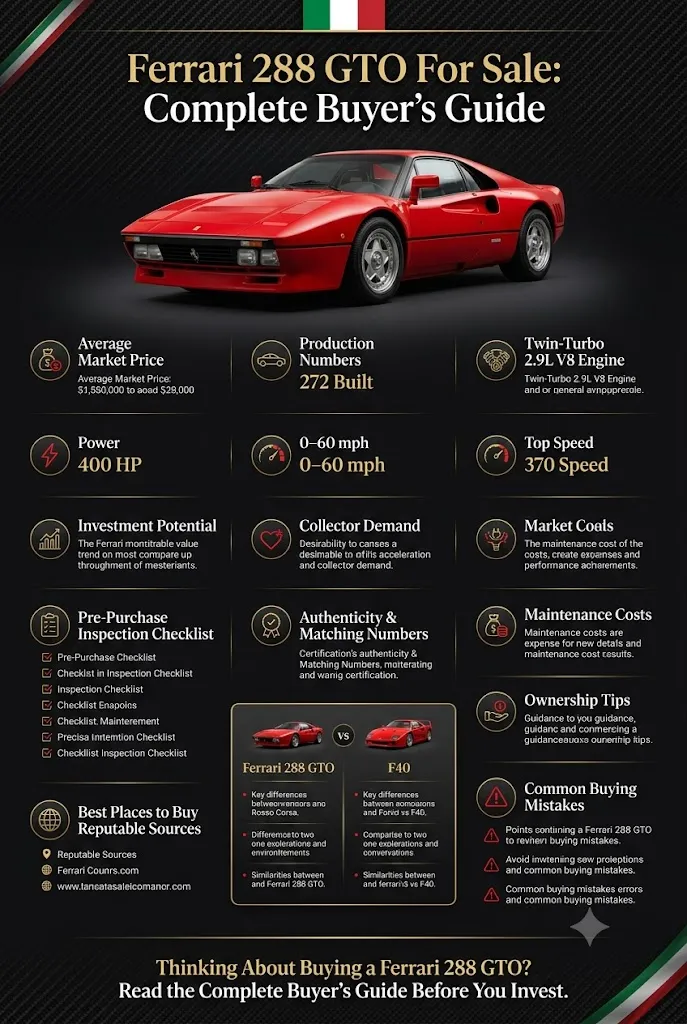
The Ferrari 288 GTO has experienced remarkable appreciation over the past two decades. Values vary significantly depending on originality, mileage, service history, certification, and provenance.
Estimated Market Values
| Condition | Estimated Market Value |
| Driver-Quality Example | $4.8M–$5.5M |
| Excellent Original Car | $5.5M–$6.8M |
| Ferrari Classiche Certified | $6.5M–$7.8M |
| Concours-Level Example | $7.5M–$9M+ |
| Exceptional Provenance | $9M–$12M+ |
Note: Market values fluctuate based on auction activity, collector demand, originality, and macroeconomic conditions. Exceptionally preserved or historically significant cars can command prices well above these ranges.
What Influences Ferrari 288 GTO Prices?
Mileage
Lower-mileage cars generally achieve higher values, particularly when accompanied by documented service history. However, a properly maintained, regularly exercised example is often more desirable than an ultra-low-mileage car that has remained dormant for years.
Original Paint
Factory paint significantly enhances collectability. Repainted cars can still be valuable if the work was completed to Ferrari standards, but originality remains a major value driver.
Matching Numbers
Collectors strongly prefer cars that retain:
- Original engine
- Original transmission
- Original chassis
- Factory identification plates
Matching-numbers examples consistently outperform altered cars in the market.
Ferrari Classiche Certification
Certification from Ferrari confirms authenticity and originality, providing buyers with additional confidence and often increasing resale value.
Service Documentation
Complete maintenance records demonstrate responsible ownership and reduce uncertainty for future buyers.
Color
Most Ferrari 288 GTOs left the factory in Rosso Corsa, the iconic Ferrari racing red. While other factory-approved colors exist, originality and documented history generally have a greater impact on value than color alone.
Ownership History
Cars previously owned by notable collectors or maintained within respected Ferrari collections often attract increased interest.
Auction Provenance
Examples sold through prestigious international auctions with transparent histories typically establish benchmark prices and reinforce market confidence.
Ferrari 288 GTO Investment Analysis
The Ferrari 288 GTO is widely regarded as one of the strongest-performing automotive investments of the modern era. Its combination of rarity, historical importance, and collector demand has supported long-term appreciation.
Why Investors Value the 288 GTO
Several characteristics make the 288 GTO especially attractive:
- Limited production of 272 units
- Significant motorsport Hhttps://thecarscompare.com/eritage
- First Ferrari halo supercar
- Foundation for the Ferrari F40
- Strong global recognition
- Broad appeal among collectors
- Consistent demand across major markets
Historical Appreciation
While short-term market fluctuations are normal, the Ferrari 288 GTO has demonstrated remarkable resilience over the past few decades.
Key drivers of appreciation include:
- Declining availability
- Increasing global wealth among collectors
- Growing appreciation for analog supercars
- Ferrari’s enduring brand prestige
- Strong auction performance
Supply vs. Demand
The investment outlook remains favorable due to:
- Extremely limited production
- Minimal annual resale activity
- Expanding international collector base
- Institutional interest in collectible automobiles
- Long-term ownership trends reducing available inventory
Ferrari Halo Car Comparison
| Model | Production | Collectability | Investment Potential |
| Ferrari 288 GTO | 272 | Exceptional | Excellent |
| Ferrari F40 | 1,315 | Outstanding | Excellent |
| Ferrari F50 | 349 | Exceptional | Excellent |
| Ferrari Enzo | 400 | Outstanding | Excellent |
| LaFerrari Coupe | 499 | Outstanding | Excellent |
Although the F40 is often more recognizable, the 288 GTO’s greater rarity and historical significance contribute to its exceptional standing among collectors.
Ferrari 288 GTO Ownership Costs
Owning a Ferrari 288 GTO extends beyond the purchase price. Proper maintenance, storage, insurance, and preservation are essential to protect both performance and long-term value.
Estimated Annual Ownership Costs
| Expense | Estimated Annual Cost |
| Routine Service | $8,000–$20,000 |
| Insurance | $15,000–$50,000+ |
| Climate-Controlled Storage | $3,000–$10,000 |
| Transportation | $2,000–$8,000 |
| Registration & Taxes | Varies by country |
| Detailing & Preservation | $2,000–$6,000 |
These figures vary depending on location, usage, insurance coverage, and maintenance requirements.
Routine Maintenance
Typical annual servicing includes:
- Engine oil replacement
- Gearbox fluid inspection
- Brake fluid replacement
- Coolant service
- Belt inspections
- Suspension checks
- Turbocharger inspection
- Electrical diagnostics
Preventative maintenance is far less expensive than addressing neglected issues.
Major Repairs
Given the Ferrari 288 GTO’s rarity, specialized repairs can be costly.
Potential high-value repairs include:
- Turbocharger rebuilding
- Clutch replacement
- Cooling system restoration
- Fuel injection servicing
- Suspension refurbishment
- Engine rebuild
- Transmission overhaul
Owners typically work with Ferrari specialists experienced in vintage halo models.
Ferrari 288 GTO Maintenance Guide
Although engineered to Ferrari’s highest standards, the 288 GTO requires diligent care due to its age and complexity.
Engine
The twin-turbocharged V8 should receive regular inspections for:
- Oil leaks
- Compression health
- Turbo performance
- Cooling efficiency
- Ignition system condition
Frequent fluid changes using manufacturer-approved lubricants are essential.
Turbochargers
The IHI turbochargers are among the car’s defining features.
Routine inspections should check for:
- Shaft play
- Oil Leakage
- Boost consistency
- Bearing wear
- Wastegate operation
Rebuilding turbos before failure can prevent more extensive engine damage.
Transmission
The iconic five-speed manual gearbox is generally durable but benefits from:
- Regular fluid changes
- Clutch inspection
- Shift linkage adjustment
- Synchronizer evaluation
Proper driving technique helps preserve transmission longevity.
Suspension
Rubber bushings, dampers, and ball joints naturally age over time.
Periodic inspection ensures:
- Accurate handling
- Ride quality
- Tire longevity
- Chassis stability
Cooling System
Because turbocharged engines generate significant heat, the cooling system demands careful attention.
Recommended maintenance includes:
- Radiator inspection
- Hose replacement
- Coolant flushes
- Thermostat testing
- Water pump evaluation
Fuel System
Long-term storage can negatively affect:
- Fuel injectors
- Fuel pumps
- Fuel lines
- Rubber seals
Owners should use high-quality fuel and appropriate stabilizers during extended storage.
Electrical System
Aging electrical components are common in classic Ferraris.
Regular inspections help prevent issues involving:
- Alternator performance
- Battery health
- Wiring insulation
- Fuse panels
- Ground connections
Ferrari 288 GTO Inspection Checklist Before Buying
Because of the Ferrari 288 GTO’s value, a professional pre-purchase inspection (PPI) is essential.
Verify the VIN
Confirm:
- Factory VIN
- Chassis number
- Engine number
- Transmission identification
- Original documentation
Any inconsistencies should be investigated thoroughly.
Confirm Matching Numbers
Verify that the following remain original:
- Engine
- Gearbox
- Chassis
- Body identification
- Factory plates
Matching-numbers cars command the strongest resale values.
Examine the Chassis
Inspect for:
- Accident repairs
- Corrosion
- Structural damage
- Weld integrity
- Suspension mounting points
Inspect Paint
Evaluate:
- Paint thickness
- Color consistency
- Panel alignment
- Evidence of previous repairs
- Overspray
Factory-original finishes are highly prized.
Review Interior Condition
Check:
- Leather quality
- Dashboard condition
- Instrument functionality
- Switchgear operation
- Factory trim originality
Evaluate Engine & Turbochargers
Look for:
- Oil leaks
- Smoke under boost
- Smooth idle
- Consistent turbo response
- Compression results
Transmission Assessment
During a test drive, verify:
- Smooth gear engagement
- Clutch operation
- Shift precision
- Noise levels
- Synchronizer condition
Review Service History
An ideal example includes:
- Original manuals
- Maintenance invoices
- Factory documentation
- Ownership history
- Restoration records
- Ferrari Classiche documentation (if applicable)
A complete paper trail significantly strengthens buyer confidence.
FAQs
A: Ferrari produced 272 examples of the 288 GTO between 1984 and 1987, making it one of the rarest and most desirable production Ferraris ever made.
A: Depending on originality, mileage, documentation, and condition, most Ferrari 288 GTOs are valued between $5 million and $9 million, while exceptional concours-quality examples with outstanding provenance can exceed $10 million.
A: Yes. The Ferrari 288 GTO is widely regarded as one of the strongest-performing collector cars due to its limited production, historical significance, and consistent demand among enthusiasts and investors. While no investment is guaranteed, it has shown strong long-term appreciation.
A: Yes. Although it was developed as a homologation special for FIA Group B racing, the Ferrari 288 GTO was built as a road-legal production car and can be legally driven in many countries, subject to local registration requirements.
A: It is powered by a 2.9-liter (2,855 cc) twin-turbocharged V8 engine producing approximately 395 horsepower and 366 lb-ft (496 Nm) of torque, paired with a five-speed manual transmission.
Conclusion
The Ferrari 288 GTO is far more than an ultra-rare classic—it is a landmark in Ferrari’s history and one of the most influential supercars ever built. Created for Group B homologation, it introduced groundbreaking twin-turbocharged performance, lightweight engineering, and a driving experience that continues to captivate collectors decades later. With only 272 units produced, demand consistently exceeds supply, making every available example a highly sought-after Collector item.
For anyone searching for a Ferrari 288 GTO for sale, purchasing one involves more than simply finding the right car. Careful attention to originality, Ferrari Classiche certification, service records, matching numbers, and professional inspections is essential to protect your investment. Although ownership comes with significant maintenance and insurance costs, the rewards include exceptional exclusivity, timeless design, and the privilege of owning one of Ferrari’s greatest creations.