Introduction
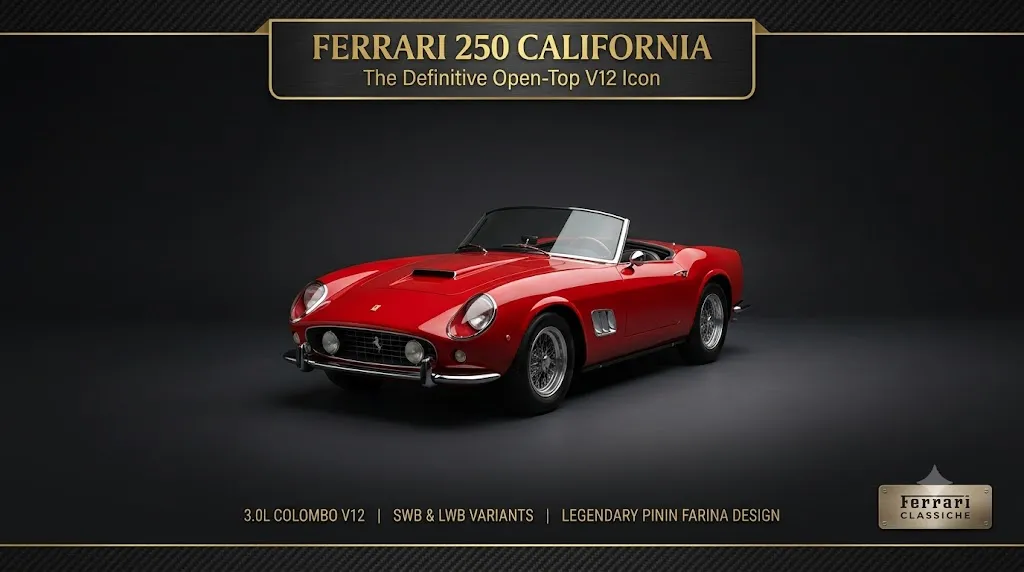
Few classic automobiles have achieved the legendary reputation of the Ferrari 250 California. More than just a beautiful convertible, it represents the perfect blend of Italian craftsmanship, race-inspired engineering, and timeless design. Built during Ferrari’s golden era between 1957 and 1963, the 250 California remains one of the most valuable, collectible, and admired classic Ferraris ever produced.
Designed primarily for affluent American enthusiasts, the Ferrari 250 California combined exhilarating V12 performance with luxurious grand touring comfort. Whether cruising along California’s scenic coastline or competing in prestigious endurance races such as the 24 Hours of Le Mans and the Targa Florio, this iconic roadster proved equally capable on the road and the racetrack.
Today, the Ferrari 250 California commands astonishing prices at international auctions, often exceeding tens of millions of dollars depending on provenance, originality, and rarity. It has become the benchmark by which many collectible Ferraris are measured.
In this complete buying guide, we’ll explore the Ferrari 250 California’s fascinating history, production timeline, technical specifications, design evolution, collector value, and investment potential. Whether you’re an enthusiast, investor, or lifelong Ferrari fan, this guide provides everything you need to understand why the 250 California continues to define automotive excellence.
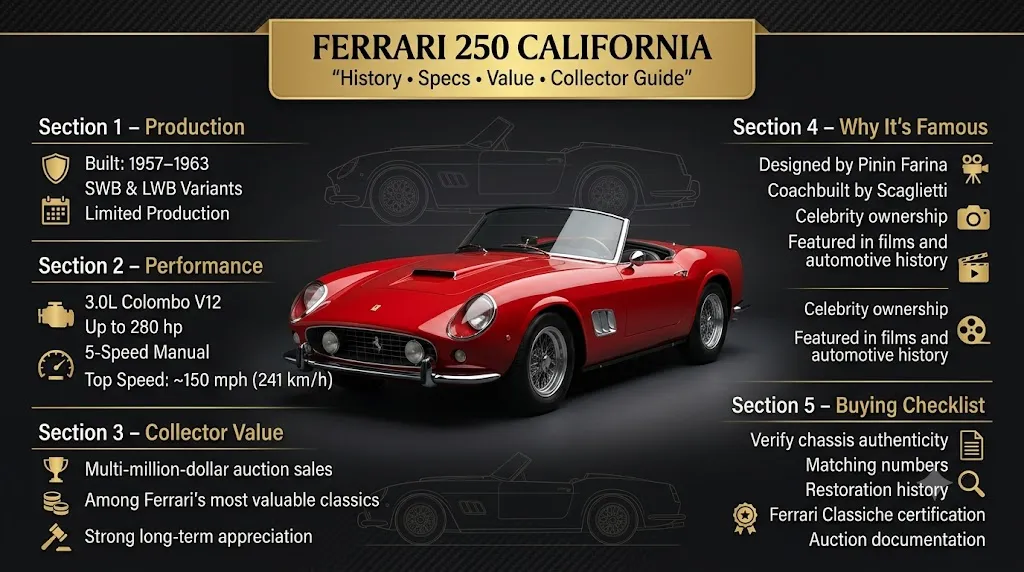
Ferrari 250 California at a Glance
| Specification | Details |
| Manufacturer | Ferrari |
| Production Years | 1957–1963 |
| Body Style | 2-door Convertible Grand Tourer |
| Coachbuilder | Scaglietti |
| Design House | Pinin Farina |
| Engine | 3.0L Colombo V12 |
| Horsepower | Approximately 240–280 hp (depending on specification) |
| Torque | Around 262 Nm |
| Transmission | 4-Speed Manual |
| Drivetrain | Rear-Wheel Drive |
| Fuel Type | Petrol |
| Seating Capacity | 2+2 (minimal rear accommodation on some examples) |
| Top Speed | Approximately 150–165 mph |
| 0–60 mph | Around 6.5–7.5 seconds |
| Production Volume | 106 cars (LWB and SWB combined) |
What Is the Ferrari 250 California?
The Ferrari 250 California, officially known as the Ferrari 250 GT California Spyder, is one of Ferrari’s most celebrated open-top grand touring cars. It was developed specifically to satisfy growing demand from the American luxury sports car market, where wealthy buyers wanted a Ferrari that could deliver thrilling performance while remaining comfortable enough for long-distance driving.
Unlike many convertibles of the late 1950s, the California was never intended to be merely stylish transportation. Instead, Ferrari engineered it using technology derived directly from its racing program. Underneath its handcrafted aluminum bodywork lay a lightweight tubular chassis, advanced suspension, and Gioacchino Colombo’s celebrated 3.0-liter V12 engine.
The Ferrari 250 California was produced in two distinct versions:
- Long Wheelbase (LWB) — built from 1957 to 1960, offering greater ride comfort and grand touring refinement.
- Short Wheelbase (SWB) — introduced in 1960 with sharper handling, lower weight, and stronger competition credentials.
Although only 106 examples were produced, the Ferrari 250 California quickly became one of the most desirable Ferraris ever built thanks to its rarity, racing pedigree, and breathtaking styling. Today it is widely regarded as one of the greatest automobiles in automotive history.
The History of the Ferrari 250 California
Origins of the California Spyder
By the mid-1950s, Ferrari had already established itself as one of the world’s premier racing manufacturers. Victories at Le Mans, Mille Miglia, and Formula One had elevated the Ferrari name to legendary status.
However, Enzo Ferrari understood that financial stability depended not only on racing success but also on selling road cars to affluent customers. At the same time, the American market was rapidly becoming Ferrari’s largest export destination.
Influential U.S. importer John von Neumann recognized that wealthy Californian buyers desired a stylish convertible capable of combining Ferrari’s motorsport DNA with luxurious touring capability. Alongside importer Luigi Chinetti, he encouraged Ferrari to develop an open-top version of the successful 250 GT Berlinetta.
Ferrari accepted the proposal, leading to the creation of one of the company’s most iconic models.
Designed for America
Although proudly Italian, the Ferrari 250 California was created with American tastes in mind.
Customers wanted:
- Open-air driving
- High-speed touring
- Elegant styling
- Competitive racing capability
- Exclusivity
California represented everything prosperous American enthusiasts desired during the booming post-war economy.
Ironically, although developed primarily for North America, the Ferrari 250 California eventually became a worldwide collector icon.
Why Ferrari Built the California
Several factors drove Ferrari’s decision.
Growing U.S. Demand
America represented Ferrari’s fastest-growing customer base throughout the late 1950s.
Luxury buyers increasingly wanted:
- Convertibles
- European styling
- Race-inspired engineering
- Exclusive craftsmanship
The California perfectly filled that niche.
Motorsport Heritage
Ferrari wanted the California to remain true to its racing philosophy.
Many examples competed successfully in:
- 24 Hours of Le Mans
- Sebring 12 Hours
- Targa Florio
- Nürburgring endurance events
Unlike many luxury convertibles, the California proved genuinely competitive on international circuits.
Handcrafted Excellence
Every Ferrari 250 California featured:
- Aluminum body panels
- Hand-built construction
- Individually finished interiors
- Racing-derived engineering
This craftsmanship explains why no two cars are Entirely identical.
Ferrari 250 California Production Timeline
Long Wheelbase (1957–1960)
The first-generation California used the proven 2,600 mm wheelbase chassis from the Ferrari 250 GT Tour de France.
Characteristics included:
- Softer suspension tuning
- Longer proportions
- Comfortable grand touring
- Drum brakes on early cars
- Elegant rounded bodywork
Although designed primarily for road use, several LWB Californias competed successfully in international motorsport.
Only approximately 50 LWB examples were produced, making them exceptionally rare.
Short Wheelbase (1960–1963)
Ferrari introduced the Short Wheelbase California to improve agility and racing performance.
Major improvements included:
- 2,400 mm wheelbase
- Reduced weight
- Improved suspension
- Better weight distribution
- Stronger V12 tuning
- Four-wheel disc brakes
The SWB became one of Ferrari’s greatest dual-purpose GT cars.
Collectors often consider it the ultimate evolution of the California concept.
Only 56 SWB Californias were built.
Production Numbers
| Version | Years | Approximate Production |
| Long Wheelbase | 1957–1960 | 50 |
| Short Wheelbase | 1960–1963 | 56 |
| Total | 1957–1963 | 106 Cars |
The exceptionally low production volume explains why surviving examples are among the world’s most valuable collector automobiles.
Ferrari 250 California LWB vs SWB
| Feature | LWB | SWB |
| Production Years | 1957–1960 | 1960–1963 |
| Wheelbase | 2,600 mm | 2,400 mm |
| Ride Comfort | Excellent | Very Good |
| Handling | Smooth | Sharper |
| Weight | Slightly Higher | Lower |
| Racing Capability | Good | Outstanding |
| Collector Demand | Extremely High | Among the Highest of Any Ferrari |
| Current Market Value | Multi-million dollars | Often commands premium valuations |
Ferrari 250 California Specifications
Engine
Powering every Ferrari 250 California is Gioacchino Colombo’s legendary naturally aspirated V12 engine.
Key highlights include:
- 2,953 cc displacement
- Single overhead camshaft per bank
- Aluminum block and heads
- Triple Weber carburetors (varied by specification)
- Naturally aspirated
- High-revving character
- Smooth power delivery
The Colombo V12 remains one of the greatest production engines ever developed, celebrated for its mechanical refinement, unmistakable exhaust note, and exceptional reliability when properly Maintained.
Transmission
Every California features a classic Ferrari four-speed manual transmission.
Highlights include:
- Rear-wheel drive
- Fully synchronized gearbox
- Mechanical clutch
- Precise shift feel
- Long gearing for grand touring
The manual gearbox is a defining part of the Ferrari 250 California driving experience, demanding skill while rewarding smooth, deliberate inputs.
Performance
Although modest by modern supercar standards, the California delivered remarkable performance for its era.
| Performance Figure | Approximate Value |
| Horsepower | 240–280 hp |
| Top Speed | 150–165 mph |
| 0–60 mph | 6.5–7.5 sec |
| Engine Redline | Around 7,000 rpm |
Its lightweight construction and free-revving V12 made the California one of the fastest production convertibles of the late 1950s and early 1960s.
Dimensions
| Measurement | Approximate |
| Length | 4,250 mm |
| Width | 1,600 mm |
| Height | 1,300 mm |
| Wheelbase (LWB) | 2,600 mm |
| Wheelbase (SWB) | 2,400 mm |
Weight
Depending on configuration, the Ferrari 250 California weighs approximately 1,100–1,200 kg.
Its lightweight aluminum construction contributes significantly to its agile handling and responsive performance.
Exterior Design
The Ferrari 250 California is frequently described as one of the most beautiful automobiles ever created. Styled by Pinin Farina and hand-built by Scaglietti, its proportions remain timeless more than six decades after its debut.
Key exterior highlights include:
- Long sculpted hood emphasizing the front-mounted V12
- Flowing front and rear fenders with graceful curves
- Signature oval Ferrari grille with the iconic Prancing Horse emblem
- Elegant chrome bumpers that complement the body rather than dominate it
- Distinctive faired-in headlights on early versions, with open-headlight configurations on later cars
- Lightweight aluminum body panels that reduced weight while enhancing performance
- Wire-spoke Borrani wheels wrapped in period-correct performance tires
- Clean rear deck with subtle integrated tail lamps and twin exhaust outlets
Unlike many sports cars of its era, the California avoids excessive styling flourishes. Its beauty comes from balanced proportions, handcrafted details, and aerodynamic simplicity, making it a timeless design that continues to influence modern Ferrari grand tourers.
Interior & Comfort
Driver-Focused Elegance
Inside, the Ferrari 250 California combines handcrafted luxury with purposeful racing Character. Every cabin was assembled by skilled artisans, meaning subtle differences exist between individual cars.
Notable interior features include:
- Hand-stitched leather upholstery
- Polished aluminum dashboard trim
- Large Veglia instrumentation with clear analog gauges
- Three-spoke wood-rim steering wheel
- Classic gated manual gear lever
- Deeply sculpted bucket seats providing excellent support
- Premium carpeting and leather door panels
- Foldable fabric convertible roof for open-air touring
Unlike modern luxury cars, the cabin focuses on driving engagement rather than electronic convenience. Every control is mechanical, tactile, and designed to connect the driver directly with the car.
Comfort on Long Journeys
Despite its racing roots, the California was engineered as a genuine grand tourer. The longer-wheelbase version, in particular, offered a supple ride, comfortable seating, and enough luggage space for weekend escapes along the Riviera or California coastline.
While it lacks modern amenities such as climate control, touchscreen infotainment, or advanced driver assistance systems, its timeless craftsmanship and driving position continue to charm collectors and enthusiasts alike.
Engine & Performance
The Legendary Colombo V12
At the heart of every Ferrari 250 California lies Gioacchino Colombo’s iconic 3.0-liter V12—an engine that became synonymous with Ferrari’s golden era. Compact, lightweight, and remarkably sophisticated for its time, it delivered a blend of smoothness, responsiveness, and an unforgettable exhaust note.
Performance Characteristics
The Colombo V12 is renowned for:
- Linear power delivery across the rev range
- Crisp throttle response thanks to Weber carburetors
- High-revving nature with a thrilling mechanical soundtrack
- Excellent balance between touring comfort and sporting performance
- Proven durability when maintained by experienced specialists
Combined with the California’s lightweight chassis and precise manual gearbox, the V12 creates an engaging driving experience that remains rewarding even by modern standards.
Driving Experience
Behind the wheel, the Ferrari 250 California feels alive. Steering is communicative, the chassis is balanced, and every gear change demands involvement from the driver. The Long Wheelbase model offers a more relaxed touring character, while the Short Wheelbase version feels sharper, more agile, and better suited to spirited driving or historic motorsport events.
The combination of handcrafted engineering, naturally aspirated power, and elegant design explains why the Ferrari 250 California continues to be regarded as one of the greatest grand touring cars ever built.
Fuel Economy & Driving Range
Unlike modern sports cars, the Ferrari 250 California was engineered long before fuel efficiency became a priority. Its naturally aspirated 3.0-liter Colombo V12 was designed to deliver exhilarating performance, smooth high-speed cruising, and a thrilling exhaust note rather than economical fuel consumption.
Owners typically report fuel economy in the range of:
| Driving Condition | Estimated Fuel Economy |
| City Driving | 8–10 mpg (US) |
| Highway Touring | 12–15 mpg (US) |
| Combined | 10–13 mpg (US) |
Because these figures vary depending on carburetor tuning, engine condition, altitude, and driving style, actual consumption differs from car to car.
Fuel Tank Capacity
California’s generous fuel tank allows for extended touring despite modest efficiency.
| Specification | Approximate Value |
| Fuel Tank | 100–110 liters |
| Estimated Touring Range | 300–400 miles |
For most collectors, fuel economy is largely irrelevant. Preservation, originality, and the driving experience are far more important than operating costs.
Safety Features
By today’s standards, the Ferrari 250 California offers only the basic safety technologies available during the late 1950s and early 1960s. Nevertheless, it was engineered to provide confident handling and strong braking performance for its era.
Passive Safety
California includes:
- Rigid steel tubular chassis
- Lightweight aluminum body panels
- Excellent driver visibility
- Large steering wheel for improved Leverage
- Strong mechanical construction
Braking Evolution
Early Long Wheelbase models featured:
- Large aluminum drum brakes
Later, short-wheelbase cars were introduced:
- Four-wheel disc brakes
- Improved fade resistance
- Better high-speed stopping power
Modern Perspective
Compared with contemporary sports cars, the Ferrari 250 California does not include:
- Airbags
- ABS
- Electronic Stability Control
- Traction Control
- Parking Sensors
- Blind Spot Monitoring
- Collision Avoidance Systems
- Lane Keeping Assist
Driving a 250 California requires skill, mechanical sympathy, and respect for its vintage engineering.
Technology & Infotainment
The Ferrari 250 California predates the digital age by several decades, yet its analog simplicity is one of its greatest attractions.
Rather than screens and software, the California offers a mechanical driving experience centered on craftsmanship and driver engagement.
Interior Equipment
Typical equipment includes:
- Veglia analog gauges
- Mechanical odometer
- Manual heater controls
- Wood-rim steering wheel
- Chrome switchgear
- Classic radio (optional on some cars)
- Hand-operated convertible roof
Why Collectors Love It
Collectors value the California because it remains untouched by electronic complexity.
There are:
- No software updates
- No digital dashboards
- No touchscreens
- No driving modes
Everything is mechanical, authentic, and timeless.
Ferrari 250 California Variants
Although the model family is relatively small, each version possesses distinct characteristics that influence collector demand.
| Variant | Characteristics | Collector Appeal |
| LWB Road Car | Comfortable touring | Extremely High |
| LWB Competition | Racing modifications | Exceptional |
| SWB Road Car | Better handling | Ultra High |
| SWB Competition | Motorsport specification | Among Ferrari’s most valuable classics |
Certain competition cars with documented race history command significantly higher auction prices than standard road cars.
Ferrari 250 California Pricing (2026)
Unlike modern Ferraris, every Ferrari 250 California is bought and sold through specialist dealers, private collectors, or prestigious auction houses.
Prices depend on numerous factors:
- Originality
- Matching numbers
- Ferrari Classiche certification
- Ownership history
- Competition pedigree
- Restoration quality
- Documentation
- Chassis rarity
Typical Market Range
| Condition | General Market Position |
| Restoration Project | Extremely Rare |
| Good Driver | Multi-million-dollar collector car |
| Excellent Original | Premium collector pricing |
| Concours Winner | Top-tier international valuation |
| Famous Provenance | Record-setting auction potential |
Because only 106 examples exist, even average-condition cars remain among the world’s most valuable Ferraris.
Ferrari 250 California Auction Records
The Ferrari 250 California has consistently broken collector-car records over the past two decades.
Why Auction Prices Continue Rising
Several factors influence values:
- Extremely limited production
- Motorsport heritage
- Ferrari V12 engineering
- Timeless Pinin Farina styling
- Celebrity ownership
- Ferrari Classiche certification
- Increasing global collector demand
Record Sales Timeline
| Period | Market Trend |
| Early 2000s | Rapid appreciation |
| 2010–2015 | Multiple record-breaking sales |
| 2016–2020 | Continued collector demand |
| 2021–2024 | Stable growth despite market fluctuations |
| 2025–2026 | Strong investment confidence for blue-chip Ferraris |
Exceptional SWB examples with outstanding provenance continue to rank among the most expensive Ferraris ever sold.
Ferrari 250 California Investment Analysis
The Ferrari 250 California is widely Regarded as one of the safest blue-chip automotive investments.
Why Investors Love It
1. Extremely Limited Supply
Only 106 cars exist.
Many remain in long-term private collections and rarely appear for sale.
2. Worldwide Recognition
California enjoys universal appeal among collectors in:
- Europe
- United States
- Middle East
- Japan
- Australia
Demand consistently exceeds supply.
3. Ferrari Heritage
California represents Ferrari’s golden era.
Collectors value:
- Colombo V12
- Scaglietti craftsmanship
- Pinin Farina styling
- Motorsport pedigree
4. Proven Long-Term Appreciation
While no investment is guaranteed, historically, the Ferrari 250 California has demonstrated exceptional long-term value growth.
Ferrari Classiche Certification
One of the most important considerations when purchasing any classic Ferrari is Ferrari Classiche Certification.
What Is Ferrari Classiche?
Ferrari Classiche is Ferrari’s official heritage program.
It verifies:
- Original chassis
- Original engine
- Original gearbox
- Correct body
- Factory specifications
- Historical authenticity
Why It Matters
Certified cars generally benefit from:
- Greater buyer confidence
- Easier resale
- Higher collector demand
- Stronger auction performance
For multi-million-dollar Ferraris, Classiche certification is often considered essential.
Restoration Guide
Restoring a Ferrari 250 California is among the most demanding automotive restoration projects in the world.
Common Restoration Areas
- Aluminum body repairs
- Engine rebuilding
- Weber carburetor restoration
- Electrical rewiring
- Suspension overhaul
- Brake restoration
- Interior leather replacement
- Convertible top restoration
- Instrument refurbishment
Restoration Challenges
Original parts are:
- Extremely rare
- Highly valuable
- Often custom fabricated
Only experienced Ferrari restoration specialists should undertake these projects.
Maintenance & Ownership Costs
Owning a Ferrari 250 California is unlike owning a modern sports car.
Annual maintenance focuses primarily on preservation.
Typical Ownership Expenses
Owners should budget for:
- Specialist servicing
- Engine tuning
- Carburetor balancing
- Fluid replacement
- Tire replacement
- Brake servicing
- Climate-controlled storage
- Comprehensive collector insurance
Unexpected mechanical repairs can be substantial due to the rarity of original components and the expertise required for restoration.
Parts Availability
Most parts remain available through:
- Ferrari specialists
- Historic Ferrari suppliers
- Custom fabrication
- Collector networks
However, original components command premium prices.
Ownership Experience
Few automobiles provide an experience comparable to the Ferrari 250 California.
Owners consistently praise:
- The unforgettable V12 soundtrack
- Elegant styling
- Exceptional road presence
- Engaging manual gearbox
- Timeless craftsmanship
- Appreciation from enthusiasts worldwide
Every drive feels like a special occasion, whether attending a concours event or enjoying a scenic weekend tour.
Pros & Cons
Pros
- One of Ferrari’s most beautiful designs
- Legendary Colombo V12 engine
- Extremely limited production
- Outstanding investment potential
- Rich motorsport heritage
- Exceptional craftsmanship
- Strong global collector demand
- Timeless driving experience
Cons
- Extremely expensive to acquire
- Specialist maintenance required
- Replacement parts are scarce
- No modern safety technology
- Vintage driving characteristics require experience
- Limited weather protection
- High insurance and storage costs
Best Alternatives
Collectors considering a Ferrari 250 California may also appreciate these iconic grand touring classics.
| Model | Why Consider It |
| Ferrari 250 GT SWB Berlinetta | Greater racing pedigree and exceptional handling |
| Maserati 3500 GT Spyder | Elegant Italian convertible with grand touring comfort |
| Aston Martin DB4 Convertible | British luxury, timeless styling, and collectible appeal |
Each offers a distinctive ownership experience, but the Ferrari 250 California remains the benchmark for open-top classic GT Ferraris.
FAQs
A: Values vary significantly depending on originality, provenance, and condition. Exceptional examples are among the most valuable collector Ferraris in the world.
A: Ferrari produced only 106 examples, including both Long Wheelbase and Short Wheelbase versions.
A: Both are highly sought after, but the Short Wheelbase (SWB) models generally command the strongest collector demand due to their enhanced performance and rarity.
A: Historically, it has been considered one of the strongest-performing blue-chip collector cars thanks to its rarity, heritage, and sustained global demand. As with any investment, future values are never guaranteed.
A: Yes. Many examples are regularly driven in historic rallies, concours events, and grand touring tours, provided they are properly maintained by experienced specialists.
Conclusion
The Ferrari 250 California represents everything enthusiasts admire about Ferrari’s golden era: breathtaking design, handcrafted engineering, motorsport heritage, and an unforgettable naturally aspirated V12. More than six decades after its introduction, it remains one of the most desirable and recognizable collector cars ever built.
Its limited production of just 106 examples, combined with timeless Pinin Farina styling, Scaglietti craftsmanship, and proven long-term collector appeal, ensures that the 250 California continues to occupy a Special Place in automotive history. Whether admired in a museum, driven on scenic roads, or presented on the concours lawn, it embodies the spirit of classic grand touring at its finest.