Introduction
Does Fiat Own Ferrari?
It is one of the most frequently searched questions among automotive enthusiasts, luxury car collectors, investors, and Ferrari admirers. The short answer is:
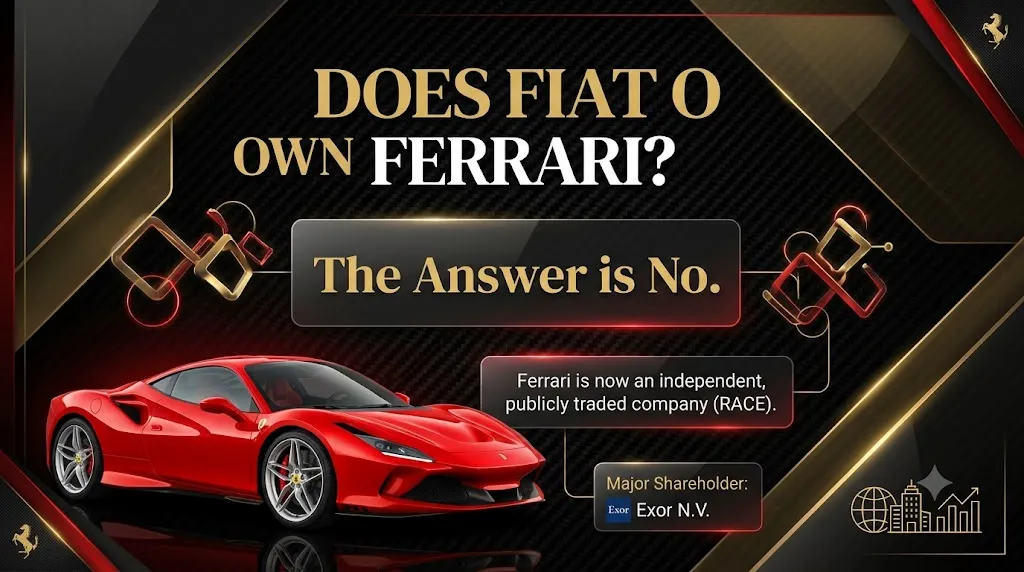
No, Fiat does not own Ferrari today.
However, the complete story is far more interesting than a simple yes or no answer.
For nearly five decades, Fiat played an essential role in Ferrari’s evolution. The Italian automotive giant invested substantial resources into Ferrari, helped expand manufacturing capabilities, increased the company’s international presence, and supported its legendary Formula One racing program.
Many automotive historians believe that Ferrari’s rise into one of the world’s most valuable luxury performance brands would have been significantly more difficult without Fiat’s financial and industrial support.
Today, Ferrari is an independent publicly traded corporation listed on the New York Stock Exchange (NYSE) under the ticker symbol RACE. Although Fiat no longer owns Ferrari, the historical connections among Ferrari, Fiat, Fiat Chrysler Automobiles (FCA), Exor, and the Agnelli family continue to create confusion.
This comprehensive guide explains:
- Does Fiat own Ferrari today?
- Why did Fiat buy Ferrari?
- How long did Fiat own Ferrari?
- Why did Ferrari become independent?
- Who owns Ferrari today?
- Does Stellantis own Ferrari?
- What role do Exor and the Agnelli family play?
By the end of this article, you will completely understand the fascinating ownership journey of one of the world’s most prestigious automotive companies.
Quick Overview of Ferrari
| Specification | Details |
| Founded | 1947 |
| Founder | Enzo Ferrari |
| Headquarters | Maranello, Italy |
| Stock Symbol | NYSE: RACE |
| Ownership Type | Publicly Traded Company |
| Largest Shareholder | Exor N.V. |
| Major Individual Shareholder | Piero Ferrari |
| Industry | Luxury Performance Automobiles |
| Primary Business | Sports Cars and Formula One Racing |
| Current Status | Independent Company |
Does Fiat Own Ferrari?
No. Fiat does not own Ferrari anymore.
Ferrari officially became an independent company following its separation from Fiat Chrysler Automobiles (FCA) during 2015 and 2016.
Today, Ferrari operates with:
- Independent executive management
- Separate financial reporting
- Individual shareholders
- Its own corporate strategy
- Independent stock exchange listing
- Complete operational autonomy
Many websites simply answer “No” and stop there.
However, understanding why Fiat no longer owns Ferrari requires exploring several decades of history.
For almost fifty years, Fiat maintained a significant ownership stake in Ferrari and helped transform the company from a relatively small Italian sports car manufacturer into one of the world’s most profitable luxury automotive brands.
Therefore, while Fiat does not own Ferrari today, its historical influence remains enormous.
Understanding the Relationship Between Fiat and Ferrari
The relationship between Fiat and Ferrari began in 1969.
At the time, Ferrari had already established itself as a highly respected manufacturer of high-performance sports cars and a dominant force in motorsport.
However, success also created challenges.
Ferrari required:
- Additional capital
- Improved manufacturing systems
- Larger production facilities
- Stronger worldwide distribution networks
- Greater Formula One investment
Enzo Ferrari realized that the company could not continue expanding without the support of a powerful industrial partner.
Fiat became that partner.
The collaboration allowed Ferrari to accomplish several important objectives.
Secure Financial Stability
Luxury performance vehicles are extremely expensive to design, engineer, and manufacture. Fiat’s investment provided the financial Security Ferrari needed.
Expand Production Capacity
Increasing demand required additional manufacturing capabilities and factory improvements.
Improve Global Distribution
Fiat’s international business network enabled Ferrari to reach customers across numerous markets.
Support Formula One Operations
Motorsport expenses continued to rise, and Fiat’s support helped Ferrari remain competitive at the highest level of racing.
Maintain Brand Exclusivity
Ferrari could continue producing limited quantities of highly desirable vehicles while benefiting from stronger financial backing.
This relationship eventually became one of the most successful partnerships in automotive history.
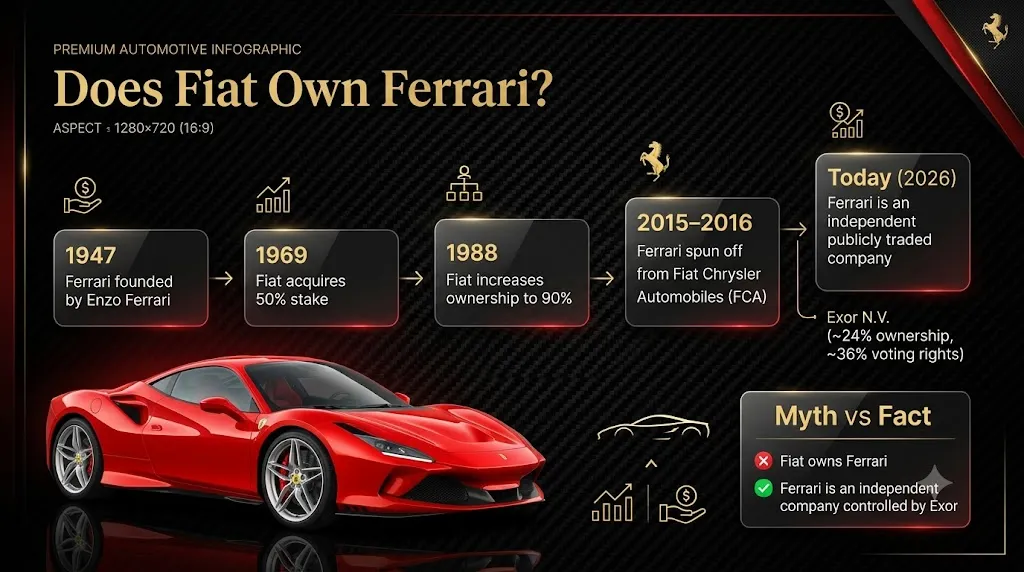
Ferrari Ownership Timeline
Understanding Ferrari’s ownership becomes easier when viewed chronologically.
| Year | Event |
| 1947 | Ferrari was founded by Enzo Ferrari |
| 1969 | Fiat acquires a 50% stake in Ferrari |
| 1988 | Fiat increases ownership to 90% |
| 2014 | Ferrari becomes part of Fiat Chrysler Automobiles |
| 2015 | Ferrari IPO announced |
| 2016 | Ferrari officially becomes independent |
| 2026 | Ferrari remains an independent company |
This timeline clearly demonstrates that while Fiat once controlled Ferrari, the company now operates independently.
The Birth of Ferrari (1947)
Enzo Ferrari’s Vision
Ferrari was established in 1947 by the legendary entrepreneur and racing pioneer Enzo Ferrari.
From the very beginning, Ferrari distinguished itself from other automakers.
Enzo Ferrari firmly believed:
“Racing improves the breed.”
He considered motorsport the heart and soul of his company.
Ferrari initially concentrated on:
- High-performance sports automobiles
- Limited-production vehicles
- Racing technologies
- Formula One competition
- Engineering innovation
The company rapidly developed a reputation for producing some of the world’s most exciting and technologically advanced automobiles.
Early Years of Independence
During its early years, Ferrari operated as a completely independent company.
The organization maintained control over:
- Vehicle design
- Engineering decisions
- Manufacturing methods
- Racing operations
- Corporate strategy
This independence allowed Ferrari to establish its unique identity and preserve its creative freedom.
However, independence also created financial pressures.
Developing exotic sports cars and participating in international motorsport demanded enormous investments.
As demand increased, Ferrari required additional funding and industrial support.
This necessity eventually led to one of the most significant partnerships in automotive history.
Why Did Fiat Buy Ferrari?
Ferrari Needed Capital
By the late 1960s, Ferrari had become one of the most admired names in luxury performance vehicles and motorsport.
However, growth created new challenges.
The company required major investments in:
- Research and development
- Factory expansion
- New technologies
- International distribution
- Formula One operations
Producing high-performance vehicles was becoming increasingly expensive.
Ferrari needed assistance.
Fiat Offered Industrial Strength
Fiat was already one of Italy’s largest industrial organizations.
The company possessed:
- Financial resources
- Manufacturing experience
- Corporate infrastructure
- Global capabilities
- Management expertise
For Enzo Ferrari, Fiat represented the ideal Partner.
He could receive financial support while preserving Ferrari’s unique identity and engineering philosophy.
Formula One Was Becoming More Expensive
Formula One has always required substantial investment.
Research and development costs continued increasing.
Competing against major manufacturers required:
- Advanced engineering
- Aerodynamic development
- Engine innovation
- Skilled personnel
- Continuous financial support
Fiat’s resources made these investments possible.
Without additional funding, Ferrari’s racing ambitions might have been significantly restricted.
Growing Worldwide Demand
Demand for Ferrari vehicles was increasing rapidly.
Customers wanted Ferraris in:
- Europe
- North America
- Asia
- Middle East
- South America
Meeting this demand required:
- Larger factories
- Better supply chains
- Improved production systems
- Greater manufacturing capacity
Fiat possessed the resources necessary to provide these capabilities.
Fiat Acquires 50% of Ferrari (1969)
In 1969, Fiat acquired a 50 percent ownership stake in Ferrari.
This agreement changed Ferrari’s future permanently.
However, Enzo Ferrari carefully negotiated the transaction.
He wanted investment while also protecting Ferrari’s identity.
The agreement allowed:
Fiat to Manage Business Expansion
Fiat supplied financial resources and industrial expertise.
Ferrari to Maintain Engineering Independence
Ferrari continued designing and developing vehicles according to its own principles.
Enzo Ferrari to Control Racing Activities
Enzo remained deeply involved in Formula One operations and motorsport decisions.
Why the Deal Worked So Well
The partnership succeeded because both organizations benefited substantially.
Benefits for Ferrari
- Financial security
- Manufacturing improvements
- Increased production capabilities
- Global expansion opportunities
- Better Formula One funding
Benefits for Fiat
- Ownership of an iconic luxury brand
- Prestige and worldwide recognition
- Association with Formula One success
- Access to advanced engineering knowledge
The arrangement proved remarkably successful.
Ferrari gained financial strength while preserving its exclusivity, heritage, and identity.
Fiat Increases Ownership to 90% (1988)
In 1988, shortly before Enzo Ferrari’s death, Fiat increased its ownership stake from 50 percent to 90 percent.
The remaining 10 percent was retained by Enzo Ferrari’s son, Piero Ferrari.
This transaction marked another major turning point in Ferrari’s history.
Despite Fiat becoming the Controlling owner, Ferrari continued operating with considerable independence.
The company maintained:
- Its own engineering teams
- Distinctive design philosophy
- Exclusive manufacturing strategy
- Unique corporate culture
- Dedicated racing operations
Fiat understood that Ferrari’s value depended on preserving its uniqueness.
As a result, Ferrari remained a highly exclusive luxury brand.
How Fiat Changed Ferrari
Fiat’s investment transformed Ferrari into much more than a niche sports car manufacturer.
Modern Manufacturing Systems
Ferrari benefited from:
- Improved production methods
- Better quality assurance procedures
- Advanced industrial processes
- More efficient supply management
Expanded Production Capacity
Growing demand required additional vehicles.
Fiat helped Ferrari:
- Upgrade factories
- Increase manufacturing efficiency
- Expand production capabilities
International Business Expansion
Fiat’s global presence allowed Ferrari to enter new markets and strengthen its worldwide reputation.
The company expanded significantly in:
- Europe
- North America
- Asia
- Middle East
Ferrari became a truly global luxury brand.
Greater Financial Stability
Developing high-performance vehicles requires enormous investments.
Fiat’s support allowed Ferrari to:
- Build better engines
- Develop innovative technologies
- Expand research and development
- Improve production facilities
This financial strength enabled Ferrari to continue innovating.
Formula One Growth
Ferrari’s Formula One team benefited tremendously from Fiat’s support.
Additional resources allowed Ferrari to:
- Hire world-class engineers
- Invest in new technologies
- Improve facilities
- Remain competitive
Ferrari eventually became the most successful team in Formula One history.
Ferrari’s Transformation Into a Luxury Icon
During Fiat’s ownership period, Ferrari evolved dramatically.
The company became internationally recognized for:
- Exclusive production
- Extraordinary performance
- Beautiful Italian design
- Rich racing heritage
- Premium pricing
- Global prestige
Ferrari was no longer simply a sports car manufacturer.
It became one of the world’s most admired luxury brands.
Ferrari Becomes Part of Fiat Chrysler Automobiles (2014)
In 2014, Fiat merged with Chrysler to create Fiat Chrysler Automobiles (FCA).
As a result, Ferrari became part of FCA.
This corporate restructuring raised questions about Ferrari’s future.
Many analysts believed Ferrari’s value was not being fully recognized inside the larger automotive group.
Ferrari operated differently from mass-market brands.
It produced limited numbers of vehicles, generated extremely high profit margins, and possessed extraordinary brand strength.
These characteristics eventually led to an important strategic decision.
Why Did Ferrari Become Independent?
FCA decided to separate Ferrari for several reasons.
Unlocking Shareholder Value
Ferrari’s luxury business model was fundamentally different from FCA’s mass-market brands.
Analysts believed Ferrari could command a much higher valuation as an independent company.
Independent Growth Strategy
Ferrari required freedom to pursue its own long-term business strategy.
An independent structure allowed management to focus entirely on luxury performance vehicles.
Better Financial Visibility
As a standalone company, Investors Could clearly evaluate Ferrari’s profitability and growth potential.
Greater Strategic Flexibility
Independence allowed Ferrari to make decisions without being tied to the priorities of larger automotive groups.
Ferrari’s Initial Public Offering (IPO)
In October 2015, Ferrari launched its initial public offering.
The company was listed on the New York Stock Exchange under the ticker symbol:
RACE
The IPO attracted tremendous investor interest.
Ferrari’s combination of:
- Luxury positioning
- Exceptional profitability
- Global prestige
- Limited production
- Formula One heritage
made it one of the most desirable automotive stocks.
Ferrari Officially Becomes Independent (2016)
In January 2016, Ferrari officially completed its separation from FCA.
The company became an independent public corporation.
Today, Ferrari operates with:
- Independent leadership
- Separate financial reporting
- Individual shareholders
- Independent strategic planning
- Separate stock market listing
Ferrari now controls its own future.
Who Owns Ferrari Today?
Ferrari is currently owned by a combination of institutional investors, public shareholders, and major individual investors.
The largest shareholders include:
Exor N.V.
Exor is Ferrari’s largest shareholder.
The investment company is controlled by the Agnelli family and owns a significant stake in Ferrari.
Piero Ferrari
Piero Ferrari, the son of founder Enzo Ferrari, remains one of Ferrari’s largest individual shareholders.
His ownership stake helps preserve the family’s historical connection with the company.
Public Investors
Institutional and retail investors around the world own millions of shares.
Because Ferrari is publicly traded, ownership is distributed among numerous shareholders.
Does Stellantis Own Ferrari?
No. Stellantis does not own Ferrari.
This is another area of confusion.
Stellantis was formed through the merger of Fiat Chrysler Automobiles and PSA Group.
Although Fiat was once Ferrari’s owner, Ferrari became independent before Stellantis was created.
Therefore:
- Ferrari is not a Stellantis brand.
- Ferrari does not operate under Stellantis management.
- Ferrari has separate financial reporting.
- Ferrari maintains independent corporate governance.
Ferrari and Stellantis are entirely separate companies.
What Role Does Exor Play?
Exor remains Ferrari’s largest shareholder and plays an important role in the company’s ownership structure.
However, Ferrari remains independently managed.
Exor does not directly operate Ferrari’s daily business activities.
Instead, it functions primarily as a major investor.
This structure allows Ferrari to:
- Maintain independence
- Preserve long-term strategy
- Continue innovation
- Protect its luxury positioning
FAQs
No. Fiat no longer owns Ferrari. Since 2016, Ferrari has operated as an independent publicly traded company listed on the New York Stock Exchange (NYSE) under the ticker symbol RACE.
Yes. Fiat acquired a 50% stake in Ferrari in 1969 and increased its ownership to 90% in 1988. It remained Ferrari’s majority owner until the company was spun off in 2015–2016.
Fiat invested in Ferrari to provide financial stability, expand production, strengthen global distribution, and support Ferrari’s increasingly expensive Formula One racing program while allowing the brand to maintain its exclusivity.
Ferrari officially became an independent company in January 2016 after completing its separation from Fiat Chrysler Automobiles (FCA) following its IPO in October 2015.
Conclusion
No. Fiat does not own Ferrari today.
However, Fiat’s role in Ferrari’s history was absolutely essential.
From acquiring a 50 percent stake in 1969 to increasing ownership to 90 percent in 1988, Fiat provided the financial resources, industrial expertise, and global support that helped Ferrari become one of the world’s most successful luxury automotive brands.
In 2015 and 2016, Ferrari separated from Fiat Chrysler Automobiles and became an independent publicly traded company.
Today, Ferrari operates independently, trades on the New York Stock Exchange under the symbol RACE, and is primarily owned by Exor, Piero Ferrari, and public investors.
Although Fiat no longer owns Ferrari, its decades-long partnership remains one of the most important and influential Relationships in automotive history.