Ferrari Hatchback
When people who love cars hear the words Ferrari Hatchback, they get confused. Ferrari is known for making fast cars with engines in the middle, special cars for racing, and small cars that are just for two people and are made to be exciting. A hatchback does not seem like something that would come from the Ferrari factory in Maranello.
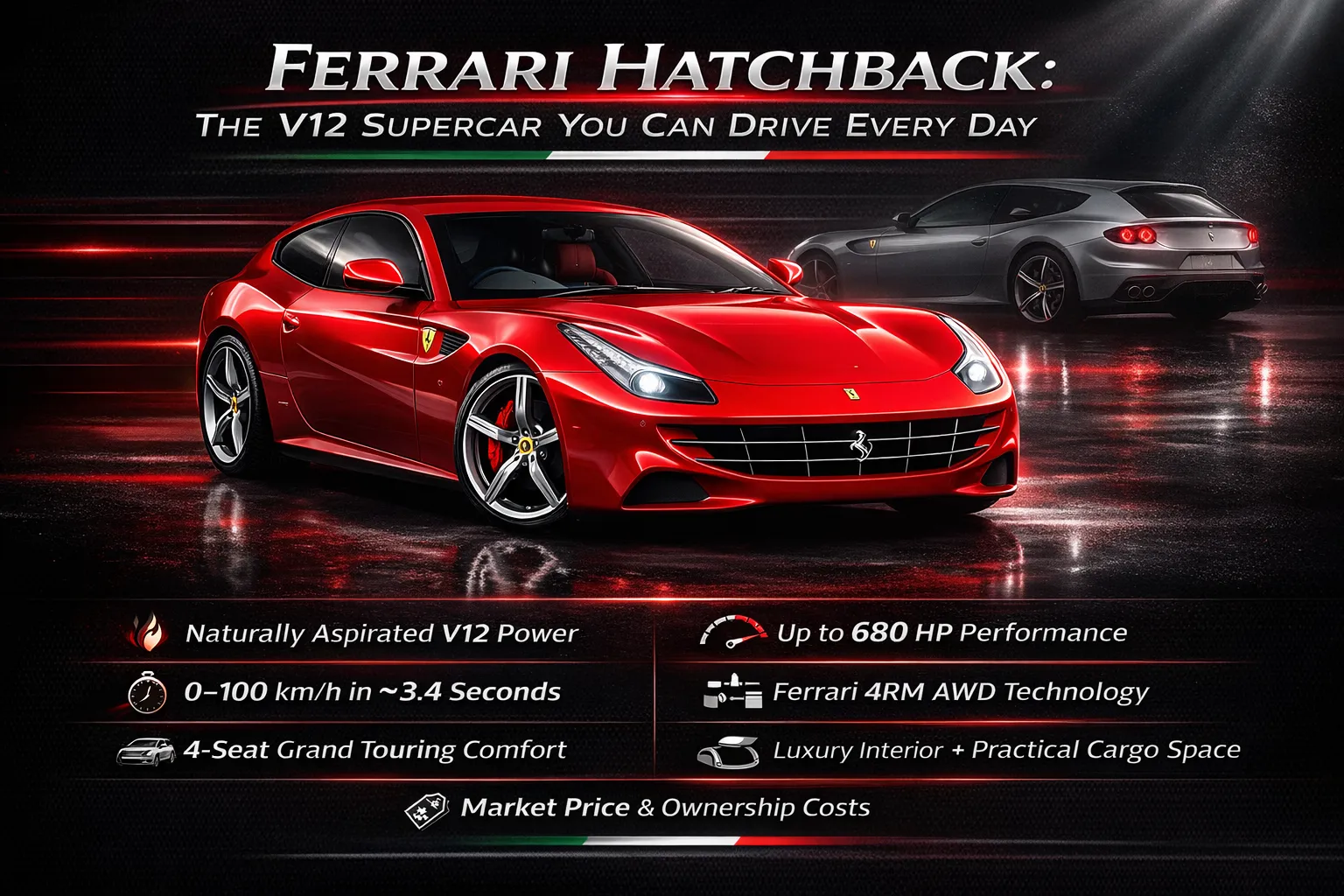
Ferrari did something surprising. They made a car with four seats and a door in the back that opens upwards. A real shooting-brake style that changed what people thought was possible.
These cars were the Ferrari FF and the Ferrari GTC4Lusso.
These cars had some great things:
Big engines that were either naturally aspirated V12 or turbocharged V8
Special systems that helped the cars stay on the road
Real seats in the back for people to sit in
Space in the back for luggage
Comfortable seats and a nice ride
In words: these cars were like supercars but also good for everyday use. The errari hatchback is an example of this. A Ferrari hatchback is what people think of when they want a car that’s exciting and also practical.
What Is a Ferrari Hatchback?
A Ferrari hatchback is not a city car.
Ferrari calls its design a shooting brake.
It is a car style that mixes sports car looks with features, like a wagon.
What Is a Shooting Brake?
A shooting brake traditionally integrates:
Extended bonnet proportions
This car has a roof that looks like a coupe.
It has a liftgate that opens like a hatch.
You can fit four people inside.
The Ferrari is not an SUV. It is not a sedan. It is a kind of car that is made for long trips, and it is also very fast.
Ferrari made this car so you can drive it across the country without losing any speed or excitement. You will still have a lot of fun driving it. It will sound really good.
Ferrari Hatchback Models Overview
only made two hatchback models, the kind that you can use every day.
Ferrari FF
The Ferrari FF, also known as the Ferrari Four, was first shown at the 2011 Geneva Motor Show. This really shook things up in the touring market. The Ferrari FF was a deal.
The Ferrari Four had a lot of power.
It was very powerful.
The Ferrari FF was a deal for the Ferrari company. The Ferrari Four changed everything for Ferrari.
It was Ferrari’s first:
- Production of a four-seat car equipped with AWD
- Hatchback-style Ferrari
- Practical V12 grand tourer
Key Specifications
- The engine is a 6.3-liter V12 that is naturally aspirated.
- This engine gives us around 651 horsepower.
- The car has a lot of torque. It is 683 Nm.
- The car can go from 0 to 100 kilometers per hour in 3.7 seconds.
- It can go fast. The top speed is 335 kilometers per hour.
- This car has a 4RM All Wheel Drive system.
- The gearbox is a 7-speed clutch transmission.
Why the FF Was Groundbreaking
The FF introduced Ferrari’s 4RM AWD architecture, enabling torque distribution to the front wheels only when necessary. This delivered enhanced traction in Snow and rain without traditional AWD weight penalties.
It provided:
- Genuine rear passenger legroom
- 450+ liters of luggage capacity
- Year-round usability
The FF validated that Ferrari could merge practicality with uncompromised performance credentials.
Ferrari GTC4Lusso
The Ferrari GTC4Lusso replaced the FF in 2016, refining the formula in aesthetics, cabin sophistication, and driving dynamics.
Two Variants
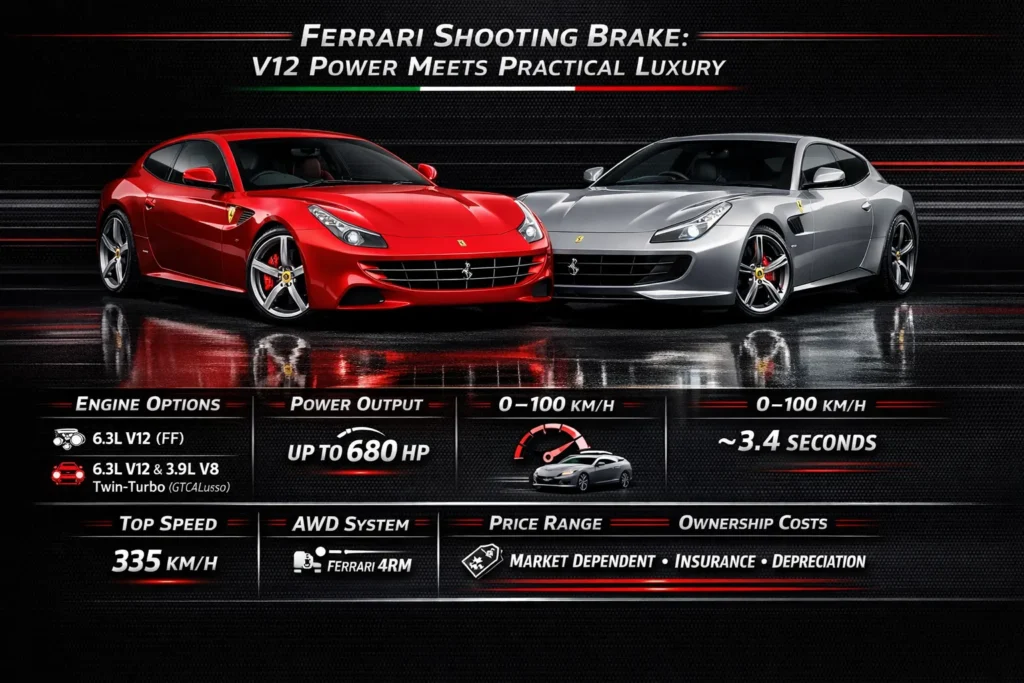
- GTC4Lusso (6.3L V12 AWD) – ~680 hp
- GTC4Lusso T (3.9L twin-turbo V8 RWD) – ~602 hp
Enhancements Over FF
- Rear-wheel steering integration
- Updated infotainment interface
- Passenger-side display screen
- Improved suspension calibration
- Elevated interior craftsmanship
Technical Comparison Overview
| Specification | Ferrari FF | GTC4Lusso V12 | GTC4Lusso T |
| Engine | 6.3L V12 | 6.3L V12 | 3.9L Twin-Turbo V8 |
| Power | 651 hp | 680 hp | 602 hp |
| Drivetrain | AWD | AWD | RWD |
| 0–100 km/h | 3.7 sec | 3.4 sec | 3.5 sec |
| Top Speed | 335 km/h | 335 km/h | 320 km/h |
| Seating | 4 | 4 | 4 |
| Body Style | Shooting Brake | Shooting Brake | Shooting Brake |
Exterior Design
Despite the hatchback architecture, Proportions remain distinctly Ferrari.
Design characteristics include:
- Elongated sculpted hood
- Aggressive LED headlamps
- Muscular rear fenders
- Quad exhaust configuration
- Fastback rear glazing
The rear liftgate integrates seamlessly into the silhouette, preserving aerodynamic integrity.
Interior
Ferrari hatchback models are engineered as true grand tourers.
Cabin Architecture
- Dual-cockpit layout
- Hand-stitched leather upholstery
- Carbon fiber trim accents
- Fully digital instrument cluster
Technology Suite
- Touchscreen infotainment system
- Navigation optimized for European touring
- Apple CarPlay availability
- Interactive passenger display (Lusso)
Seating & Cargo Capacity
- Four individual sport seats
- Adult-friendly rear accommodation
- Expansive luggage compartment
- Split-folding rear seats
This configuration supports:
- Long-distance road travel
- Family excursions
- Multi-bag touring capability
Engine & Performance
V12 Powertrain
The naturally aspirated V12 offers:
- Immediate throttle responsiveness
- Linear torque curve
- High-revving soundtrack
- Emotional acoustic signature
AWD enhances composure in wet or cold climates.
V8 Turbo
The Lusso T was introduced:
- 3.9L twin-turbocharged V8
- Rear-wheel drive configuration
- Reduced front axle mass
- Increased agility
Driving Experience
The Ferrari hatchback embodies dual personalities:
1. Refined Grand Tourer
- Composed ride quality
- Insulated cabin
- Stable high-speed cruising
2. High-Performance Sports Car
- Explosive acceleration
- Precision steering
- Dynamic chassis feedback
Fuel Efficiency & Driving Range
| Model | Combined Consumption |
| Ferrari FF | 15–18 L/100 km |
| GTC4Lusso V12 | ~15 L/100 km |
| GTC4Lusso T | 11–13 L/100 km |
The turbocharged V8 variant demonstrates improved Fuel economy.
Safety & Stability
Ferrari integrated comprehensive systems:
- Multiple airbags
- ABS with EBD
- Electronic stability program
- Traction management
- Carbon ceramic braking system
- Adaptive dampers
- Advanced AWD calibration
Ferrari Hatchback vs Alternatives
Comparable models include:
- Ferrari Purosangue
- Porsche Panamera Turbo
- Aston Martin DB11
Comparison Snapshot
| Model | Seats | Engine | Practicality | Character |
| GTC4Lusso | 4 | V12/V8 | High | Sport-Luxury |
| Purosangue | 4 | V12 | Very High | SUV Performance |
| Panamera Turbo | 4 | Turbo V8 | High | Balanced |
| DB11 | 2+2 | V12/V8 | Medium | Classic GT |
Ownership Costs & Maintenance
Owning a Ferrari hatchback requires strategic budgeting.
Annual Servicing
- Recommended yearly maintenance
- Ferrari-authorized workshops
- Elevated labor rates
Carbon Ceramic Brakes
- High replacement cost
- An extended lifespan if properly maintained
Insurance
- Premium classification vehicle
- Rates vary by region and driver profile
Fuel
- High consumption
- Premium fuel requirement
Parts Supply
- Factory Network availability
- Lusso components are generally more accessible
Resale Value & Collectability
Production ceased in 2020.
Factors supporting long-term value:
- Last naturally aspirated V12 shooting brake Ferrari
- Rare AWD V12 configuration
- Limited production numbers
- Unique body format
Pros & Cons
Advantages
Four full seats
Naturally aspirated V12 option
Distinctive styling
Practical cargo volume
AWD traction (V12 models)
Disadvantages
Elevated fuel usage
Costly maintenance
Complex AWD components
Large footprint for urban settings
Discontinued production
Who Should Buy a Ferrari Hatchback?
Ideal candidates include:
- Grand touring enthusiasts
- Ferrari collectors
- Performance-oriented families
- Drivers preferring low-slung dynamics over SUVs
- V12 purists
It suits buyers seeking versatility without abandoning Ferrari’s performance ethos.
Expert Buying Advice
1: Check Service History
Comprehensive Ferrari maintenance records are critical.
2: Inspect AWD System (FF & V12 Lusso)
Mechanical repairs can be expensive.
3: Assess Brake Condition
Carbon ceramic discs are costly to replace.
4: Evaluate Mileage vs Condition
Maintenance documentation outweighs the odometer reading alone.
5: Pre-Purchase Inspection
Use a Ferrari specialist for independent evaluation.
FAQs
A: Technically, Ferrari designates it a shooting brake, but it features a rear liftgate similar to a hatchback.
A: Yes, production ended in 2020.
A: In terms of practicality, yes — but the driving dynamics differ significantly.
A: V12 delivers emotion and AWD traction. V8 offers improved agility and efficiency.
Final Verdict
The Ferrari hatchback represents one of the boldest strategic decisions in Ferrari’s modern era.
It demonstrates that:
- Performance and practicality can coexist
- Naturally aspirated V12 engines can power family-friendly vehicles
- Innovation can occur without diluting brand identity
If you desire:
- Four usable seats
- Substantial luggage capacity
- Supercar acceleration
- Emotional V12 acoustics