Ferrari F70: The Complete Guide to Ferrari’s Legendary Hypercar Codename, Specs, History & Collector Value
Introduction
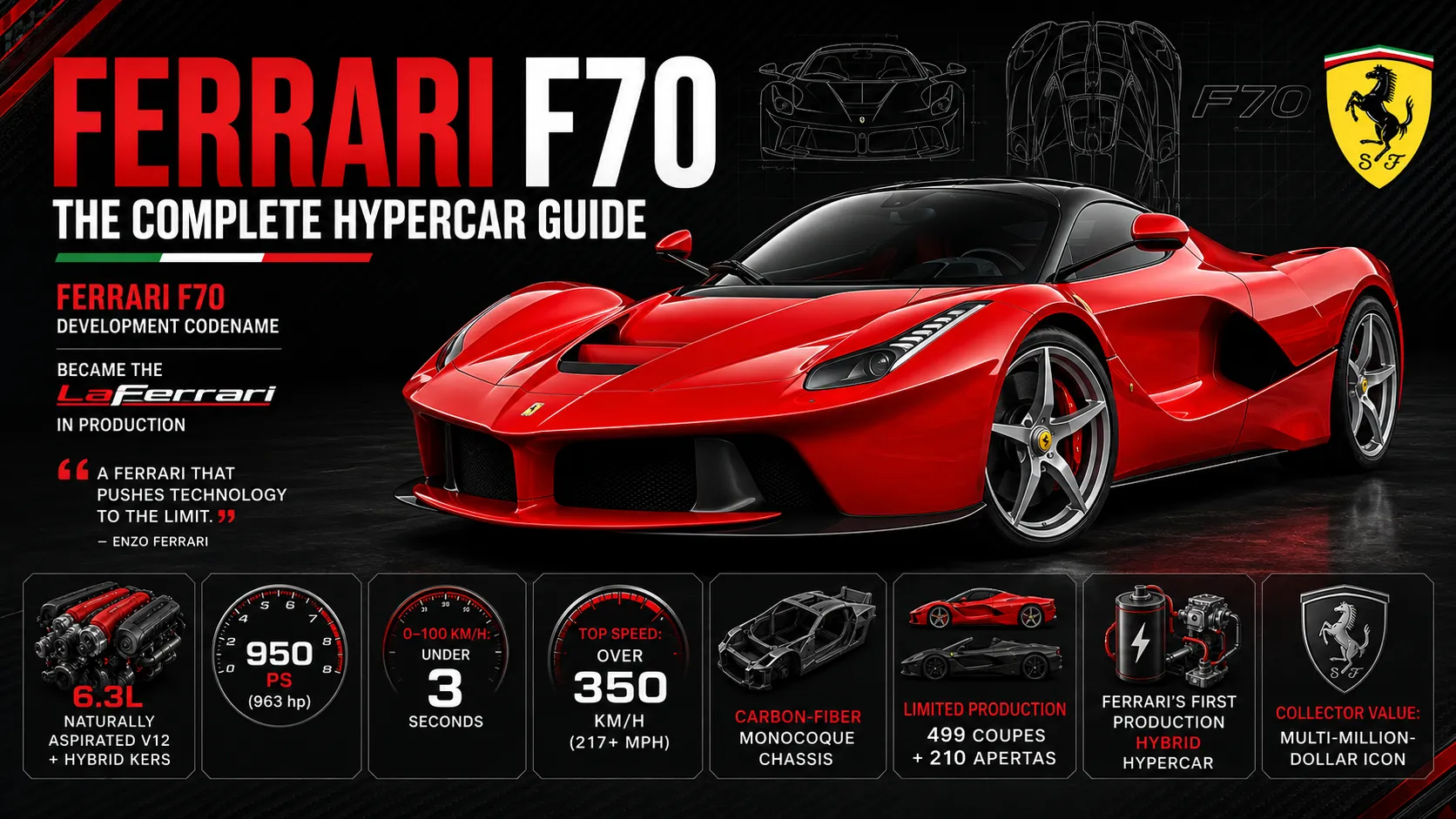
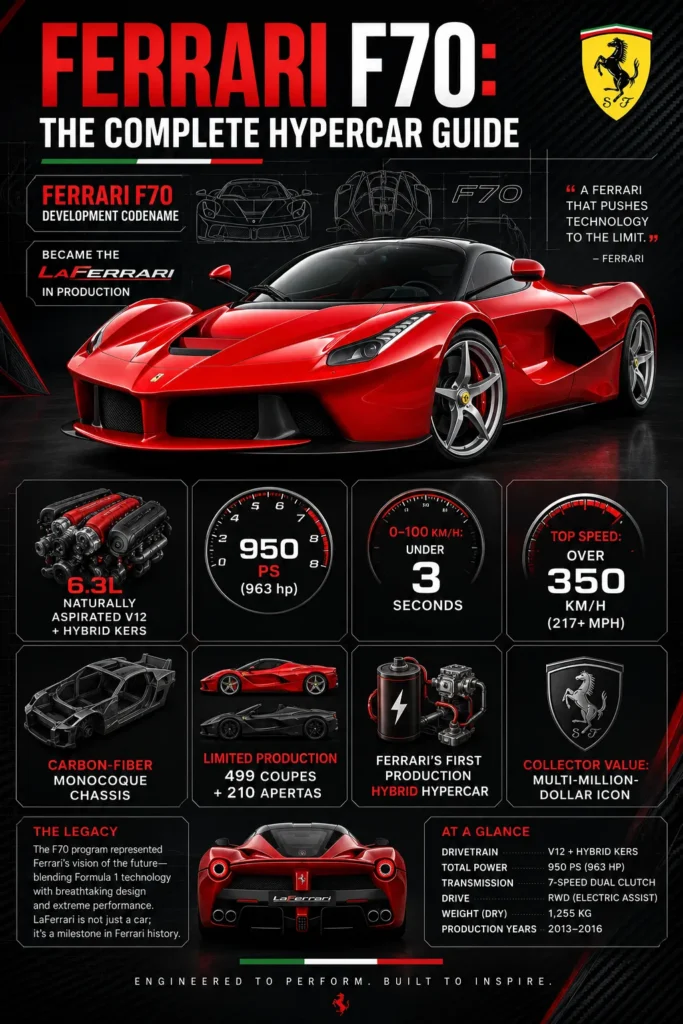
The Ferrari F70 remains one of the most searched yet frequently misunderstood names in the world of high-performance automobiles. Many enthusiasts assume the F70 was an official production model released by Ferrari, but the reality is quite different. The designation Ferrari F70 was the internal project codename assigned to the vehicle that ultimately debuted as LaFerrari, Ferrari’s groundbreaking flagship hybrid hypercar.
Long before the production car was unveiled, journalists, photographers, engineers, and Ferrari enthusiasts around the globe referred to the secret development project as the Ferrari F70. Spy photographs, industry reports, leaked engineering details, and online discussions cemented the codename in automotive culture. Even years after LaFerrari entered production, thousands of enthusiasts continue searching for “Ferrari F70,” making it one of Ferrari’s most enduring unofficial model names.
The project represented far more than the successor to the legendary Ferrari Enzo. Ferrari’s engineers were challenged with creating the most technologically advanced road-going machine in the company’s history. Their objective was to combine a naturally aspirated V12 engine with Formula 1-derived hybrid technology, a lightweight carbon-fiber monocoque, intelligent active aerodynamics, cutting-edge electronic systems, and race-proven engineering without compromising the emotional character that defines every Ferrari.
Ferrari F70 Quick Overview
| Specification | Details |
| Official Production Name | LaFerrari |
| Internal Development Codename | Ferrari F70 |
| Manufacturer | Ferrari |
| Vehicle Category | Limited-Production Hybrid Hypercar |
| Engine | 6.3-Liter Naturally Aspirated V12 |
| Electric System | HY-KERS Hybrid Motor |
| Total Output | 963 Horsepower |
| Maximum Torque | Over 900 Nm |
| Transmission | Seven-Speed Dual-Clutch Automatic |
| Drive Configuration | Rear-Wheel Drive |
| Body Configuration | Two-Door Coupe |
| Seating Capacity | Two Occupants |
| Top Speed | More than 350 km/h (217+ mph) |
| 0–100 km/h | Less than 3 Seconds |
| Production Period | 2013–2016 |
| Production Volume | 499 Units (Later Expanded to 500) |
| Replaced Model | Ferrari Enzo |
| Ultimate Successor | Ferrari F80 |
What Is the Ferrari F70?
The Ferrari F70 was never marketed as an official production model. Instead, it served as Ferrari’s confidential internal Development codename during the research, design, engineering, validation, and testing stages of the company’s next-generation flagship hypercar.
Using internal project names is standard practice throughout the automotive industry. Manufacturers often assign temporary designations to vehicles while development is underway, long before marketing teams determine the final production name. Ferrari has followed this practice for decades, but few project names have gained as much worldwide recognition as F70.
As heavily disguised prototypes began appearing on public roads around Italy and during testing sessions at famous racing circuits, automotive media quickly adopted the F70 codename. Industry magazines, enthusiast websites, YouTube creators, photographers, and online discussion forums consistently referred to the mysterious prototype as the Ferrari F70, making the designation widely recognized years before the official unveiling.
When Ferrari finally introduced the production version at the Geneva Motor Show, the company surprised enthusiasts by abandoning the expected numerical naming tradition. Rather than continuing the lineage of the F40 and F50, Ferrari revealed the car under a completely new identity—LaFerrari, meaning “The Ferrari.”
Although the official production name changed, the original development codename never disappeared. Today, searches for Ferrari F70 overwhelmingly lead to information about LaFerrari because the two names remain permanently connected in Ferrari history.
The F70 designation has become more than just an internal engineering label. It represents one of Ferrari’s most ambitious development programs, symbolizing the moment when traditional naturally aspirated performance merged with advanced hybrid technology to create an entirely new generation of Ferrari hypercars.
Why Do People Still Search for the Ferrari F70?
More than a decade after LaFerrari’s global debut, the phrase Ferrari F70 continues generating substantial search traffic. The enduring popularity of the codename can be explained by several important factors that have kept it relevant among enthusiasts, collectors, journalists, and automotive historians.
1. Extensive Pre-Launch Media Coverage
Long before Ferrari officially introduced the production vehicle, nearly every major automotive publication referred to the upcoming flagship as the Ferrari F70.
Industry insiders, journalists, and automotive analysts had little information beyond the confidential project designation, so the codename naturally became the standard reference across magazines, newspapers, television programs, blogs, and digital media. This widespread coverage established years of familiarity before the public ever learned the official name.
As a result, many enthusiasts became emotionally attached to the F70 designation, and even after LaFerrari’s debut, countless articles, archived reports, and historical discussions continued referencing the project by its original codename.
2. Famous Spy Photography
Prototype testing played a major role in popularizing the Ferrari F70 name.
Disguised development vehicles were regularly photographed on public roads throughout Italy and at Ferrari’s Fiorano test circuit. Automotive photographers captured these prototypes during high-speed evaluation sessions, creating enormous anticipation among enthusiasts eager to discover Ferrari’s next flagship.
Because Ferrari remained silent about the project, publications consistently labeled every prototype as the Ferrari F70. These exclusive spy photographs circulated globally, generating millions of views and fueling years of speculation regarding engine configuration, performance figures, aerodynamics, and design.
3. Ferrari’s Historic Naming Tradition
Ferrari enthusiasts naturally expected the company’s next halo car to continue its famous numerical naming sequence.
Previous generations included legendary models such as:
- Ferrari 288 GTO
- Ferrari F40
- Ferrari F50
- Ferrari Enzo
Many believed the logical successor would simply become the Ferrari F70, following the established pattern of iconic flagship vehicles.
Instead, Ferrari chose a completely different approach by introducing the name LaFerrari, surprising both journalists and longtime enthusiasts.
The unexpected branding decision only increased public curiosity about the original codename, helping preserve its popularity long after production began.
4. Collector and Auction Discussions
The Ferrari F70 codename remains Deeply embedded within collector communities and the classic car marketplace.
Auction houses, investment analysts, historians, and Ferrari specialists frequently reference the vehicle’s development program as the F70 Project when discussing prototype history, engineering evolution, production planning, or factory documentation.
This continued use within collector circles has ensured that the codename remains an important part of Ferrari’s historical record.
Even today, many enthusiasts searching for information about LaFerrari begin their research using the phrase Ferrari F70, demonstrating the lasting influence of the project’s original identity.
Ferrari’s Halo Hypercar Philosophy
Ferrari has never built flagship automobiles simply to achieve impressive sales figures. Instead, each generation of its limited-production halo cars has served as a technological showcase—a platform where the company’s latest innovations, motorsport experience, and engineering expertise converge into a single extraordinary machine.
These ultra-exclusive models are often referred to as halo cars because they elevate Ferrari’s entire brand image while introducing technologies that eventually influence future production vehicles.
Unlike conventional sports cars, halo Ferraris are developed with virtually no compromises. Engineers prioritize maximum performance, lightweight construction, advanced aerodynamics, cutting-edge electronics, and race-derived innovation above all else.
Throughout Ferrari’s history, only a handful of vehicles have earned this prestigious status.
| Ferrari Halo Model | Launch Year |
| Ferrari 288 GTO | 1984 |
| Ferrari F40 | 1987 |
| Ferrari F50 | 1995 |
| Ferrari Enzo | 2002 |
| Ferrari F70 (LaFerrari) | 2013 |
| Ferrari F80 | 2025 |
Each generation introduced Revolutionary advancements that later appeared throughout Ferrari’s broader lineup.
For example:
- The 288 GTO pioneered Ferrari’s modern supercar philosophy.
- The F40 showcased lightweight composite construction and twin-turbocharged performance.
- The F50 brought Formula 1-inspired naturally aspirated V12 technology to the road.
- The Enzo introduced advanced aerodynamics, carbon-fiber engineering, and electronic driver systems.
- The Ferrari F70 elevated hybrid performance to an entirely new level while preserving the unmistakable character of a naturally aspirated Ferrari V12.
Rather than replacing Ferrari’s heritage, the F70 represented the next evolution of that legacy.
Its hybrid system was never Intended merely to improve fuel economy. Instead, it delivered instant electric torque, sharper throttle response, improved acceleration, and enhanced efficiency without sacrificing emotion, sound, or driver engagement.
In many respects, the Ferrari F70 marked the most significant technological leap Ferrari had achieved since the introduction of the F40 more than two decades earlier.
Why Ferrari Changed the Name to LaFerrari
One of the most frequently asked questions among enthusiasts concerns Ferrari’s decision to abandon the widely recognized F70 codename before production.
The explanation centers on branding, identity, and the symbolic importance of Ferrari’s newest flagship.
By the early 2010s, Ferrari recognized that its next halo car represented much more than another sequential evolution. The company believed it had created the most advanced road-going automobile in its history—a vehicle worthy of standing above every previous Ferrari.
Rather than assigning another numerical designation, Ferrari selected a name with a far deeper meaning:
LaFerrari—literally translated from Italian as “The Ferrari.”
The company believed this title perfectly represented the ultimate expression of everything Ferrari stood for: engineering excellence, motorsport innovation, timeless design, handcrafted craftsmanship, and uncompromising performance.
More Than Just Another Ferrari
Ferrari wanted the new flagship to symbolize the absolute pinnacle of the brand’s engineering achievements.
The project embodied several defining characteristics:
- Ultimate Ferrari engineering
- Formula 1-inspired innovation
- Advanced hybrid performance
- Exceptional craftsmanship
- Naturally aspirated V12 excellence
- Lightweight carbon-fiber construction
- Intelligent active aerodynamics
- Limited-production exclusivity
Choosing another numbered model designation could have suggested that the vehicle was merely the next chapter in an established series.
Instead, Ferrari wanted a timeless identity that emphasized the car’s unique significance within the company’s history.
The name LaFerrari immediately communicated that this was not simply another Ferrari—it was intended to represent the very essence of the brand itself.
Ferrari’s First Production Hybrid
The Ferrari F70 project achieved several historic milestones that justified its distinctive identity.
It became Ferrari’s:
- First production hybrid road car
- Most powerful Ferrari available at launch
- Fastest production Ferrari of its era
- Most aerodynamically advanced Ferrari ever built
- Most technologically sophisticated Ferrari road vehicle
- Most efficient naturally aspirated V12 flagship in company history
Instead of compromising traditional Ferrari values, the hybrid system enhanced virtually every aspect of the driving experience.
Electric assistance improved acceleration, throttle response, corner exit performance, and overall efficiency while preserving the unmistakable soundtrack of Ferrari’s legendary naturally aspirated V12.
The result demonstrated that Electrification could complement Ferrari’s heritage rather than replace it.
The Geneva Motor Show Reveal
After years of confidential research, engineering, and extensive prototype testing, Ferrari officially introduced the production version of the F70 project at the 2013 Geneva Motor Show.
The unveiling instantly became one of the exhibition’s biggest attractions.
Automotive journalists praised the car for its:
- Revolutionary hybrid powertrain
- Stunning exterior styling
- Formula 1-derived engineering
- Lightweight carbon-fiber architecture
- Extraordinary performance figures
- Advanced active aerodynamics
- Exceptional technological sophistication
Although the world officially welcomed LaFerrari, the original Ferrari F70 codename remained permanently woven into the vehicle’s history.
Today, the two names are inseparable. While “LaFerrari” represents the production model, “Ferrari F70” continues to symbolize one of the most secretive, ambitious, and influential development programs ever undertaken by the legendary Italian manufacturer.
FAQs
A: The Ferrari F70 was the internal development codename for the hypercar that was eventually introduced as the LaFerrari. It was never sold under the F70 name, but the codename became widely recognized through pre-production reports, spy photos, and automotive media.
A: Yes. Ferrari F70 and LaFerrari refer to the same vehicle. “F70” was the confidential project name used during development, while “LaFerrari” became the official production name when the car debuted at the 2013 Geneva Motor Show.
A: Ferrari chose the name “LaFerrari,” which translates to “The Ferrari,” to emphasize that the car represented the ultimate expression of the brand. The company wanted a unique identity rather than continuing the numerical naming tradition established by the F40 and F50.
A: Ferrari initially planned to produce 499 coupe models. Later, a 500th coupe was built for charity following devastating earthquakes in Italy. Ferrari also produced 210 LaFerrari Aperta roadsters, making the model exceptionally rare.
A: The Ferrari F70 is powered by a naturally aspirated 6.3-liter V12 engine paired with Ferrari’s HY-KERS hybrid electric motor. Together, the system produces a combined output of 963 horsepower.
Conclusion
The Ferrari F70 may never have appeared on a production badge, but its impact on Ferrari’s history is undeniable. As the internal codename for the project that became LaFerrari, the F70 represents one of the most ambitious engineering programs ever undertaken by the Italian manufacturer. It bridged Ferrari’s legendary naturally aspirated V12 heritage with Formula 1-derived hybrid technology, creating a hypercar that redefined performance, innovation, and exclusivity.
More than a decade after its debut, the Ferrari F70 continues to attract enthusiasts, collectors, and historians who recognize it as the foundation of one of Ferrari’s greatest achievements. Its revolutionary HY-KERS powertrain, carbon-fiber construction, advanced aerodynamics, limited production, and timeless design have secured its place among the most significant supercars ever built.
Whether you searched for Ferrari F70 out of curiosity, Historical interest, or investment research, it is clear that the name remains an important part of Ferrari’s legacy. While the world officially knows the car as LaFerrari, the F70 codename will always symbolize the extraordinary vision, engineering excellence, and relentless pursuit of perfection that define Ferrari’s flagship hypercars.