Ferrari F40 Lap Time Nürburgring: Performance Analysis, Estimated Time, History & Legacy
Introduction
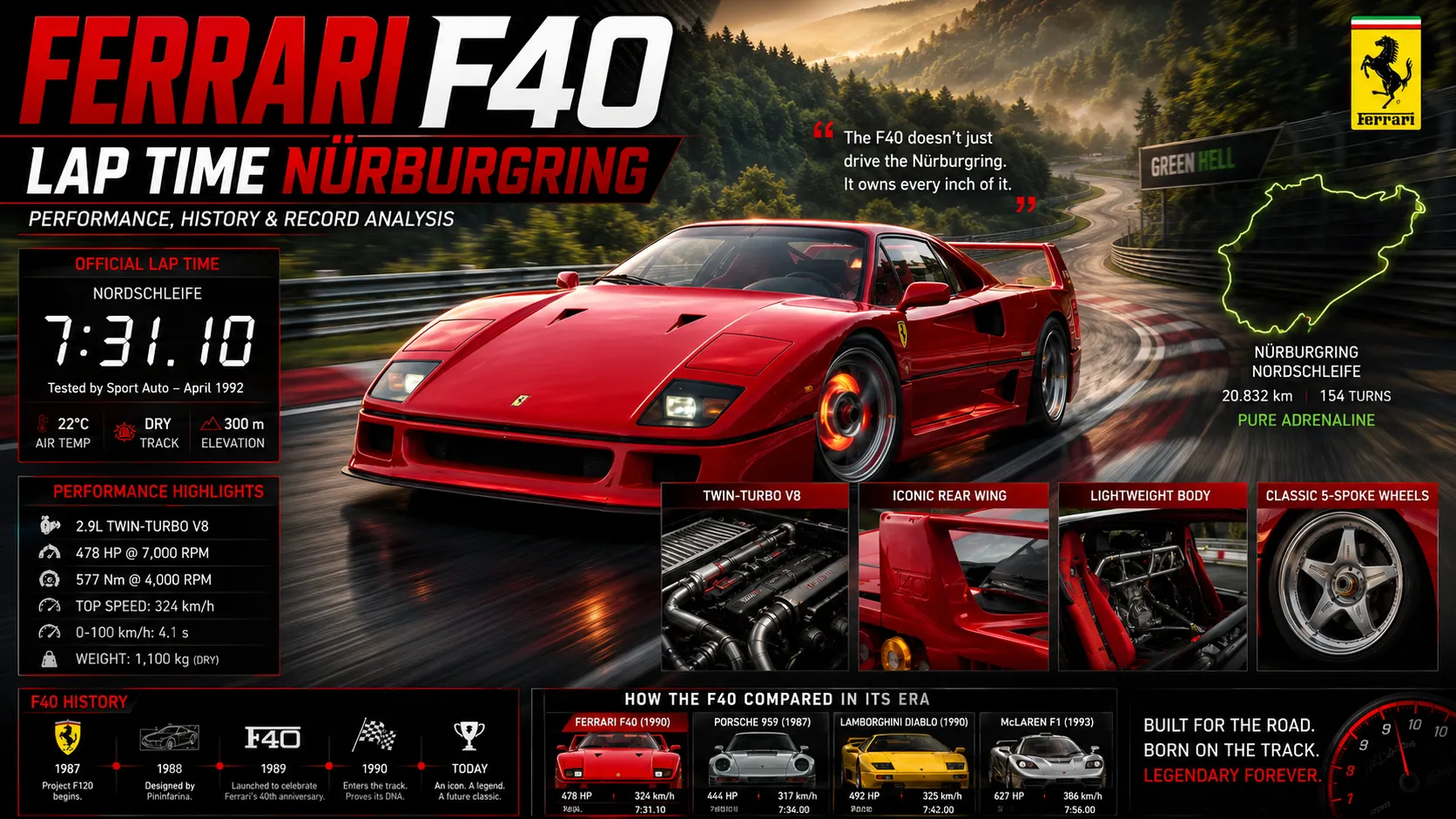
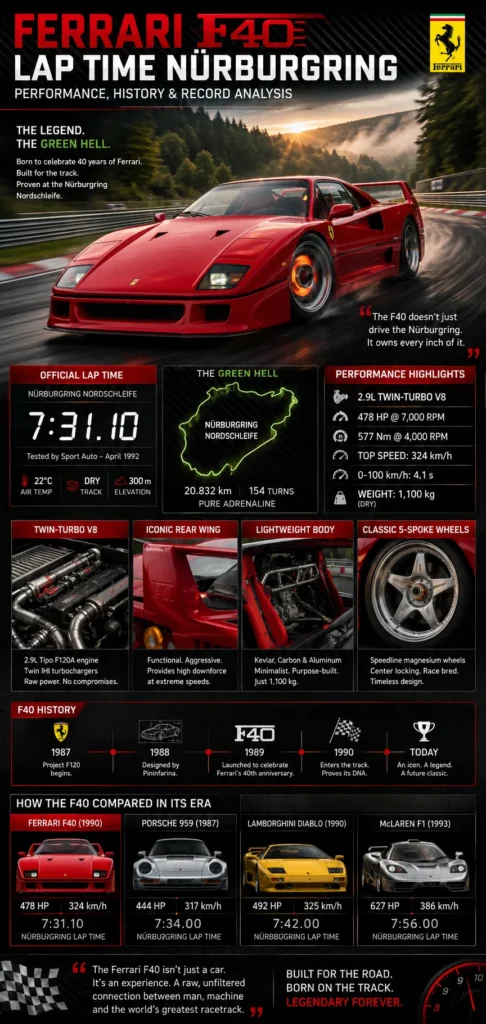
The Ferrari F40 lap time Nürburgring remains one of the most searched topics among Ferrari enthusiasts, collectors, and performance car fans. While modern supercars regularly post official lap records around Germany’s legendary Nürburgring Nordschleife, the Ferrari F40 occupies a unique place in automotive history. Despite its iconic status, Ferrari never released an official production Nürburgring lap time for the F40, leaving enthusiasts to debate what the car could realistically achieve.
Introduced in 1987 to celebrate Ferrari’s 40th anniversary, the F40 was the last road car personally approved by Enzo Ferrari. It was designed with one goal: to deliver an uncompromising driving experience. Lightweight construction, a twin-turbocharged V8 engine, and race-inspired engineering made it one of the fastest production cars of its era.
In this comprehensive guide, we’ll examine why there is no official Nürburgring lap record for the Ferrari F40, estimate its potential performance based on engineering principles, compare it with legendary rivals such as the Porsche 959, and explore why the F40 continues to be regarded as one of the greatest analog supercars ever built.
Ferrari F40 Overview
The Ferrari F40 wasn’t created to dominate marketing lap records. Instead, it represented Ferrari’s philosophy of building the purest possible driver’s car.
Developed using knowledge gained from Ferrari’s endurance racing program, the F40 combined cutting-edge composite materials with a brutally powerful twin-turbocharged engine. The result was a road-legal supercar capable of exceeding 200 mph at a time when very few production cars came close.
Unlike today’s electronically assisted performance cars, the F40 offers no traction control, stability control, adaptive suspension, or anti-lock braking system. Every input comes directly from the driver, making it one of the most engaging—and demanding—cars ever built.
Who Was the Ferrari F40 Built For?
The F40 was designed for experienced driving enthusiasts who valued mechanical feedback over luxury. Even today, it appeals to:
- Ferrari collectors
- Classic supercar investors
- Track-day enthusiasts
- Drivers seeking an authentic analog experience
- Automotive historians
Ferrari F40 Quick Specifications
| Specification | Ferrari F40 |
| Production Years | 1987–1992 |
| Engine | 2.9-liter Twin-Turbocharged V8 |
| Horsepower | 471 hp (478 PS) |
| Torque | 577 Nm (426 lb-ft) |
| Transmission | 5-Speed Manual |
| Drivetrain | Rear-Wheel Drive |
| Body Type | Two-Door Coupe |
| Seating Capacity | 2 |
| Fuel Type | Petrol |
| 0–60 mph | Approximately 4.1 seconds |
| Top Speed | 201 mph (324 km/h) |
| Weight | Approximately 1,100 kg (Dry) |
Exterior Design:
The Ferrari F40’s exterior remains instantly recognizable decades after its debut. Designed by Pininfarina, every body panel served a functional aerodynamic purpose rather than pure aesthetics.
Lightweight Construction
Ferrari engineers extensively used advanced materials, including:
- Kevlar
- Carbon fiber
- Composite panels
- Aluminum
These materials significantly reduced weight while improving structural rigidity.
Aerodynamic Philosophy
Unlike many modern supercars that rely on active aerodynamics, the F40 uses fixed aerodynamic elements such as:
- Large integrated rear wing
- Deep front splitter
- Flat underbody
- Functional air intakes
- Rear engine cooling vents
The body generated impressive downforce without compromising its iconic appearance.
Wheels and Brakes
The F40 rides on lightweight multi-piece alloy wheels paired with large ventilated disc brakes. Although advanced for the late 1980s, braking performance still demands respect due to the absence of ABS.
Interior & Comfort:
Stepping inside the Ferrari F40 reveals just how focused the car is.
Luxury features common today are intentionally absent.
Dashboard
The dashboard features:
- Simple analog gauges
- Large tachometer
- Basic switchgear
- Minimal instrumentation
Everything exists to support driving rather than comfort.
Seats
The lightweight racing bucket seats provide excellent lateral support while keeping weight to a minimum.
Cabin Materials
Rather than hiding the car’s construction beneath leather and wood trim, Ferrari proudly exposed carbon fiber and Kevlar throughout the cabin.
Practicality
Storage space is almost nonexistent, Cabin noise is substantial, and ride comfort is firm. These compromises were deliberate, reinforcing the F40’s race-inspired character.
Engine & Performance
The heart of the Ferrari F40 is its legendary twin-turbocharged V8.
Engine Specifications
- 2.9-liter V8
- Twin IHI turbochargers
- Five-speed manual transmission
- Rear-wheel drive
- Approximately 471 horsepower
Acceleration
Performance figures remain impressive even today:
| Performance Metric | Figure |
| 0–60 mph | ~4.1 sec |
| 0–100 mph | ~10 sec |
| Top Speed | 201 mph |
Crossing the 200 mph barrier in the late 1980s established the Ferrari F40 as one of the world’s fastest production cars.
Driving Experience
Driving the F40 is unlike driving any modern supercar.
Characteristics include:
- Noticeable turbo lag before boost arrives
- Exceptionally direct steering
- Mechanical gear changes
- Strong high-speed stability
- Demanding throttle control
Rather than masking driver mistakes with electronic systems, the F40 rewards precision and skill.
Fuel Economy
Fuel economy was never a priority during the F40’s development.
Typical estimates include:
| Driving Condition | Approximate Economy |
| City | 10–12 mpg |
| Highway | 15–17 mpg |
| Combined | 13–14 mpg |
Owners generally prioritize performance over efficiency.
Safety Features
Compared with modern sports cars, the Ferrari F40 includes only basic safety equipment.
Standard Features
- Steel safety structure
- Ventilated disc brakes
- Reinforced composite chassis
- High-performance tires
- Racing-inspired seating Position
Not Included
- ABS
- Traction Control
- Stability Control
- Multiple Airbags
- Adaptive Driver Assistance
This lack of electronic intervention is one reason experienced drivers hold the F40 in such high regard.
Technology & Infotainment
Modern infotainment simply did not Exist when the Ferrari F40 was introduced.
The car intentionally omits:
- Touchscreen displays
- Navigation
- Bluetooth
- Smartphone connectivity
- Voice controls
- Driver assistance technology
Instead, every component supports the driving experience.
Understanding the Nürburgring Nordschleife
Known worldwide as the Green Hell, the Nürburgring Nordschleife is considered one of the most demanding race circuits ever built.
Why Is It So Challenging?
The circuit features:
- More than 20 kilometers of racing surface
- Over 150 corners
- Significant elevation changes
- Blind crests
- High-speed compressions
- Constantly changing weather conditions
These characteristics make it the ultimate proving ground for chassis balance, suspension tuning, braking performance, and driver confidence.
Manufacturers frequently use the Nordschleife to validate suspension setups and benchmark performance because success here Often translates into real-world capability on challenging roads.
Did Ferrari Ever Record an Official Ferrari F40 Nürburgring Lap Time?
One of the biggest misconceptions surrounding the Ferrari F40 is that an official Nürburgring lap time exists.
The reality is different.
Ferrari never published a verified production-car Nürburgring lap time for the F40. During the late 1980s, manufacturers did not view the Nordschleife as the marketing battleground it has become today. Instead, Ferrari concentrated much of its development work at its private Fiorano test circuit, where engineers could repeatedly evaluate handling, braking, engine response, and reliability in a controlled environment.
Although prototype testing and private laps may have occurred over the years, there is no officially verified Ferrari production record for the F40 at the Nürburgring. Many lap times circulating online originate from simulations, magazine estimates, or forum discussions rather than authenticated manufacturer data.
For enthusiasts, this absence of an official number is part of the F40’s enduring mystique. Rather than chasing a headline lap record, Ferrari created a car defined by its raw, mechanical driving experience.
Estimated Ferrari F40 Nürburgring Lap Time
Without an official benchmark, estimating the Ferrari F40’s Nordschleife performance requires careful analysis rather than speculation.
Factors influencing a realistic lap include:
- Tire compound and condition
- Weather and track temperature
- Driver experience
- Surface evolution over time
- Vehicle setup and maintenance
- Fuel load
Based on the F40’s power-to-weight ratio, chassis design, top speed, braking capability, and historical performance against contemporary rivals, many analysts suggest that a well-driven production Ferrari F40 on modern ultra-high-performance tires could complete the Nordschleife in the high 7-minute to low 8-minute range.
This estimate should be viewed as an informed engineering assessment—not an official Ferrari record.
Pros & Cons
Pros
- Iconic analog driving Experience
- Lightweight race-inspired construction
- Legendary twin-turbo V8 performance
- Exceptional collector value
- Timeless Pininfarina styling
Cons
- No ABS or traction control
- Pronounced turbo lag
- Limited cabin comfort
- Expensive maintenance and parts
- Demands experienced driving skills
Best For
The Ferrari F40 is best suited for:
- Serious Ferrari collectors
- Classic supercar enthusiasts
- Experienced track-day drivers
- Investors seeking appreciating automotive icons
- Drivers who value pure mechanical engagement over modern electronic assistance
It is less suitable for buyers seeking everyday comfort, advanced technology, or daily practicality.
Comparison Suggestions
If you’re considering the Ferrari F40, these legendary alternatives are also worth exploring:
| Model | Key Strength |
| Porsche 959 | Advanced all-wheel drive and technology |
| Ferrari F50 | Naturally aspirated Formula 1-inspired V12 |
| Ferrari Enzo | Carbon-fiber chassis with modern performance |
Maintenance & Ownership
Owning a Ferrari F40 is both rewarding and demanding.
Servicing
Routine maintenance requires specialist knowledge of classic Ferrari engineering. Engine-out servicing may be necessary for major repairs, and sourcing original parts can be expensive.
Parts Availability
While many components remain available through Ferrari specialists, rare original parts and body panels command premium prices.
Resale Value
The F40 has consistently appreciated in value due to its limited production, historical significance, and enduring demand among collectors. Well-documented, low-mileage examples typically attract the strongest interest at auctions.
FAQs
A: There is no officially verified production Nürburgring lap time published by Ferrari for the Ferrari F40.
A: During the late 1980s, Ferrari focused primarily on development at its Fiorano test circuit rather than using Nürburgring lap times as a marketing tool.
A: In straight-line performance, the F40 remains remarkably quick. However, modern supercars benefit from advanced aerodynamics, tire technology, electronic driver aids, and significantly improved braking systems.
A: Its combination of rear-wheel drive, twin-turbo power delivery, manual transmission, and lack of electronic safety systems requires exceptional driver skill and respect.
A: Historically, the Ferrari F40 has been one of the most desirable collectible Ferraris, with values generally appreciating over time. Condition, originality, mileage, and documented history play a major role in determining market value.
Conclusion
The search for the Ferrari F40 Nürburgring lap time continues to fascinate enthusiasts because the car represents far more than a single number on a stopwatch. While no officially verified production lap time exists, the F40’s engineering, lightweight construction, and twin-turbocharged performance suggest it would remain highly competitive even by modern standards when equipped with contemporary tires and driven by an expert.
More importantly, the Ferrari F40’s legacy was never built on marketing records. As the last road car personally approved by Enzo Ferrari, it embodies an era when driver skill, mechanical purity, and uncompromising engineering defined the ultimate supercar experience. Its raw character, timeless design, and motorsport-inspired DNA continue to captivate collectors and enthusiasts around the world.
If you enjoyed this guide, explore more Ferrari comparisons, performance analyses, and buying guides on TheCarsCompare.com to deepen your knowledge of the world’s most iconic sports cars.