Introduction
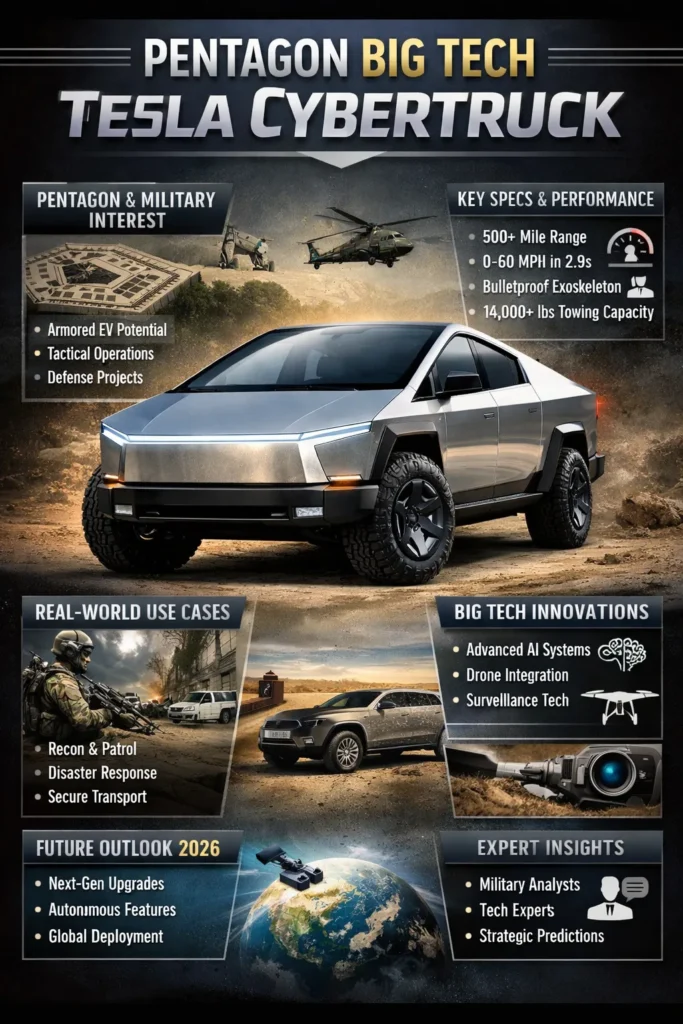
The Pentagon Big Tech Tesla Cybertruck subject has quickly become one of the most interesting and compelling areas of convergence between automotive technology and Pentagon/military defense. It is a term that combines a futuristic electric pickup truck, the Tesla Cybertruck, with the influence and interest that has been shown by the Pentagon and U.S. military testing programs. In 2026, this is not simply a matter of memes and headlines; it is a sign of how civilian technology is changing the face of military defense.
Quick Overview Table
| Specification | Details/Estimates |
| Body Type | Full‑Size Electric Pickup |
| Drive | Rear‑Wheel Drive / All‑Wheel Drive |
| Power (HP) | Up to ~845 hp (Cyberbeast) |
| Estimated Range | ~300–350+ miles (varies by trim) |
| Battery Capacity | ≈ 123 kWh |
| Acceleration (0‑60 mph) | ~2.6–6.5 sec (trim dependent) |
| Seating | 5 Adults |
| Charging | DC Fast Charging (≤ 250 kW) |
| Build | Stainless Steel Exoskeleton |
| Military Relevance | Target Testing / Structural Analysis |
What Is the Pentagon Big Tech Tesla Cybertruck Story?
The phrase Pentagon Big Tech Tesla Cybertruck refers to the U.S. military’s interest and evaluation of the Tesla Cybertruck — not as a combat vehicle, but as advanced technology worth studying. Recent reports confirm the U.S. Air Force sought to procure Cybertruck units for missile target testing, simulation exercises, and battlefield training scenarios at places like the White Sands Missile Range in New Mexico. These vehicles are not being weaponized; instead, they help military engineers understand how modern electric vehicles respond to impacts and detection technology used in modern conflicts.
Exterior Design
One of the defining facets of the Tesla Cybertruck is its radical styling and industrial construction. At first glance, many people describe it as “post‑apocalyptic” or futuristic — but there’s more behind that look than meets the eye.
Body & Materials
- Built with ultra‑hard 30X cold‑rolled stainless steel exoskeleton panels, the Cybertruck’s body is different from traditional painted steel trucks. This material provides strength and rigidity — qualities that interest engineers studying impact and penetration behavior.
- The truck requires no paint and showcases a raw steel finish that contributes to unique potential interactions with sensors, radar, and weapon trajectories — a reason it’s been studied in military contexts.
Lighting & Shape
Its full LED light bars, illuminated handles, and flat surfaces offer a stark contrast to the rounded shapes of conventional pickups. These sharp surfaces can influence radar signatures and optical sensor readings — one reason defense planners consider testing against such profiles.
Tonneau & Vault Design
The rear cargo area — dubbed the “vault” — is lockable and weather‑resistant, blending utility with Tesla’s unconventional design philosophy. Ground clearance and robust suspension aim to balance physics for highway and mild off‑road use.
Interior & Comfort
Unlike many premium pickups or luxury SUVs, the Cybertruck’s interior leans toward utilitarian minimalism.
Dashboard & Controls
Inside, a massive touchscreen serves as the central command hub. Almost every function — from climate control to navigation — runs through it. While impressive, this touchscreen‑centric approach is a design polarizer, with some praising its modernity and others noting a lack of physical Controls.
Seating & Space
- The Cybertruck can seat up to five adults comfortably, though rear headroom can feel a bit constrained due to the sloped roofline.
- Front and rear seats provide decent legroom, but materials are utilitarian rather than ultra‑luxurious.
Infotainment & Storage
Tesla’s massive central screen is the centerpiece, offering entertainment, navigation, and connectivity. Storage areas, including hidden compartments and the front trunk (“frunk”), increase utility.
Engine & Performance
Though strictly electric, the Cybertruck’s performance varies by configuration:
Multiple Motor Options
- Single‑motor RWD (older trim)
- Dual‑motor AWD
- Tri‑motor AWD “Cyberbeast” variant
Depending on the configuration, power output ranges from a capable highway cruiser to blistering acceleration capable of 0‑60 mph in around 2.6 seconds.
Acceleration and handling make the Cybertruck competitive with many high‑end performance vehicles — though towing capacity and heavy payloads are part of its true utility.
Fuel Economy / Range
Electric range estimates for the Cybertruck commonly are:
- ~250–350+ EPA‑estimated miles depending on trim and battery setup.
Real‑world tests often show a slightly lower range, influenced by speed, terrain, and payload. Charging at Tesla’s Supercharger network remains one of the Cybertruck’s biggest strengths, with fast charging adding significant range in a short time.
Safety Features
Traditional safety systems included in the Cybertruck are supplemented by Tesla’s suite of driver assists (Autopilot, etc.). Crash test data varies by region, but the vehicle has faced both praise and criticism for safety performance, especially regarding electronics and sensor reliability.
It’s worth noting that some countries restrict their road use due to compliance with pedestrian safety standards.
Technology & Infotainment
Tesla’s technology in the Cybertruck isn’t just about speed — it’s connectivity and software:
- 18.5‑inch central touchscreen controls nearly all systems.
- Over‑the‑air updates keep the truck improving long after purchase.
- Rear passenger touchscreen and advanced sound systems enhance tech appeal.
Variants & Pricing
Tesla typically offers multiple trim levels without fixed Price tags in this article (as required), but the lineup historically includes:
- Entry‑level RWD (earlier)
- Dual‑motor AWD
- Tri‑motor AWD “Cyberbeast”
Pros & Cons
Pros
Futuristic design that stands out
Strong acceleration and electric torque
Large cargo capacity and utility
Tesla’s software and charging network
Interest from the military context highlights engineering resilience
Cons
Interior materials are utilitarian
Polarizing styling isn’t for everyone
Real‑world range can vary
Some safety/testing data mixed
High entry cost compared to rivals
Best For
The Cybertruck is ideal for:
- Tech enthusiasts craving cutting‑edge EV performance
- Buyers wanting standout design
- Drivers seeking strong towing and utility
- Those who embrace software‑driven vehicle ecosystems
Comparison Suggestions
| Model | Why Compare |
| Ford F‑150 Lightning | Traditional truck competitor |
| Rivian R1T | Premium EV truck with strong reviews |
| GMC Hummer EV | Rugged EV alternative |
These provide insight into how Cybertruck stacks up across design philosophy and use cases.
Maintenance & Ownership
Electric vehicles generally have lower mechanical maintenance than combustion trucks. Battery health, software updates, and service appointments remain essential. Resale value is still being established.
FAQs
A: The military wants to test how modern automotive technology reacts under battlefield conditions — especially with its unique design and materials.
A: Not currently — the interest is for testing and evaluation rather than deployment.
A: Documents show procurement for testing, not widespread acquisition.
A:Unlikely directly; military use is separate from consumer market strategies.
Conclusion
The Pentagon Big Tech Tesla Cybertruck conversation reflects a key trend of the 21st century — civilian technology and cutting‑edge automotive innovation influencing national defense testing and strategy. Tesla’s Cybertruck stands out not just as an electric truck but as a symbol of how tech and mobility integrate with global security thinking.
Pentagon big tech Tesla Cybertruck. While civilian buyers evaluate the Cybertruck for performance, comfort, and practicality, military planners see its design as a challenge and a tool for modern battlefield simulation. Even if it never serves in combat, its presence in testing reinforces how vehicles — once tools for transport — now carry implications beyond Roads.