Introduction
If someone suddenly sends you “KMT” in a text, comment, or DM, you may wonder whether it is an abbreviation, slang term, or something else entirely.
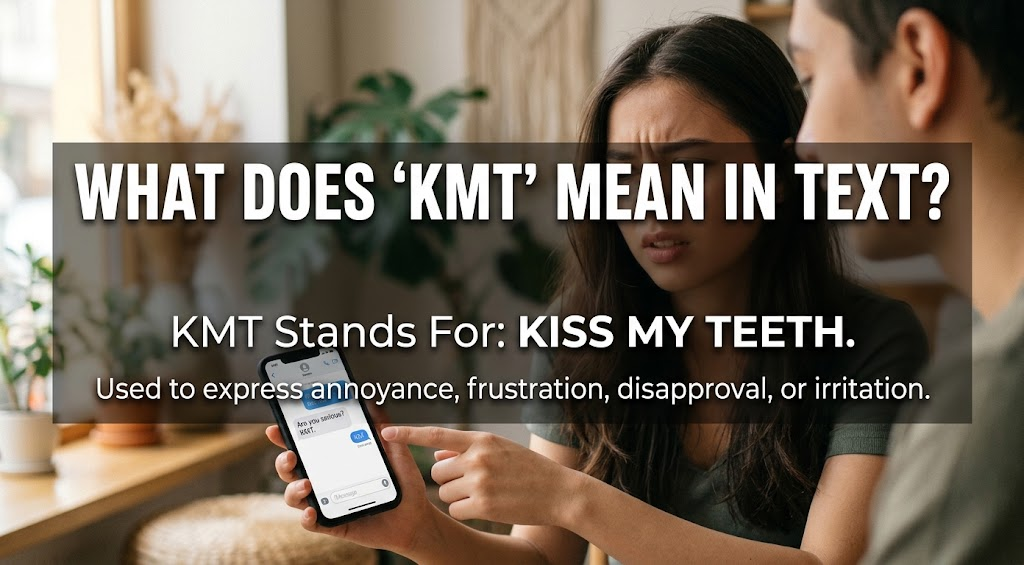
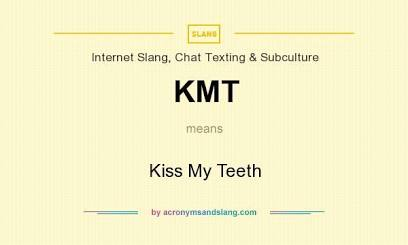
In texting and internet slang, KMT usually means “Kiss My Teeth” or “kissing my teeth.” It is used to express a reaction such as annoyance, frustration, disbelief, disappointment, irritation, or disapproval.
For example:
Friend: “He canceled our plans again.”
You: “KMT 😒”
Here, KMT could mean something like “Seriously?”, “That’s annoying,” or “I’m not impressed.”
The exact feeling depends on the conversation, the relationship between the people, and even the emoji or punctuation used with KMT.
What Does KMT Mean in Text?
KMT means “Kiss My Teeth” in texting and internet slang.
It represents the reaction of sucking or “kissing” your teeth to show irritation, disapproval, frustration, or disbelief.
The term is documented as an internet and text-messaging initialism, particularly in Caribbean, Multicultural London English (MLE), and related usage.
So when somebody types:
“KMT, you forgot again.”
They are not literally talking about kissing their teeth.
They are expressing an attitude similar to:
- “Seriously?”
- “Come on.”
- “That’s annoying.”
- “I can’t believe this.”
- “I’m not impressed.”
- “Ugh.”
In other words, KMT works like a written version of a nonverbal reaction.
What Does KMT Stand For?
In casual texting, KMT stands for “Kiss My Teeth.”
You may see it written in several ways:
- KMT
- kmt
- Kiss My Teeth
- kissing my teeth
Capitalization usually does not change the slang meaning.
For example:
“KMT, why is the Wi-Fi down again?”
and:
“kmt 😭”
can both communicate irritation or frustration.
KMT Meaning at a Glance
| Term | Meaning | Typical feeling |
| KMT | Kiss My Teeth | Annoyance, frustration, disapproval |
| SMH | Shaking My Head | Disbelief, disappointment |
| TSK | Written teeth-clicking sound | Disapproval, irritation |
| UGH | Frustrated reaction | Irritation, disgust, frustration |
The supplied SERP analysis similarly identifies KMT, SMH, TSK, and UGH as useful comparison terms, while noting that competitors often fail to explain the distinction clearly.
What Does “Kiss My Teeth” Mean?
“Kiss my teeth” describes a recognizable sound or gesture made by sucking air through the teeth.
The reaction can communicate irritation, impatience, disbelief, or disapproval without requiring spoken words.
A 2013 Guardian explanation describes “kissing your teeth” as a nonverbal reaction associated with frustration and explains that the intensity can vary—from mild irritation to stronger frustration or disdain.
That helps explain why KMT works so naturally in text.
Instead of physically making the sound, a person types KMT to represent the reaction.
It is similar in function to typing:
“Ugh.”
or:
“Tsk.”
or:
“Seriously?”
But KMT carries its own cultural and linguistic history, so it should not simply be treated as a generic synonym for every expression of annoyance.
Why Do People Use KMT in Text Messages?
The main reason is simple: KMT communicates an attitude quickly.
Instead of writing:
“I’m really annoyed that you did that again.”
Someone can write:
“KMT.”
That short response can communicate the emotional reaction immediately.
People may use KMT when:
- Someone repeats the same mistake
- Plans are canceled
- Something goes wrong
- They hear something ridiculous
- They disagree with someone
- Someone disappoints them
- A situation becomes frustrating
- They want to tease a friend
- They are mildly shocked or disapproving
This makes KMT function almost like emotional punctuation.
KMT Meaning Depending on Context
The exact meaning of KMT is not always identical. Its emotional shade changes with context.
1. KMT = Annoyance
This is one of the most straightforward Uses.
“You left the door unlocked again. KMT.”
Here, the sender is irritated.
The intended meaning could be:
“Come on, you did it again.”
2. KMT = Frustration
KMT can also describe frustration with a situation rather than anger toward another person.
“my phone died before I saved the file.”
The sender is expressing frustration about what happened.
3. KMT = Disbelief
Sometimes KMT communicates that something sounds ridiculous or difficult to believe.
“He forgot his own birthday? KMT.”
In this context, it is similar to:
“You’ve got to be kidding me.”
4. KMT = Disappointment
KMT can express dissatisfaction when something does not go as expected.
“They canceled the event at the last minute. KMT.”
Here, the reaction is closer to:
“That’s so disappointing.”
5. KMT = Disapproval
A person may also use KMT to show that they do not approve of someone’s behavior.
“You really said that to her? KMT.”
This communicates disapproval rather than simple annoyance.
6. KMT = Playful Teasing
Not every KMT is serious.
Close friends may use it dramatically to joke about a minor inconvenience.
Friend: “I watched movies instead of studying.”
You: “KMT 😂”
The emoji changes the tone considerably. The sender may be teasing rather than genuinely angry.
Context is therefore essential.
Is KMT Rude?
KMT can sound rude or dismissive, but it is not automatically rude.
Its tone depends heavily on the relationship and situation.
For example:
“You forgot your password again? KMT 😂”
could be playful between friends.
But:
“KMT. I’m done explaining this.”
sounds much more dismissive and irritated.
Punctuation can matter too.
Compare:
- KMT 😂 → potentially playful
- KMT 😭 → potentially dramatic or humorous
- KMT 😒 → clearly irritated
- KMT. → potentially blunt or dismissive
If you are speaking with someone you do not know well, a clearer statement such as “I’m frustrated” or “I disagree” is less likely to be misunderstood.
Is KMT Positive or Negative?
KMT generally has a negative emotional tone.
It is associated with:
- annoyance
- irritation
- frustration
- disappointment
- disbelief
- disapproval
However, a negative emotional tone does not necessarily mean serious hostility.
Friends may use KMT jokingly.
For example:
“KMT, You Ate The Last Slice 😂”
could simply mean:
“Come on, you ate my pizza!”
But:
“KMT. Don’t message me again.”
has a much more serious tone.
The surrounding conversation tells you how strongly the expression should be interpreted.
KMT Meaning on Social Media
KMT can appear in informal digital communication, including text messages, comments, DMs, and group chats.
Its basic meaning does not fundamentally change just because it appears on a different platform.
KMT on WhatsApp
On WhatsApp, KMT can appear in:
- private conversations
- group chats
- replies
- jokes
- arguments
- reactions to frustrating situations
Example:
“He said he’d arrive at 7 and it’s 9 now. KMT.”
The sender is expressing irritation or disbelief.
KMT on TikTok
It can appear in TikTok comments or replies when someone reacts to something annoying, ridiculous, disappointing, or ironic.
“KMT, why did he do that? 😭”
The video and surrounding comments help determine whether the reaction is serious or humorous.
KMT on Instagram
On Instagram, KMT may appear in:
- comments
- DMs
- story replies
- group conversations
Example:
“You posted that old picture of me? KMT 😂”
Between friends, this may be playful rather than genuinely angry.
KMT on Snapchat
On Snapchat, KMT can be used as a quick response to a message, photo, story, or situation.
“KMT you really wore that? 😂”
Again, the relationship between the people matters.
KMT in Group Chats
Group chats are another natural environment for short reactions.
For example:
Person 1: “The teacher moved the exam to Monday.”
Person 2: “KMT 😭”
The abbreviation communicates immediate disappointment without requiring a long explanation.
Does KMT Mean Something Different From a Guy or Girl?
No. KMT does not have a Separate standard meaning based on the sender’s gender.
If a guy sends KMT, the basic meaning is generally the same as when a girl sends it:
annoyance, frustration, disbelief, disappointment, disapproval, or playful irritation.
What changes is the context, not the dictionary meaning.
For example:
“KMT 😂”
from a close friend could be playful.
Meanwhile:
“KMT.”
during an argument could be dismissive.
It is therefore better to examine the conversation instead of assuming there is a hidden “guy meaning” or “girl meaning.”
How to Respond When Someone Says KMT
Your response should depend on what caused the reaction.
If They Seem Annoyed
You can ask:
“What happened?”
or:
“Why are you annoyed?”
If You Made a Mistake
A simple acknowledgment may work:
“My bad 😂.”
or:
“Sorry, I didn’t mean to annoy you.”
If They Are Clearly Joking
You can respond playfully:
“😂 What did I do now?”
If You Are Unsure
Ask for clarification:
“KMT? What do you mean?”
This is especially useful when you are unfamiliar with the sender’s slang.
KMT Examples in Text Conversations
Example 1: Canceled Plans
A: “She canceled our plans again.”
B: “KMT 😒”
Meaning: “That’s really annoying.”
Example 2: Internet Problems
A: “The Wi-Fi stopped working during the meeting.”
B: “KMT.”
Meaning: “Seriously? That’s frustrating.”
Example 3: Playful Teasing
A: “I forgot my keys again.”
B: “KMT 😂”
Meaning: “Come on, you did it again!”
Example 4: Disbelief
A: “He said he didn’t know about the deadline.”
B: “KMT 😭”
Meaning: “I Can’t Believe That.”
Example 5: Disapproval
A: “He laughed while she was explaining the problem.”
B: “KMT, that’s messed up.”
Meaning: “I strongly disapprove of that.”
Example 6: Mild Frustration
A: “The bus is late again.”
B: “KMT.”
Meaning: “I’m so tired of this.”
KMT vs. SMH
KMT and SMH overlap, but they are not identical.
SMH means “shaking my head.” It commonly communicates disappointment, disbelief, or disapproval.
KMT means “Kiss My Teeth” and represents the teeth-sucking reaction associated with irritation or disapproval.
Compare:
“You forgot your homework again. SMH.”
This emphasizes disappointment or disbelief.
“You forgot your homework again. KMT.”
This can feel more like an irritated reaction.
The distinction is subtle, and actual usage varies by speaker and context. The supplied competitor research specifically identifies this distinction as an opportunity because many competing pages treat the terms too generically.
KMT vs. TSK
TSK represents a clicking or disapproving sound.
KMT specifically represents the “kissing” or sucking-teeth reaction.
Both can communicate irritation or disapproval, but they are not exactly the same linguistic expression.
For example:
“You did what? Tsk.”
versus:
“You did what? KMT.”
Both can signal disapproval, but KMT carries the specific meaning associated with kissing or sucking the teeth.
KMT vs. UGH
UGH is a broad expression of frustration, disgust, boredom, or irritation.
KMT can express similar feelings but has a more culturally specific slang background.
Compare:
“Ugh, this traffic.”
with:
“KMT, this traffic.”
Both communicate frustration, but the second represents the KMT reaction.
Where Did KMT Come From?
The physical expression behind KMT is older than internet texting.
“Kissing the teeth” describes a nonverbal sound produced by drawing air through the teeth. It has been documented in Caribbean contexts and in British multicultural speech.
A Queen Mary University of London teaching resource describes the “kissing teeth” sound as a form of sound symbolism widely used in the Caribbean and notes its use among young speakers of Multicultural London English. A Guardian feature from 2013 also documented KMT—“kissing my teeth” as a text-speak representation of this reaction and described different levels of intensity associated with the physical gesture. So it is more accurate to understand modern KMT as the written representation of an existing spoken/nonverbal expression, rather than something invented by TikTok or modern social media.
KMT in UK Slang
KMT is strongly associated with UK slang and Multicultural London English, particularly through Caribbean-influenced language practices.
The expression can communicate annoyance or disbelief in a British texting context.
For example:
“KMT, you’re joking.”
could mean:
“Seriously?”
or:
“I can’t believe this.”
The strength of the reaction depends on the context.
The current dictionary-style documentation also specifically associates KMT with Caribbean, MLE, and MTE usage.
People Also Ask
KMT usually means “Kiss My Teeth.” It is an informal expression used to communicate annoyance, frustration, disbelief, disappointment, irritation, or disapproval.
In texting slang, KMT stands for “Kiss My Teeth” or represents “kissing my teeth.”
No, KMT is not inherently a swear word. However, it can sound rude, dismissive, or disrespectful depending on the context.
KMT is generally negative in emotional tone because it expresses dissatisfaction or irritation. Among friends, however, it can be used playfully.
The basic meaning does not change. A girl using KMT may be expressing annoyance, frustration, disbelief, disappointment, disapproval, or playful irritation.
Conclusion
KMT in text usually means “Kiss My Teeth.”
It is an informal slang expression representing the reaction of kissing or sucking the teeth, commonly used to show annoyance, frustration, disbelief, disappointment, irritation, or disapproval.
You may see KMT in text messages, WhatsApp chats, TikTok comments, Instagram DMs, Snapchat conversations, group chats, and other informal online spaces.
The most important point is that KMT is context-dependent.
“KMT 😂” between friends may be playful.
while:
“KMT.”
during an argument may sound dismissive or irritated.
So when you see KMT, do not interpret the three letters in isolation. Look at the conversation, relationship, punctuation, emojis, and situation around them.
That context usually reveals exactly how strongly the sender intended the reaction.
In short: KMT = “Kiss My Teeth” → an informal way of expressing irritation, disbelief, frustration, or disapproval.