Introduction
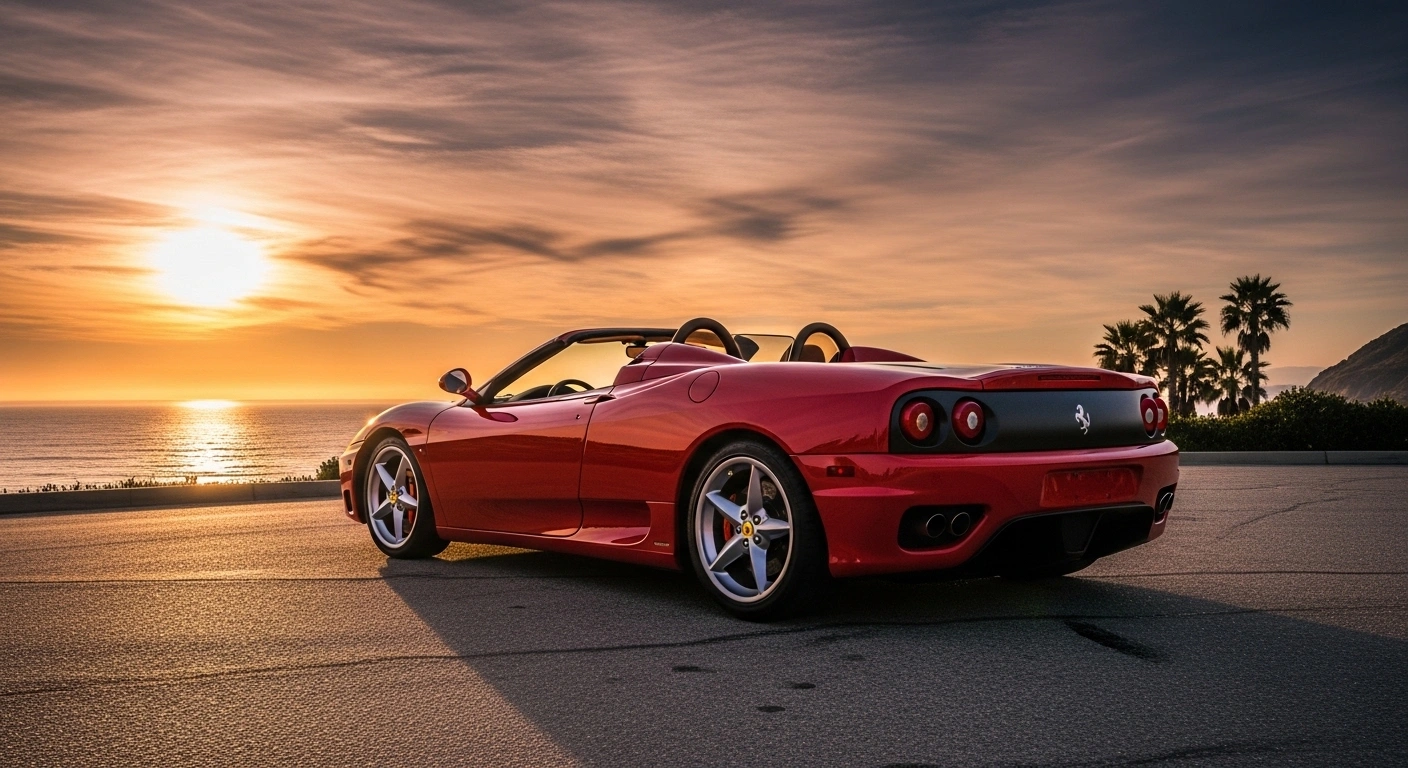
The Ferrari 360 Spider remains one of the most rewarding open-top Ferraris you can buy in 2026—an exotic convertible that delivers old-school emotion without the seven-figure price tag attached to newer collector favorites. Introduced in 2000 as the drop-top counterpart to the 360 Modena, it combined elegant Pininfarina styling, a screaming naturally aspirated V8, and one of the most immersive analog driving experiences of the modern Ferrari era.
More than two decades later, the 360 Spider still stands out for the reasons enthusiasts care about most: sharp steering, lightweight aluminum construction, a thrilling 8,500-rpm redline, and the unmistakable sound of a naturally aspirated Ferrari V8 with the roof down. It may be more affordable than many newer Ferraris, but it doesn’t feel watered down behind the wheel. In fact, for many buyers, that lack of digital filtering is exactly the point.
The 360 was also a major turning point for Ferrari. It replaced the F355 with a completely new aluminum spaceframe chassis, improved rigidity, lower weight, and more modern engineering. That shift helped move Ferrari into a new era—one where performance, usability, and structural sophistication improved dramatically without sacrificing character. For the Spider, that mattered even more, because Ferrari managed to preserve impressive chassis stiffness in a convertible format.
Today, the Ferrari 360 Spider is no longer just an “entry Ferrari.” Clean, well-maintained examples are increasingly viewed as modern classics, especially manual-transmission cars with strong service history. Whether you’re considering one as a weekend toy, a first Ferrari, or a long-term collectible, the 360 Spider deserves a serious look.
Ferrari 360 Spider
These days, the Ferrari 360 Spider pulls glances once more, luring those chasing a raw thrill, roof down, breeze cutting through. Sure, it turns heads – yet what stays with you is the way it answers every twist of the wheel. Time moves on, good examples become rare, value climbs even if nobody shouts about it. Right now, it stands clear from the pack back then, mixing ease on ordinary roads with a spark most cars lack.
Peeling back the layers reveals exactly what shapes the Ferrari 360 Spider – who it is, how it moves, why it looks that way, because of choices made around the engine. Once seated, motion speaks before words do. Function rules inside, though small touches whisper personality without shouting. After many weeks on the road, drivers start noticing little habits it picks up. Worth changes oddly, tied less to years passed and more to how carefully it’s been kept. Some models stand out simply because they’re made in small batches or pack rare features. Day-to-day users spot trends that numbers tend to miss
Full specifications
- Performance and driving dynamics
- Interior design and cabin comfort
- Reliability and common issues
- Ownership and maintenance costs
- Market value and price trends
- Detailed buying guide tips
- Comparison with key rivals
Keys in your palm, picture yourself pausing, unsure if the Ferrari 360 Spider holds up years ahead. A quick peek beneath its shine might just tilt your view without warning. Time has a way of reshaping it overnight. How things look now isn’t always how they stay.
Quick Overview
Before diving deeper into the complete review, here is a quick snapshot of the Ferrari 360 Spider specifications.
| Specification | Details |
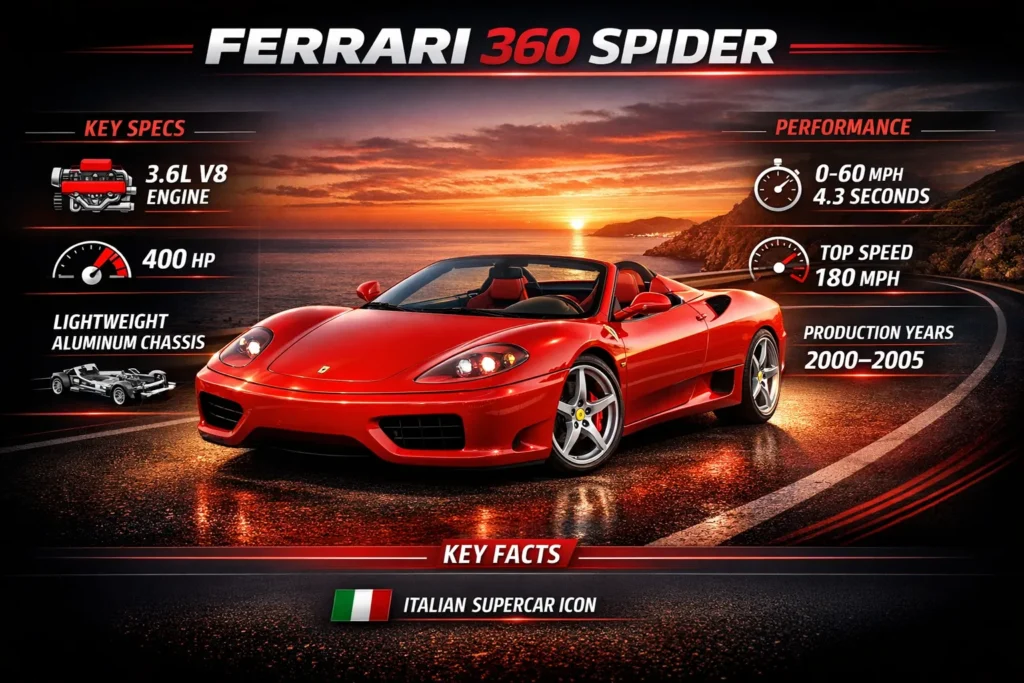
| Engine | 3.6L Naturally Aspirated V8 |
| Horsepower | 400 hp |
| Torque | 275 lb-ft |
| Transmission | 6-Speed Manual / F1 Automated |
| Drivetrain | Rear Wheel Drive |
| 0–60 mph | ~4.5 seconds |
| Top Speed | ~180 mph |
| Fuel Type | Petrol |
| Body Style | Convertible Supercar |
| Seating | 2 |
| Production Years | 2000 – 2005 |
This exceptional blend of high-revving performance and classic analog driving feedback is exactly why the Ferrari 360 Spider continues to be highly respected by car enthusiasts around the world.
History of the Ferrari 360 Spider
Ferrari’s Transition into the Modern Era
Ferrari unveiled the 360 Spider in 2000, right when change was sweeping through Maranello. Though rooted in tradition, those years pushed the brand toward smarter engineering and sharper performance. Instead of sticking to old formulas, they embraced new ideas under the skin. By then, the 1990s’ analog charm had begun giving way to digital precision across their lineup.
Fresh off the track, the Ferrari 360 series stepped in where the F355 left off – popular, yes, but needing updates in looks and mechanics. Though strong on reputation, the older model began showing its age in design details and under-the-hood tech. So Ferrari shifted gears, introducing a newer face and smarter engineering beneath. Style met substance this time, with smoother curves and improved performance parts working together. Instead of just tweaking the past, they rebuilt key elements from the ground up. Even small touches got rethought, helping it feel more current without losing that classic pulse.
Ferrari designers aimed at three core goals:
- Reduce overall vehicle weight
- Improve structural rigidity and chassis stiffness
- Increase performance capabilities
Ferrari teamed up with Alcoa – known for its work in aluminum – to build a lightweight frame made entirely of metal. This new structure changed how the car was put together. A fresh approach came from combining expertise across companies. The result took shape through shared knowledge and advanced materials.
Surprisingly light, the frame shed pounds fast – yet stiffness jumped beyond older Ferraris in tough tests. Still, strength rose without adding bulk across sharp turns.
What stood out most? The 360 Spider roadster held its shape almost like the fixed-roof version – a tough feat for any drop-top sports car. Despite missing a roof, it didn’t wobble or twist much more than the coupe did. Few convertibles manage that balance so well.
Production Numbers
Ferrari manufactured the 360 Spider between 2000 and 2005.
Here are the approximate production numbers across the 360 lineup:
| Model | Units Produced |
| Ferrari 360 Modena | ~8,800 |
| Ferrari 360 Spider | ~7,565 |
| Ferrari 360 Challenge Stradale | ~1,288 |
These figures demonstrate that while the Ferrari 360 Spider is not extremely rare, it remains a relatively exclusive exotic sports car compared with the significantly higher production volumes of modern Ferrari vehicles.
Exterior Design
Few cars turned heads like the 360 Spider did when it slipped onto roads in the early two thousands. Its curves felt natural, almost effortless, unlike designs trying too hard. Beauty here wasn’t added on – it grew from how every piece fit. Some called it timeless before the decade even ended. Shape met purpose without shouting about it.
Styled by the famed Italian studio Pininfarina, the car carries a legacy tied to many of Ferrari’s standout shapes over time.
Curves move like water, yet cut wind sharply – this shape lives between old-school balance and modern speed. Mid-engine stance gives it a low whisper of power, while every edge leans into motion even when standing still.
Body Design
The Ferrari 360 Spider wasn’t just a coupe stripped down – it grew out of plans drawn for open-top driving right from day one. While others adapt later, this one started whole.
Ferrari’s team kept things stiff where needed, yet skipped heavy bracing that would pile on pounds. Rigidity stayed strong through smart design, not bulk. Extra parts weren’t necessary because the structure worked smarter than sheer mass. Weight crept up only as much as absolutely required – no more.
Key exterior characteristics include:
- Smooth aerodynamic contours
- Large sculpted side air intakes
- Wide rear stance for stability
- Transparent engine cover design
- Elegant soft-top convertible roof
Ferrari’s choices here keep the 360 Spider looking sharp – still holding up next to today’s fast machines. Though years have passed, its shape refuses to fade into the background. Lines flow without shouting. Even beside newer models, it stands without apology. Time hasn’t dulled its presence. Details speak quietly but stay memorable.
Headlights
The Ferrari 360 introduced a new design direction for Ferrari lighting.
Previous models, such as the Ferrari F355, featured pop-up headlights, but the 360 adopted fixed clear-lens headlights.
This design gave the car a more contemporary appearance and influenced the styling of many future Ferrari models.
Wheels
The Ferrari 360 Spider typically came equipped with 18-inch alloy wheels.
The most recognizable wheel design is the five-spoke star pattern, which has become iconic among Ferrari enthusiasts.
Many owners choose to upgrade their wheels to:
- 19-inch performance wheels
- Forged aftermarket rims
- Challenge Stradale-style wheels
Convertible Roof
One of the defining features of the Ferrari 360 Spider is its fully automatic soft-top roof.
Key roof characteristics include:
- Opens in approximately 20 seconds
- Fully electronic operation
- Compact folding mechanism behind seats
With the roof lowered, drivers can fully enjoy the soundtrack of the naturally aspirated Ferrari V8 engine.
Interior & Comfort
The heart of the Ferrari 360 Spider beats where the driver sits. Instead of loading it with gadgets, Ferrari shaped the cabin around driving Itself, using simplicity as its guide.
Even after twenty years, the inside holds a character that stands out. Though aged, its design carries a quiet uniqueness.
Dashboard Layout
A calm design puts the driver at the center. Not crowded, it focuses on what matters most first.
Important elements include:
- Large analog tachometer positioned centrally
- Clear speedometer and instrument gauges
- Straightforward control layout
With fewer interruptions by design, Ferrari let drivers stay locked into the feel of driving. What mattered most was how clean the attention stayed – focused, sharp, nothing extra cluttering the moment.
Interior Materials
Fine materials found their way into every corner of the interior by Ferrari.
Common interior materials include:
- High-quality Italian leather upholstery
- Brushed aluminum trim accents
- Carbon fiber trim available inside, if wanted
- Hand-stitched craftsmanship
Fresh air moves through the space like an old promise kept. Smooth surfaces catch light in ways that do not shout but whisper. Texture here does not demand attention yet holds it anyway. Comfort arrives without announcement, settling into corners where people sit. Even now, years later, the feel stays rich – not loud, just sure.
Seating
Comfort meets firm side support in these sporty bucket seats.
Seat advantages include:
- Excellent support during cornering
- Low and sporty seating position
- Adjustable driving ergonomics
Firmly planted behind the wheel, the driver senses a strong bond with the car when pushing it hard.
Cabin Storage
Few places to stash things inside, just like you’d figure for a sports car built with engine behind the seats.
Yet there’s a storage compartment up front on the Ferrari 360 Spider.
It can accommodate:
- Small travel bags
- Weekend luggage
- Camera equipment or backpacks
When driving a short distance, there’s enough room to store what you need.
Ferrari 360 Spider Engine & Performance
The heart of the Ferrari 360 Spider is its remarkable naturally aspirated V8 powerplant.
Many enthusiasts consider this engine to represent the golden era of Ferrari V8 engines.
Engine Specifications
| Engine Specification | Details |
| Engine Type | 3.6L V8 |
| Displacement | 3586 cc |
| Horsepower | 400 hp |
| Torque | 275 lb-ft |
| Redline | 8,500 rpm |
| Layout | Mid-Engine |
This engine is celebrated for its high-revving personality, smooth power delivery, and unforgettable exhaust note.
Acceleration & Top Speed
The Ferrari 360 Spider still delivers impressive performance today.
| Performance Metric | Result |
| 0–60 mph | ~4.5 seconds |
| 0–100 mph | ~10 seconds |
| Top Speed | ~180 mph |
These figures demonstrate that the car remains extremely fast even compared with many modern performance vehicles.
Driving Experience
Driving the Ferrari 360 Spider feels raw, unfiltered. Its engine roars without digital masks in between. You steer it like older machines did – direct, honest. Power flows through your hands, not computers. Open roof, open road – it answers only to you.
Drivers frequently praise the car for:
- Immediate throttle response
- Linear powerband delivery
- Perfect mid-engine balance
- Incredible V8 engine sound
- Lightweight and agile handling
That modern turbocharged engine might push out extra twist at the wheels – yet somehow misses what the old-school Ferrari V8 breathes in its stride: soul without forced help.
The open air rushes in once the roof drops down. Immersion deepens behind the wheel when sky replaces steel overhead. Driving feels closer to the elements, suddenly.
Ferrari 360 Spider Fuel Economy
Supercars are not built primarily for fuel efficiency, but the Ferrari 360 Spider still offers reasonable consumption for its class.
| Driving Condition | Fuel Economy |
| City | 10–12 mpg |
| Highway | 15–17 mpg |
| Combined | 13–15 mpg |
These figures are typical for early-2000s naturally aspirated high-performance sports cars.
Ferrari 360 Spider Safety Features
Back then, safety tech hadn’t gone far yet, though the Ferrari 360 Spider came with key protections anyway.
Standard safety equipment includes:
- Dual front airbags
- Anti-lock braking system (ABS)
- Traction control system
- Stability control assistance
- High-performance ventilated brakes
Crash safety gets a boost when the frame’s rigidity goes up – thanks to its aluminum spaceframe construction.
Technology & Infotainment
The Ferrari 360 Spider uses technology that feels basic when compared to newer Ferraris.
Still, many fans prefer the hands-on feel of analog controls.
Among the standout aspects are these tech elements:
- Classic analog instrument cluster
- Optional factory navigation system
- Climate control system
- Premium sound system
- Steering-wheel-mounted controls on later models
Folks these days swap out factory radios for newer models that link up with phones via Bluetooth. Some choose gadgets letting apps run straight through the dashboard display. Others want wireless music streaming without plugging in a cable. Modern replacements often support voice controls alongside touch interfaces. Installation usually fits existing dash spaces without major tweaks.
Ferrari 360 Spider Variants
The Ferrari 360 family included several versions.
| Model | Description |
| Ferrari 360 Modena | Coupe version |
| Ferrari 360 Spider | Convertible version |
| Ferrari 360 Challenge Stradale | Track-focused lightweight version |
The Challenge Stradale is the rarest and most valuable variant in the lineup.
Ferrari 360 Spider Price & Market Value
The Ferrari 360 Spider price varies significantly depending on condition and specifications.
Typical market prices today:
| Condition | Price Range |
| High mileage | $70,000 – $90,000 |
| Good condition | $90,000 – $120,000 |
| Low mileage/collector | $120,000 – $160,000 |
Important price factors include:
- Mileage
- Service records
- Transmission type
- Original factory condition
- Exterior and interior color combinations
Manual transmission models typically command higher resale values than F1 automated versions.
Ferrari 360 Spider Reliability
Many buyers ask about Ferrari 360 Spider reliability.
Compared with earlier Ferrari models, the 360 is considered reasonably dependable when properly maintained.
However, it remains a complex high-performance exotic car.
Common issues include:
- F1 gearbox clutch wear
- Sticky interior buttons
- Exhaust manifold cracks
- Suspension bushing wear
Most issues are manageable with regular servicing.
2026 Market Trend: What Buyers Should Watch
New value-added section under price/market value covering condition vs mileage, manual premium, and collector behavior.
Ferrari 360 Spider Maintenance Cost
Owning a Ferrari requires a substantial maintenance budget.
Typical maintenance costs include:
| Service | Estimated Cost |
| Annual service | $1,000 – $2,000 |
| Timing belt replacement | $4,000 – $7,000 |
| Clutch replacement | $3,000 – $5,000 |
| Brake replacement | $2,000+ |
The timing belt service every five years is one of the most critical maintenance requirements.
Expanded Buying Guide with “Check the Convertible Top Operation
Added Spider-specific inspection advice that adds genuine user value.
Ferrari 360 Spider Buying Guide
If you are planning to buy a Ferrari 360 Spider, consider these important tips.
Check Service History
A complete service record is extremely important.
Look for documentation showing:
- Timing belt replacements
- Clutch replacements
- Routine maintenance
Inspect the Transmission
The Ferrari 360 Spider was available with:
- 6-speed manual transmission
- F1 automated manual transmission
Manual versions are often more reliable and more valuable in the collector market.
Look for Accident Damage
Because these cars are high-performance vehicles, some may have been driven aggressively.
Inspect carefully for:
- Chassis alignment issues
- Paint inconsistencies
- Uneven panel gaps
Get a Professional Inspection
A pre-purchase inspection by a Ferrari specialist is strongly recommended.
This can potentially save thousands of Dollars in unexpected repairs.
Ferrari 360 Spider Pros & Cons
Pros
- Iconic Ferrari styling
- Incredible naturally aspirated V8 sound
- Engaging analog driving experience
- Increasing collector interest
- One of the most affordable Ferraris
Cons
- High maintenance costs
- Limited cargo capacity
- Outdated infotainment technology
- F1 gearbox clutch wear
Ferrari 360 Spider vs Competitors
Buyers often compare the Ferrari 360 Spider with other convertible supercars.
| Car | Engine | Power | 0–60 mph |
| Ferrari F430 Spider | 4.3L V8 | 483 hp | 3.9 sec |
| Lamborghini Gallardo Spyder | 5.0L V10 | 493 hp | 4.1 sec |
| Porsche 911 Turbo Cabriolet | 3.6L Turbo | 420 hp | 3.7 sec |
Each competitor delivers a unique performance character and driving experience.
Is the Ferrari 360 Spider a Good Investment?
The Ferrari 360 Spider is increasingly considered a modern collectible supercar.
Reasons collectors appreciate it include:
- Naturally aspirated Ferrari V8
- Analog driving dynamics
- Classic Ferrari styling
- Limited production volume
- Growing collector demand
Market prices have gradually increased in recent years.
FAQs
A: The Ferrari 360 Spider can accelerate from 0-60 mph in about 4.5 seconds and reach a top speed of around 180 mph.
A: Yes, the Ferrari 360 Spider is considered relatively reliable for a Ferrari, especially when properly maintained.
A: Ferrari produced approximately 7,565 units worldwide between 2000 and 2005.
A: Many collectors believe the Ferrari 360 Spider has strong investment potential due to its naturally aspirated engine and increasing collector interest.
Conclusion
The Ferrari 360 Spider remains one of the most compelling open-top Ferraris you can buy in 2026. It blends Timeless Pininfarina styling, a high-revving naturally aspirated V8, and genuinely engaging analog dynamics in a way that feels increasingly rare in today’s performance car market.
Yes, it lacks modern infotainment and ownership is not inexpensive—but that is also part of its charm. The 360 Spider delivers a direct, mechanical, emotionally rich driving experience that many newer supercars, despite their greater speed, simply cannot replicate. For enthusiasts who value sound, feel, and character over pure numbers, it still hits a sweet spot.
If you want a Ferrari that feels special every time the roof drops and the V8 climbs toward redline, the 360 Spider remains a standout choice. Buy carefully, prioritize service history over headline mileage, and you could end up with one of the most satisfying modern-classic Ferraris to own, drive, and enjoy for years to come.