Introduction
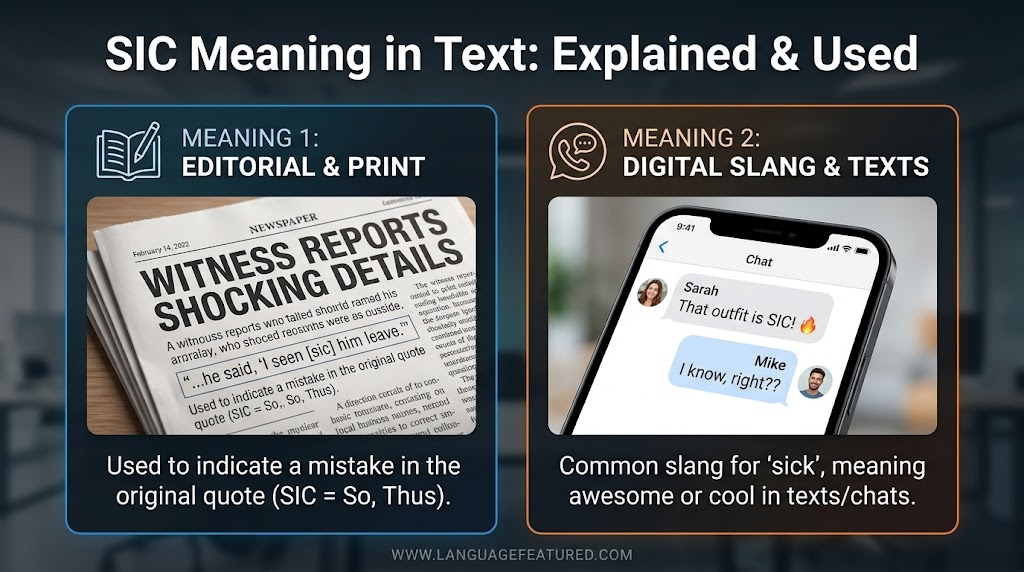
Have you ever Read A Text, comment, article, or screenshot and noticed [sic] sitting next to a strange spelling or awkward phrase?
If so, you may have wondered whether sic is texting slang, an abbreviation, or a way of saying “sick.”
In most cases, [sic] has a completely different purpose.
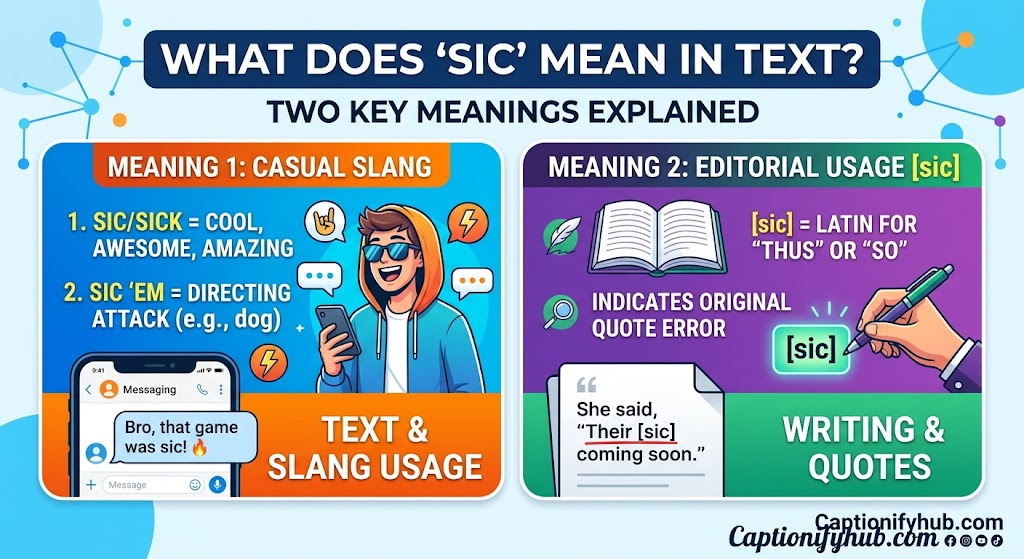
[Sic] is an editorial notation that tells readers an unusual word, spelling, or grammatical error appeared in the original quoted material. In other words, the person quoting the text is saying, “I have reproduced the wording as it appeared in the original.”
For example:
“I recieved [sic] your message yesterday.”
The spelling “recieved” is incorrect, but the person quoting the message has intentionally left it unchanged. The [sic] tells readers that the spelling mistake came from the original source, not from the person quoting it.
There is also a separate informal use of sic as a stylized spelling of “sick,” particularly when something is described as cool, impressive, or exciting.
So, context matters.
This guide explains the SIC meaning in text, what [sic] means in messages and social media, whether it is slang or rude, how to use it correctly, and how to distinguish it from “sick,” a typo, a correction, and a paraphrase.
SIC Meaning in Text: Quick Answer
[Sic] means that an apparent error or unusual wording has been intentionally preserved because it appeared that way in the original quoted material.
A simple way to remember it is:
[sic] = “This is how it appeared in the original.”
For example:
“She definately [sic] sent the email.”
The word “definately” is misspelled. Adding [sic] tells the reader that the person quoting the sentence did not make that spelling mistake themselves.
Quick Meaning Table
| What you see | Most likely meaning |
| “recieved [sic]” | The original source contained the spelling “recieved.” |
| “Your [sic] going to love it.” | The quoted source used “Your” in that position. |
| [sic] after a questionable word | The wording has been preserved from the original. |
| “That car is sic!” | Potentially slang for “sick,” meaning cool or impressive. |
| SIC code | A different meaning: Standard Industrial Classification. |
The brackets are an especially useful clue. When you see [sic] immediately after an apparent error in quoted material, the editorial meaning is usually intended.
What Does [Sic] Mean?
[Sic] is an editorial notation used to identify an apparent error in quoted material.
It can appear after:
- A spelling mistake
- A grammatical error
- An incorrectly used word
- An unusual expression that may look like a transcription mistake
- Other wording that the writer needs to preserve exactly
For example:
“The company recieved [sic] three complaints.”
The writer has not silently changed “recieved” to “received.”
Instead, the original wording remains visible, while [sic] signals that the unusual spelling came from the source being quoted.
That distinction is important because readers might otherwise assume the person creating the quotation made the mistake.
What Does “Sic” Literally Mean?
Sic is a Latin word generally translated as “thus,” “so,” or “in this manner.”
It is not normally an English acronym.
You may occasionally see humorous explanations online claiming that SIC stands for phrases made from the letters S-I-C. Those explanations are not the traditional origin of the editorial term.
In modern English writing, [sic] functions as an editorial signal.
You can mentally interpret it as:
- “This is how the source wrote it.”
- “The wording has been preserved.”
- “I did not introduce this apparent error.”
- “The original contained this wording.”
The exact interpretation depends on the surrounding context, but its editorial function is tied to quoted material.
Why Do People Use [Sic]?
The main reason is accuracy when reproducing someone else’s words.
Imagine that a journalist is quoting a public statement containing a spelling mistake.
The original says:
“The results were unpresidented.”
If the journalist silently changes the word to “unprecedented,” the quotation is no longer an exact reproduction of the original wording.
Using [sic] can make the distinction visible:
The statement described the results as “unpresidented [sic].”
The reader can now see that the unusual spelling belongs to the original statement.
This can matter in:
- Journalism
- Academic research
- Historical documents
- Professional documentation
- Legal or scholarly contexts
- Discussions of screenshots
- Reproductions of online comments
- Analysis of someone’s exact wording
However, [sic] is not a requirement every time you encounter a typo. Good editorial judgment matters.
What Does [Sic] Mean in Text Messages?
When [sic] appears while someone is quoting a text message, it generally has the same editorial meaning.
For example:
Sarah texted, “I cant [sic] come tonight.”
Here, [sic] tells readers that “cant” appeared in Sarah’s original message.
Another example:
He texted, “Your [sic] going to love this movie.”
The person quoting the message is preserving the original wording rather than silently changing “Your” to “You’re.”
Is [Sic] Common in Ordinary Texting?
Not really.
Most people do not use [sic] every time a friend makes a typo. Everyday conversations are informal, and small spelling mistakes are normally understood without editorial notation.
You are more likely to encounter [sic] in a text-related context when someone is:
- Quoting another person’s message
- Reproducing a screenshot
- Discussing someone’s exact wording
- Documenting a conversation
- Making a joke about a noticeable mistake
- Writing an article about a message or post
So if you see [sic] in a text message discussion, examine the context before assuming it is ordinary texting slang.
What Does [Sic] Mean on Social Media?
On social media, [sic] generally keeps its editorial meaning when it follows quoted wording.
You might see it in discussions involving:
- Instagram posts
- TikTok comments
- Facebook posts
- Reddit discussions
- X posts
- Discord messages
- Online forums
- Screenshots of conversations
For example:
The comment said, “Your the best creator [sic].”
The [sic] indicates that the commenter originally used “Your” in that wording.
Can [Sic] Be Used Humorously Online?
Yes.
Online writers sometimes use [sic] while highlighting an obvious typo or awkward phrase for humorous effect.
For example:
He described himself as a “profeshunal [sic] photographer.”
The notation still draws attention to the original wording, but the surrounding sentence gives it a playful or sarcastic tone.
This is why meaning and tone should be separated.
The notation itself does not automatically mean “this person is stupid” or “this person is wrong.” The writer’s purpose and surrounding language determine how it comes across.
Is SIC Slang?
Usually, no.
The traditional [Sic] is an editorial notation, not a standard texting abbreviation like:
- LOL
- BRB
- IDK
- BTW
- TBH
- IMO
- SMH
Those expressions function primarily as internet or texting abbreviations.
[Sic] works differently.
It is connected to quoted wording and indicates something about the source text.
There is, however, another informal use of sic that causes confusion.
Does SIC Mean “Sick”?
Sometimes, but context is essential.
In informal slang, people may write sic as a stylized spelling of sick.
In that context, “sick” can mean:
- Cool
- Amazing
- Impressive
- Excellent
- Exciting
For example:
“That skateboard trick was sic!”
Here, the writer may simply be using sic as a playful spelling of “sick.”
Compare that with:
“The article described the trick as ‘impossible [sic].’”
The second example is an editorial notation.
Sic vs. Sick
| Form | Likely meaning | Example |
| [sic] | Original wording preserved | “I recieved [sic] it.” |
| sic | Informal spelling of “sick” | “That trick was sic!” |
| sick | Ill or, in slang, cool/impressive | “He is sick.” |
| sic someone on | Order or urge someone/animal to attack or pursue | “They sicced the dog on him.” |
So “sic” does not automatically mean “sick.”
The surrounding sentence tells you which meaning applies.
How Can You Tell Which Meaning of SIC Is Intended?
Use context.
1. Look for square brackets
If you see:
[sic]
especially after a strange word, it is probably the editorial notation.
2. Look at the word before it
If the preceding word appears misspelled or grammatically unusual, [sic] is likely signaling that the wording came from the original source.
3. Check whether someone is being quoted
For example:
She wrote, “I definately [sic] remember.”
The presence of a quotation makes the editorial interpretation especially clear.
4. Check whether “sic” describes something
For example:
“That motorcycle is sic!”
Here, it is much more likely to be informal slang based on “sick.”
5. Consider the punctuation
[sic] and a standalone sic do not necessarily serve the same function.
The bracketed form is strongly associated with editorial notation.
Is [Sic] Rude?
[Sic] is not inherently rude.
In academic, journalistic, historical, or professional writing, it can be a neutral editorial device.
For example:
The document described the agreement as “finaly [sic] approved.”
The writer is simply clarifying that the original document contained that spelling.
However, [sic] can sound sarcastic, mocking, or condescending when someone uses it unnecessarily to highlight another person’s harmless mistake.
For example:
“You dont [sic] even know how to spell.”
Here, the purpose appears less about accurate documentation and more about drawing attention to another person’s error.
The important distinction
Neutral use:
Preserve an original wording because the exact quotation matters.
Potentially mocking use:
Highlight someone’s trivial typo purely to make fun of them.
This is one reason professional style guidance recommends using [sic] selectively.
When Should You Use [Sic]?
A useful rule is:
Use [sic] when preserving an apparent error in quoted material serves a genuine editorial or explanatory purpose.
Common situations include the following.
Academic Writing
A researcher may need to reproduce a source exactly.
The author called the result “extraordenary [sic].”
The spelling remains unchanged because it belongs to the quoted source.
Journalism
A journalist may reproduce a statement exactly:
The spokesperson called the decision “unpresidented [sic].”
The notation helps distinguish the original spelling from the journalist’s own writing.
Historical Documents
Older sources can Contain Spelling and grammatical forms that differ from modern English.
If an apparent error needs to be identified for readers, [sic] may be appropriate.
But remember: old or unfamiliar language is not automatically an error.
Professional Documentation
If the exact wording of a message, statement, report, or document matters, [sic] can help clarify that an apparent mistake belongs to the original.
Screenshots and Online Posts
When reproducing someone’s online wording, [sic] can make it clear that the spelling or grammar was already present.
For example:
The post stated, “Their going too win [sic].”
The notation identifies the unusual wording as belonging to the quoted material.
When Should You NOT Use [Sic]?
This is where context matters most.
Do not treat [sic] as a general-purpose label for anything that looks unusual to you.
Don’t Use It Just for British vs. American Spelling
For example:
“The colour of the building was unusual.”
If you normally use American English, “colour” may look different, but it is not automatically an error.
MLA specifically advises against using [sic] simply because a quotation follows a different standard spelling system. (MLA Style Center)
Don’t Use It Just Because a Quote Contains Slang
Slang is not automatically an error.
MLA guidance specifically says [sic] should not be used merely to identify slang in a quotation. (MLA Style Center)
Don’t Use It for Unusual Styling Alone
A source might use unusual capitalization, typography, or formatting intentionally.
MLA guidance notes that [sic] is for an error, not simply unusual styling. (MLA Style Center)
Don’t Add It After Every Typo
If the mistake is irrelevant and readers will not confuse it with your own error, adding [sic] may simply make the sentence harder to read.
Don’t Use It to Mock Someone
If the only purpose is to embarrass someone over a harmless typo, the notation may create an unnecessarily hostile tone.
[Sic] in Academic Writing
Academic writing is one of the contexts where readers are most likely to encounter [sic].
Suppose a researcher is quoting an old source:
The author described the event as a “succesfull [sic] campaign.”
The researcher has intentionally preserved the original spelling.
However, academic style does not mean that every unusual expression should receive [sic].
A regional spelling, historical form, slang term, or stylistic choice may be perfectly intentional.
The question is not simply:
“Does this look strange to me?”
A better question is:
“Does identifying this apparent error help the reader understand the quotation or avoid attributing the error to me?”
That distinction produces cleaner academic writing.
[Sic] in Journalism
Journalists may encounter [sic] when quoting statements, social-media posts, documents, or public comments.
For example:
The statement called the project “nearly compleated [sic].”
The notation tells readers that the spelling appeared in the source.
However, journalists do not need to decorate every quotation with [sic].
If a mistake is irrelevant to the story, repeatedly highlighting it can distract from the actual information.
The editorial purpose should therefore remain clear.
[Sic] in Legal and Professional Writing
Exact language can be particularly important in professional documentation.
For example:
The client wrote that the payment was “already recieved [sic].”
The notation makes clear that the spelling belongs to the original statement.
The same principle applies here as elsewhere:
preserve the wording when necessary, but do not assume that every unfamiliar expression is an error.
For formal documents, the relevant organization’s style rules should take priority.
[Sic] vs. Typo
A typo is the mistake itself.
[Sic] is the notation used to signal that the mistake was already present in the original quotation.
For example:
“I recieved your email.”
Here:
recieved = the typo
Now consider:
“I recieved [sic] your email.”
Here:
recieved = the typo
[sic] = the editorial signal that the typo was in the original
This distinction is easy to remember:
The typo is the mistake.
[Sic] vs. Correction
[Sic] and a correction work in opposite directions.
Suppose the original says:
If you preserve the original wording:
“The results was [sic] unexpected.”
The quotation remains unchanged.
If you correct it, you are no longer presenting those words exactly as they originally appeared. Depending on the style and context, a correction may be indicated using editorial brackets or explained separately.
The key point is:
[Sic] does not correct the mistake.
It signals that the original mistake has been retained.
[Sic] vs. Paraphrasing
A quotation reproduces someone’s words.
A paraphrase communicates the idea using your own words.
Original
“The project was completly successful.”
Quotation
The manager called the project “completly [sic] successful.”
Paraphrase
The manager said the project was completely successful.
The paraphrase does not need [sic] because you are not reproducing the original wording word for word.
This is an important distinction for students, writers, journalists, and anyone working with sources.
[Sic] vs. (Sic)
You may encounter both:
- [sic]
- (sic)
The basic idea is similar: the notation draws attention to wording in the original material.
However, square brackets are especially recognizable as editorial material inserted into a quotation.
For formal academic or professional writing, follow the style guide required by your school, publication, employer, or discipline.
Common Examples of SIC in Text
Example 1: Spelling Error
“I recieved [sic] your package.”
Meaning: The original source spelled the word “recieved.”
Example 2: Grammar
“There was three [sic] people waiting.”
Meaning: The quoted source used that grammatical construction.
Example 3: Social Media
The comment said, “Your the best singer [sic].”
Meaning: “Your” appeared in the original comment.
Example 4: Historical Source
The document described it as a “succesfull [sic] campaign.”
Meaning: The original document contained that spelling.
Example 5: Text Message
He texted, “I cant [sic] come tonight.”
Meaning: The original message contained “cant.”
Example 6: Informal Slang
“That gaming setup is sic!”
Meaning: Here, sic may be a playful spelling of “sick,” meaning cool or impressive.
How to Understand SIC From Context
When you’re unsure, use this four-step test.
Step 1: Is it written as [sic]?
If yes, the editorial meaning is highly likely.
Step 2: Is it attached to an apparent mistake?
If it follows a misspelling or grammatical problem, it probably signals that the error was present in the original.
Step 3: Is the writer quoting someone?
If another person’s words are being reproduced, [sic] likely indicates that the quoted wording has been preserved.
Step 4: Is “sic” describing something as cool?
If someone writes:
“That car is sic!”
the term may instead be an informal version of “sick.”
Context solves most cases.
Common Misunderstandings About SIC
Myth 1: SIC is a texting abbreviation
Usually false.
Traditional [sic] is an editorial notation rather than a standard texting acronym.
Myth 2: SIC means the spelling is correct
Not exactly.
[Sic] does not certify that the spelling follows standard English. It indicates that the wording has been retained from the original source.
Myth 3: SIC fixes a mistake
No.
The original mistake remains visible.
Myth 4: SIC is always rude
No.
It can be neutral in academic, journalistic, historical, and professional contexts. Tone depends on how and why it is used.
Myth 5: SIC always means “sick”
No.
The editorial [sic] and informal slang sic are different uses.
Myth 6: Every unusual word needs [sic]
Definitely not.
Regional spelling, dialect, slang, historical language, and intentional styling are not automatically errors.
Why Does [Sic] Matter?
At first glance, [sic] may seem like a tiny punctuation detail.
But it solves an important communication problem.
When you quote another person, readers may assume that every word in the quotation was written or edited by you.
If the original contains an obvious error, [sic] can show where that wording came from.
Consider the difference:
Original writer:
“I recieved the message.”
Person quoting it:
“I recieved [sic] the message.”
The second version makes the relationship between the two writers clearer.
That can be particularly valuable when dealing with:
- Historical records
- Research
- Journalism
- Public statements
- Legal or professional documents
- Online posts
- Screenshots
- Exact quotations
SIC Meaning in One Sentence
If you only need the short answer:
[Sic] means that an apparent error or unusual wording in quoted material appeared that way in the original source and has been intentionally preserved.
If you see sic without brackets in a phrase such as:
“That bike is sic!”
it may instead be informal slang meaning cool, excellent, or impressive.
SIC Meaning in Text: Quick Comparison
| Term | Meaning | Typical context |
| [sic] | Original wording preserved despite an apparent error | Quotes, articles, research |
| sic | Possible slang spelling of “sick” | Informal online language |
| sick | Ill; sometimes “cool” in slang | Everyday English |
| typo | Accidental typing/spelling mistake | Messages and writing |
| correction | Change made to fix an error | Editing |
| paraphrase | Same idea expressed in different words | Writing and research |
| sic someone on | Order or urge someone/animal to pursue or attack | Verb usage |
What Does SIC Mean in Different Contexts?
| Context | Likely meaning |
| Text containing [sic] after a typo | Original wording preserved |
| Academic paper | Editorial notation |
| Newspaper quotation | Original wording preserved |
| Historical document | Signal concerning original wording |
| Screenshot | Usually identifies wording from the original screenshot |
| Social-media quotation | Usually editorial; sometimes humorous |
| “That outfit is sic” | Probably slang for “sick/cool” |
| “Sic the dog on him” | A different verb meaning to urge or set upon someone |
There is also a completely separate SIC abbreviation used in business and government contexts for Standard Industrial Classification, so capitalization and context can matter.
People Also Ask
[Sic] usually means that quoted wording has been reproduced as it appeared in the original source, including an apparent spelling or grammatical error.
It means the spelling mistake was already present in the original source.
For example:
“I definately [sic] remember.”
The writer intentionally preserved “definately” rather than silently correcting it.
No, not in its traditional editorial use.
Sic comes from Latin and is generally translated as “thus” or “so.” It is not an English acronym formed from the letters S-I-C.
Conclusion
The most common SIC Meaning In Text is not a secret texting abbreviation.
When you see [sic] after an unusual word inside quoted material, it generally means:
“This is how the original source wrote it.”
The notation allows writers to preserve the original wording while making it clear that an apparent spelling or grammatical error did not come from the person quoting it.











1 thought on “SIC Meaning in Text: What Does [Sic] Mean in Messages?”