Introduction
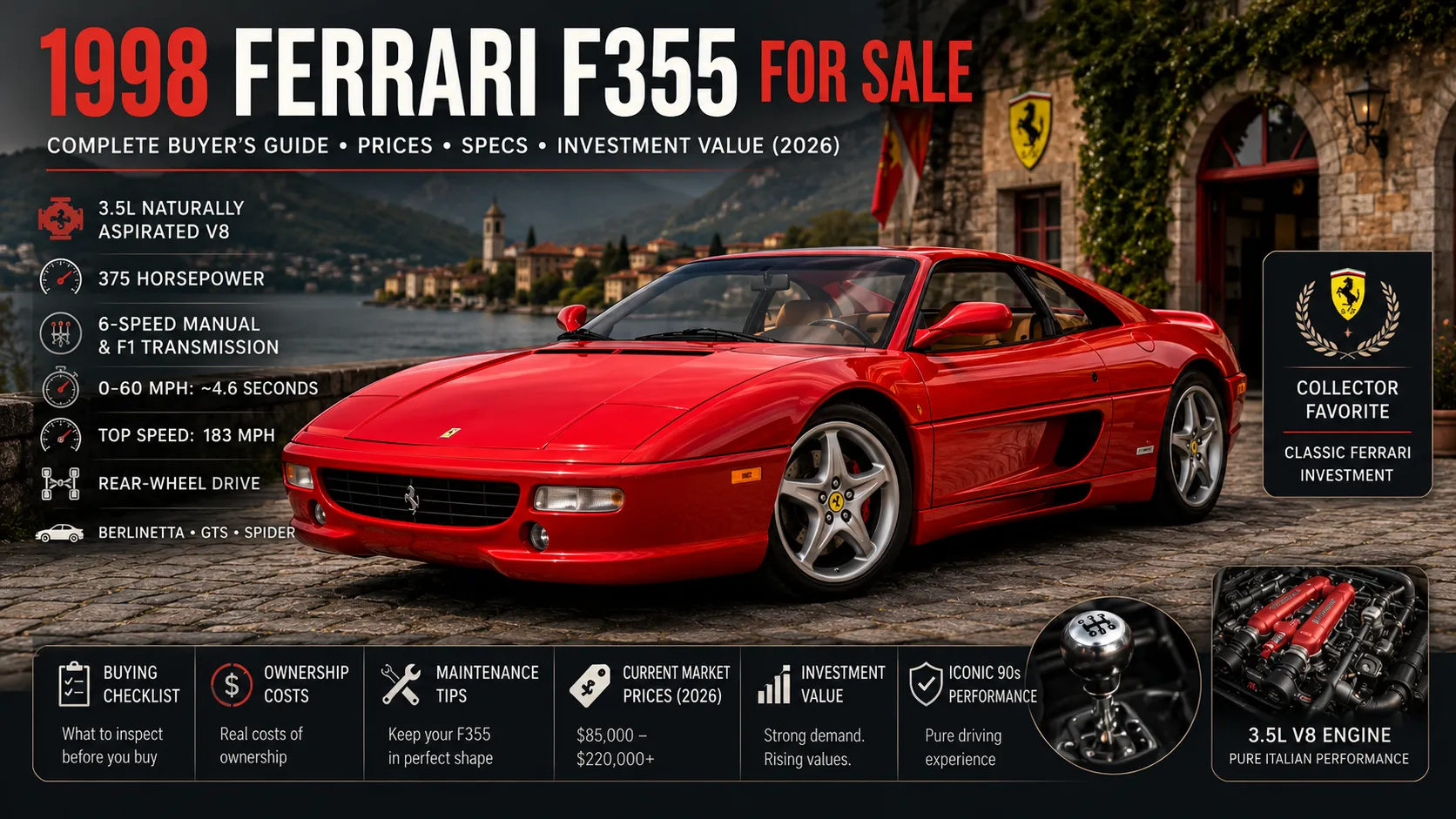
Searching for a 1998 Ferrari F355 For Sale is about far more than purchasing a used exotic car. It is an opportunity to own one of the most celebrated Ferraris ever produced—a vehicle that perfectly captures the spirit of the brand before electronics began dominating the driving experience.
For collectors, the 1998 model year holds particular importance. By the final years of F355 production, Ferrari had refined many aspects of the car, improving build quality, reliability, and manufacturing consistency while preserving everything enthusiasts loved about the original design.
Why the 1998 Ferrari F355 Is Special
Among every version produced between 1994 and 1999, many Ferrari specialists consider the 1998 Ferrari F355 to be one of the finest examples of the model. It represents the culmination of several years of continuous refinement before Ferrari introduced its successor, the Ferrari 360 Modena.
Rather than making dramatic design changes, Ferrari focused on improving manufacturing processes, enhancing reliability, updating engine management systems, and resolving minor issues identified during earlier production years. These subtle improvements created a more polished ownership experience while preserving the raw, emotional character that made the F355 legendary.
For enthusiasts seeking the perfect balance between classic Ferrari charm and everyday usability, the 1998 model often represents the sweet spot of the entire F355 production run.
Why Collectors Prefer the 1998 Model
Demand for the 1998 Ferrari F355 continues to increase among collectors for several important reasons.
Later-production vehicles generally benefit from improved quality control, refined assembly techniques, and updated mechanical components. These enhancements reduce the likelihood of certain age-related problems while maintaining complete originality.
Collectors particularly appreciate the 1998 model because it offers:
- Higher manufacturing consistency
- Better electrical system reliability
- Refined Bosch engine management software
- Improved cooling performance
- Enhanced component durability
- Excellent long-term collectability
- Strong appreciation potential
- Greater buyer confidence in the used market
As the number of well-preserved examples continues to decline, pristine cars with documented maintenance records have become increasingly valuable. Many industry experts expect demand to remain strong as collectors seek analog Ferraris with naturally aspirated engines.
Final Years of Production
The Ferrari F355 debuted in 1994 as the successor to the Ferrari 348. While the F355 immediately impressed reviewers with its dramatic styling and extraordinary performance, Ferrari continued refining the car throughout its production life.
By 1998, many early production issues had been addressed through ongoing engineering improvements and updated manufacturing practices.
As a result, later-production cars generally offer a more dependable ownership experience without sacrificing the engaging driving dynamics that define the F355.
Advantages of Buying a Later Production Car
| Benefit | Why It Matters |
| Improved build quality | Better assembly precision and finish |
| Updated electronics | Reduced likelihood of electrical faults |
| Revised engine software | Smoother power delivery and improved drivability |
| Enhanced cooling system | Better temperature management |
| Stronger resale value | Increased demand among collectors |
| Better component durability | Lower long-term ownership risk |
These refinements explain why many Ferrari dealers and independent specialists recommend purchasing a later-model F355 whenever possible.
Ferrari’s Continuous Engineering Improvements
One characteristic that separates Ferrari from many manufacturers is its commitment to continuous product development. Instead of waiting for an entirely new generation, Ferrari often introduced incremental improvements throughout a model’s production cycle.
The 1998 Ferrari F355 benefited from several of these updates.
Although none dramatically changed the car’s appearance, they collectively improved reliability, refinement, and owner satisfaction.
Some notable engineering enhancements include:
- Updated Bosch Motronic engine management
- Improved cooling system efficiency
- Better wiring harness quality
- Stronger electrical connectors
- Enhanced quality control procedures
- Improved fit and finish throughout the vehicle
- Increased long-term durability of various mechanical components
These improvements may seem minor individually, but together they contribute to why many enthusiasts specifically search for a 1998 Ferrari F355 for sale rather than earlier production years.
Timeless Pininfarina Design
Very few sports cars have aged as gracefully as the Ferrari F355.
Penned by the legendary Italian design house Pininfarina, the F355 represents one of Ferrari’s most elegant creations. Its proportions remain perfectly balanced, blending sophisticated styling with functional aerodynamics.
Unlike many modern supercars that feature oversized vents, exaggerated wings, and aggressive bodywork, the F355 relies on clean Surfaces and flowing curves. The result is a design that continues to attract admiration nearly thirty years after production.
Its beauty is understated rather than excessive, allowing it to remain timeless rather than trendy.
For many Ferrari enthusiasts, the F355 represents the final expression of classic Ferrari styling before modern aerodynamic requirements dramatically changed vehicle design.
Exterior Design Highlights
Every panel of the Ferrari F355 was shaped with both aesthetics and performance in mind.
Key styling characteristics include:
- Iconic retractable pop-up headlights
- Low aerodynamic front fascia
- Sculpted hood with flowing body lines
- Distinctive side air intakes feeding the mid-mounted engine
- Muscular rear fenders
- Lightweight five-spoke alloy wheels
- Signature quad circular taillights
- Twin polished exhaust outlets
- Compact rear deck emphasizing the mid-engine layout
- Perfectly balanced stance from every angle
Even when parked, the F355 communicates speed and elegance simultaneously.
Aerodynamics Ahead of Its Time
The Ferrari F355 was more than simply beautiful—it was also exceptionally aerodynamic for its era.
Ferrari engineers spent countless hours optimizing airflow underneath and around the vehicle. The result was increased stability at high speeds without relying on oversized spoilers.
Advanced aerodynamic features included:
- Flat underbody panels
- Carefully sculpted front air intakes
- Integrated rear diffuser
- Efficient brake cooling ducts
- Balanced front and rear downforce
- Optimized engine cooling airflow
These innovations helped the F355 achieve remarkable stability at speeds approaching 183 mph while maintaining its elegant appearance.
Legendary Naturally Aspirated V8
At the heart of every 1998 Ferrari F355 lies one of Ferrari’s greatest production engines.
Instead of turbochargers or electric motors, Ferrari installed a naturally aspirated 3.5-liter V8 designed to reward enthusiastic driving. The engine delivers immediate throttle response, exhilarating acceleration, and one of the finest exhaust notes ever produced by a road-going Ferrari.
Unlike modern engines that generate peak torque at low RPM, the F355 encourages drivers to explore the upper reaches of its rev range.
As the tachometer climbs toward its astonishing 8,500 rpm redline, the engine transforms from refined to ferocious, producing an unforgettable mechanical symphony.
This high-revving personality is a defining characteristic of the F355 and a major reason it remains so desirable today.
Engine Highlights
Ferrari engineered the F355’s V8 with numerous advanced technologies that were highly innovative during the 1990s.
Key specifications include:
- 3.5-liter naturally aspirated V8
- 90-degree aluminum engine block
- Five valves per cylinder
- Double overhead camshaft design
- Dry-sump lubrication system
- Bosch Motronic fuel injection
- 375 horsepower
- 268 lb-ft of torque
- 8,500 rpm maximum engine speed
- Exceptional throttle response
The unusual five-valve cylinder head design improved airflow and combustion efficiency, allowing the engine to breathe freely at extremely high engine speeds.
Even today, many automotive Engineers consider this one of Ferrari’s greatest naturally aspirated V8 powerplants.
The Sound That Defined an Era
Performance figures tell only part of the story.
What truly separates the Ferrari F355 from many other sports cars is its unforgettable soundtrack.
As engine speed rises, the exhaust note evolves from a smooth V8 rumble into an unmistakable Formula One-inspired scream that echoes through tunnels and mountain roads alike.
Unlike artificially enhanced exhaust systems found on some modern performance vehicles, every sound produced by the F355 is authentic.
Owners frequently describe the experience as addictive, often driving simply to hear the engine sing near its redline.
For countless enthusiasts, the engine’s soundtrack alone justifies the car’s legendary reputation.
Why Enthusiasts Still Love the F355
Nearly thirty years after its release, the Ferrari F355 continues to captivate enthusiasts around the world Because it offers qualities that have become increasingly rare in modern performance cars.
Owners value the F355 for its:
- Naturally aspirated engine character
- Linear power delivery
- Mechanical steering feedback
- Engaging gated manual transmission
- Lightweight construction
- Beautiful Italian styling
- Race-inspired engineering
- Emotional driving experience
- Strong collector appeal
- Excellent long-term investment prospects
While newer Ferraris may offer greater horsepower and faster acceleration, many drivers believe the F355 provides a more immersive and rewarding experience behind the wheel.
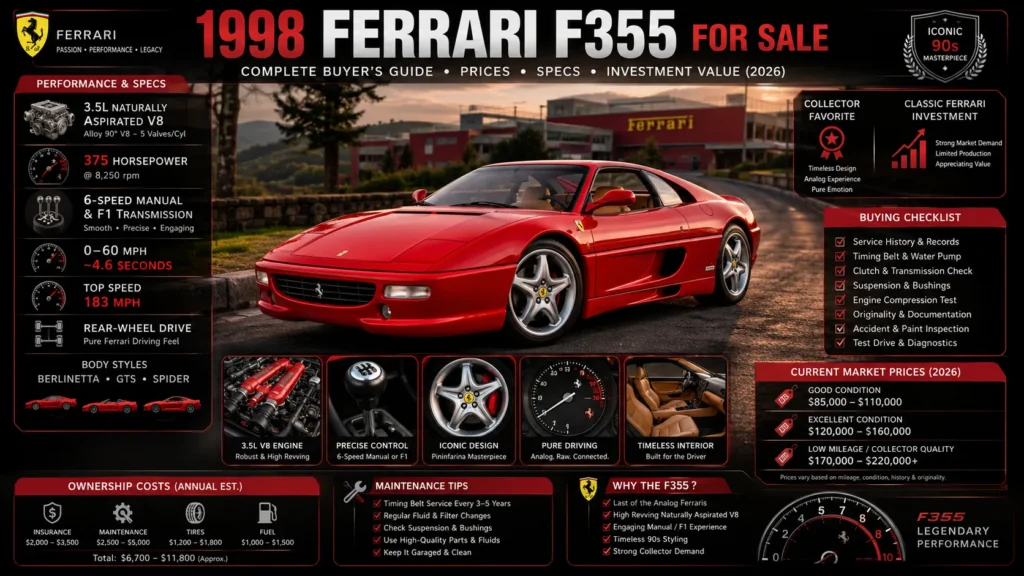
1998 Ferrari F355 Specifications
The 1998 Ferrari F355 represented the pinnacle of Ferrari’s engineering philosophy during the late 1990s. Rather than chasing overwhelming horsepower figures, Ferrari focused on creating a perfectly balanced sports car that combined lightweight construction, a high-revving naturally aspirated engine, advanced aerodynamics, and precise chassis dynamics.
Even by today’s standards, the F355 delivers a driving experience that feels remarkably modern. Its exceptional balance, responsive steering, and race-inspired engineering allow it to compete emotionally with many contemporary supercars despite producing significantly less power.
One of the biggest reasons enthusiasts continue searching for a 1998 Ferrari F355 for sale is that every component was engineered to maximize driver involvement instead of relying on electronic assistance. Every shift, corner, and acceleration feels mechanical, authentic, and deeply rewarding.
1998 Ferrari F355 Quick Specifications
| Specification | Details |
| Manufacturer | Ferrari S.p.A. |
| Model Year | 1998 |
| Engine | 3.5-Liter Naturally Aspirated V8 |
| Engine Code | Tipo F129B |
| Displacement | 3,496 cc |
| Horsepower | 375 hp (380 PS) |
| Torque | 268 lb-ft (363 Nm) |
| Valvetrain | DOHC, 5 Valves per Cylinder |
| Fuel Injection | Bosch Motronic Electronic Fuel Injection |
| Lubrication | Dry-Sump |
| Transmission | 6-Speed Manual or F1 Automated Manual |
| Drivetrain | Rear-Wheel Drive (RWD) |
| Chassis | Steel Tubular Frame |
| Body Material | Aluminum & Composite Panels |
| Suspension | Independent Double Wishbone |
| Brakes | Ventilated Disc Brakes with ABS |
| Top Speed | Approximately 183 mph (295 km/h) |
| 0–60 mph | Around 4.6 Seconds |
| Fuel Type | Premium Unleaded Petrol |
| Seating Capacity | 2 |
| Body Styles | Berlinetta, GTS, Spider |
These specifications may appear modest compared to modern Ferraris, but the F355’s relatively light weight and naturally aspirated engine create an incredibly engaging driving experience that numbers alone cannot capture.
Engine Specifications
The heart of the Ferrari F355 is undoubtedly its extraordinary 3.5-liter V8, an engine widely regarded as one of the greatest naturally aspirated powerplants Ferrari has ever built.
Introduced as a major advancement over the Ferrari 348’s engine, the F355’s V8 featured numerous technological innovations that were remarkably advanced for the mid-1990s. Ferrari engineers focused on increasing airflow, reducing internal friction, improving combustion efficiency, and allowing the engine to operate reliably at extremely high engine speeds.
The result was a powerplant capable of producing impressive performance while delivering one of the most memorable exhaust notes in automotive History.
Detailed Engine Specifications
| Specification | Value |
| Engine Configuration | 90° Naturally Aspirated V8 |
| Displacement | 3,496 cc |
| Bore x Stroke | 85 mm × 77 mm |
| Compression Ratio | 11.0:1 |
| Cylinder Heads | Aluminum Alloy |
| Engine Block | Aluminum Alloy |
| Valvetrain | DOHC, Five Valves per Cylinder |
| Total Valves | 40 |
| Fuel System | Bosch Motronic 5.2 Fuel Injection |
| Lubrication | Dry-Sump System |
| Maximum Power | 375 hp |
| Peak Torque | 268 lb-ft |
| Maximum RPM | 8,500 rpm |
Unlike turbocharged engines that produce a surge of low-end torque, the F355 rewards drivers who keep the engine spinning high in the rev range. Power builds progressively, encouraging spirited driving and making every acceleration feel exciting.
The Revolutionary Five-Valve Cylinder Head
One of the defining characteristics of the Ferrari F355 was its innovative five-valve-per-cylinder cylinder head.
At the time, this technology was rarely used in production automobiles. Each cylinder featured:
- Three intake valves
- Two exhaust valves
This arrangement allowed significantly greater airflow into the combustion chamber compared to conventional four-valve designs.
The advantages included:
- Improved breathing efficiency
- Higher engine speeds
- Increased horsepower
- Faster throttle response
- Better combustion efficiency
- Enhanced high-RPM performance
Although Ferrari later returned to four-valve designs due to evolving engineering priorities, the five-valve F355 engine remains a unique and celebrated chapter in Ferrari history.
Dry-Sump Lubrication System
Unlike ordinary sports cars that use a conventional wet-sump oil system, the Ferrari F355 employs a dry-sump lubrication system.
This racing-inspired design offers several important advantages.
Benefits of Dry-Sump Lubrication
- Maintains oil pressure during hard cornering
- Prevents oil starvation at high G-forces
- Allows the engine to sit lower in the chassis
- Improves weight distribution
- Enhances reliability during spirited driving
- Supports sustained high-RPM operation
These features demonstrate Ferrari’s commitment to incorporating motorsport technology into its road cars.
Performance
Although the F355 was introduced more than twenty-five years ago, its performance figures remain impressive.
More importantly, the way the car delivers its performance feels remarkably engaging. Rather than overwhelming drivers with brute force, the F355 encourages precision, smooth inputs, and confidence.
Its naturally aspirated engine, lightweight chassis, and balanced suspension combine to create one of the most rewarding driving experiences of any Ferrari.
Performance Figures
| Performance Metric | Value |
| Horsepower | 375 hp |
| Torque | 268 lb-ft |
| 0–60 mph | Approximately 4.6 seconds |
| 0–100 mph | Around 10.6 seconds |
| Quarter Mile | Approximately 12.9 seconds |
| Top Speed | 183 mph |
| Redline | 8,500 rpm |
While many modern performance cars accelerate more quickly, few provide the same emotional satisfaction or mechanical Connection.
Lightweight Construction
A major contributor to the F355’s exceptional agility is its relatively low curb weight.
Depending on body style and transmission, most examples weigh approximately:
- Berlinetta: around 2,980 lbs
- GTS: approximately 3,000 lbs
- Spider: roughly 3,060 lbs
Compared with today’s supercars—many of which exceed 3,500 pounds—the F355 feels nimble, responsive, and eager to change direction.
This lighter weight improves:
- Acceleration
- Braking
- Steering precision
- Cornering balance
- Driver confidence
- Overall responsiveness
Chassis and Suspension
Ferrari engineered the F355 with a sophisticated suspension system designed to provide both everyday usability and exceptional performance.
Suspension Features
- Independent double wishbone suspension
- Coil springs
- Gas-filled shock absorbers
- Front and rear anti-roll bars
- Optimized suspension geometry
- Aluminum suspension components
The result is a ride that remains surprisingly comfortable on public roads while delivering exceptional control during spirited driving.
Even today, many automotive journalists praise the F355’s chassis as one of Ferrari’s greatest achievements.
Steering Feel
Modern performance vehicles often rely on electrically assisted steering systems.
The Ferrari F355 uses a hydraulic steering setup that communicates every nuance of the road surface directly to the driver.
Owners consistently praise its:
- Exceptional precision
- Natural weighting
- Immediate response
- Outstanding feedback
- Predictable cornering behavior
This level of steering communication has become increasingly rare, making the F355 especially appealing to driving purists.
Transmission Options
One of the most important decisions buyers face when searching for a 1998 Ferrari F355 for sale is selecting the right transmission.
Ferrari offered two distinct gearboxes during this period:
- Traditional 6-speed gated manual
- F1 automated manual transmission
Each delivers a unique driving experience and appeals to different buyers.
Understanding the strengths and weaknesses of both systems is essential before making a purchase.
6-Speed Manual Transmission
The gated six-speed manual is considered by many enthusiasts to be the definitive Ferrari transmission.
Its exposed metal shift gate has become one of Ferrari’s most recognizable design elements and provides a tactile experience unmatched by modern dual-clutch gearboxes.
Every shift produces the iconic metallic “click” that Ferrari fans know and love.
Why the Manual Is So Desirable
Collectors often prioritize manual-equipped F355s because of their rarity and long-term appreciation potential.
Advantages include:
- Pure mechanical engagement
- Legendary gated shifter
- Greater driver involvement
- Lower long-term mechanical complexity
- Strong collector demand
- Higher resale values
- Excellent investment potential
- Authentic analog driving experience
Because relatively few F355s were produced with manual transmissions, these cars often command substantial premiums in today’s collector market.
Manual Transmission Driving Experience
Driving the manual F355 requires skill and precision.
The clutch pedal is firm but progressive, while the gear lever moves through its polished aluminum gate with satisfying mechanical feedback.
Every upshift and downshift becomes part of the driving experience rather than simply a means of changing gears.
Many owners describe the manual transmission as one of the greatest reasons to own an F355.
F1 Automated Manual Transmission
The Ferrari F355 also introduced one of the company’s earliest Formula One-inspired paddle-shift transmissions.
At the time, this technology represented a significant leap forward and demonstrated Ferrari’s commitment to transferring racing innovations to road cars.
Instead of using a clutch pedal, hydraulic actuators controlled clutch engagement while drivers selected gears using steering-column-mounted paddles.
Advantages of the F1 Transmission
Benefits include:
- Faster gear changes
- Paddle-shift convenience
- Easier operation in heavy traffic
- Motorsport-inspired technology
- Hands remain on the steering wheel
- Unique Ferrari ownership experience
Although shift speeds are noticeably slower than modern dual-clutch transmissions, the F1 gearbox remains an important milestone in Ferrari’s technological evolution.
Maintenance Considerations
Prospective buyers should understand that the F1 transmission contains additional hydraulic, electronic, and mechanical components.
These include:
- Hydraulic pump
- Actuator assembly
- Pressure accumulator
- Electronic control unit
- Hydraulic lines
- Position sensors
While these systems generally perform well when properly maintained, repairs can become expensive if neglected.
A pre-purchase inspection by a Ferrari specialist is strongly recommended before buying any F1-equipped F355.
Manual vs. F1 Transmission Comparison
| Feature | 6-Speed Manual | F1 Transmission |
| Driver Engagement | Excellent | Very Good |
| Collector Value | Highest | Moderate |
| Long-Term Appreciation | Excellent | Good |
| Maintenance Complexity | Lower | Higher |
| Daily Driving | Moderate | Easier |
| Shift Experience | Mechanical & Analog | Electronic & Paddle-Operated |
| Market Demand | Extremely High | Moderate |
For enthusiasts seeking maximum driving involvement and investment potential, the manual transmission remains the preferred choice.
Buyers prioritizing convenience and Ferrari’s early paddle-shift technology may find the F1 gearbox equally appealing, provided the maintenance history is complete.
Driving Experience
Ask almost any Ferrari owner to describe the 1998 Ferrari F355, and you’ll likely hear the same response:
“It makes every drive feel like a special occasion.”
Unlike many modern performance cars that isolate drivers with layers of electronic intervention, the F355 creates a direct connection between human and machine. Every steering correction, throttle application, brake input, and gear change is communicated with remarkable clarity.
The car feels alive, constantly encouraging the driver to become part of the experience rather than simply controlling it.
Whether you’re navigating winding mountain roads, cruising along coastal highways, or attending a weekend Ferrari gathering, the F355 delivers an emotional connection that few vehicles—old or new—can match.
Its combination of responsive steering, balanced chassis, exhilarating V8 soundtrack, and timeless styling ensures that every journey becomes memorable, reinforcing why the 1998 Ferrari F355 remains one of Ferrari’s most admired driver’s cars and an enduring icon among collectors worldwide.
FAQs
A: Yes. The 1998 Ferrari F355 is widely regarded as one of Ferrari’s most collectible modern classics. Well-maintained examples with low mileage, documented service history, and original factory specifications have shown steady appreciation over recent years. Manual transmission models are especially desirable and often command premium prices.
A: For a classic Italian sports car, the F355 can be dependable when properly maintained. Most reliability concerns stem from neglected maintenance rather than inherent design flaws.
Regular servicing by experienced Ferrari specialists is essential to ensure long-term reliability and performance.
A: Most Ferrari specialists recommend replacing the timing belts every 3–5 years, regardless of mileage. Since timing belt service is one of the most important maintenance items on the F355, buyers should verify that this work has been completed recently.
A: The Ferrari F355 has an estimated top speed of approximately 183 mph (295 km/h) and can accelerate from 0–60 mph in around 4.6 seconds, making it one of the fastest production sports cars of its era.
A: Yes, provided buyers understand the ownership responsibilities of a classic Ferrari. A well-maintained F355 with complete service documentation can be an excellent introduction to Ferrari ownership, offering timeless styling, exceptional performance, and strong collector appeal.
Conclusion
The 1998 Ferrari F355 represents one of the finest expressions of Ferrari’s analog performance era. With its breathtaking Pininfarina design, naturally aspirated 3.5-liter V8 engine, thrilling 8,500-rpm redline, and beautifully balanced chassis, it continues to deliver a driving experience that few modern sports cars can replicate. Every journey behind the wheel feels engaging, emotional, and unmistakably Ferrari.
Beyond its performance, the 1998 model year stands out because of its refined engineering, improved manufacturing quality, and growing desirability among collectors. Whether you prefer the classic Berlinetta, the versatile GTS, or the open-air Spider, choosing a well-maintained example with comprehensive service records can provide years of enjoyable ownership while preserving long-term value.
Before purchasing a 1998 Ferrari F355 for sale, always invest in a thorough pre-purchase inspection, review the vehicle’s maintenance history, and verify originality. Paying more for a documented, well-cared-for car is often far Less Expensive than restoring a neglected example.