Introduction
Ferrari stands apart, admired like few others on the planet. From Italy it came, a builder of fast, rare machines that blur into myth over time. Speed defines its soul – yet so does history, written lap after lap on racetracks worldwide. Engineering leaps happen here quietly, without announcement or fanfare. Enthusiasts dream of owning one; some spend lifetimes chasing the idea. Wealth opens doors, but respect comes only through understanding what lies beneath the red paint.
Ferrari’s name echoes well past race tracks and showrooms, rooted in something deeper than speed alone. What began with relentless victories in Formula 1 grew into rare machines built in small numbers, each carrying weight. Performance isn’t just measured in laps but in precision shaped by hand. Craftsmanship shows where metal meets vision without compromise. Innovation slips quietly into every curve, never announced, always present. Design speaks fluent Italian – not through flair, but balance, tension, silence between lines. Excellence here feels inevitable, not chased.
Ferrari’s fame means people often type a particular question into search bars
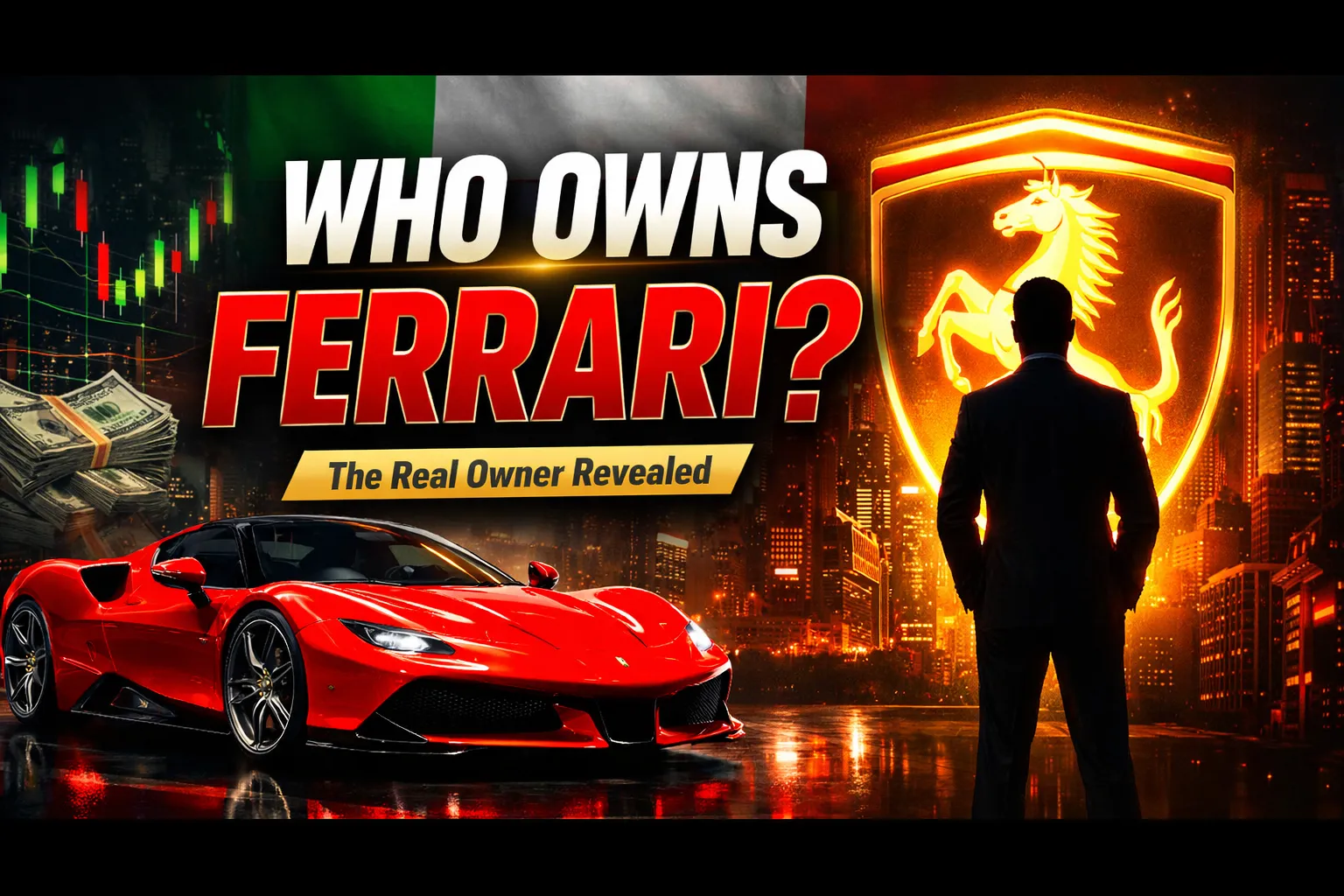
Owner of a Ferrari?
Many people assume that Ferrari is owned by:
A single billionaire entrepreneur
The Ferrari family
A big car company, think of names like Fiat or Volkswagen
Truth be told, things get trickier – yet way more interesting – once you look closer.
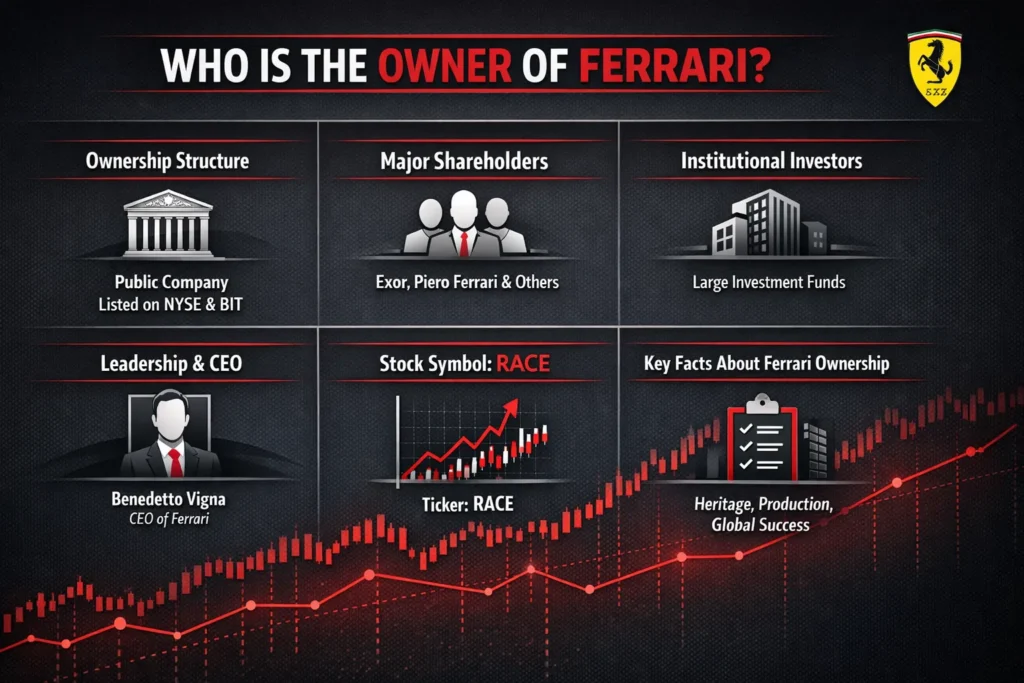
Ferrari runs now as a company whose shares float on the stock market, so pieces of it belong to many different people worldwide. Ownership spreads across global investors who hold stakes in the brand.
The modern ownership framework of Ferrari includes:
- Exor N.V. – the largest shareholder and controlling investment group
- Piero Ferrari – the son of founder Enzo Ferrari and a major stakeholder
- Institutional investors such as global asset management firms
- Public shareholders who own Ferrari stock through financial markets
Understanding Ferrari ownership also requires examining the company’s history, corporate governance structure, leadership team, and stock market presence.
In this comprehensive pillar guide, we will explore:
- Who owns Ferrari today
- The company’s shareholder structure
- Ferrari’s ownership history
- The influence of Exor and the Agnelli family
- The role of Piero Ferrari
- Ferrari’s corporate leadership
- How Ferrari operates as a public company
By the end of this guide, you will gain a clear and complete understanding of Ferrari’s ownership, governance, and global business structure.
Quick Overview Table:
| Category | Details |
| Founded | 1939 |
| Founder | Enzo Ferrari |
| Headquarters | Maranello, Italy |
| Largest Shareholder | Exor N.V. |
| Ferrari Family Stake | Piero Ferrari (~10%) |
| CEO | Benedetto Vigna |
| Chairman | John Elkann |
| Stock Ticker | RACE |
| Listed On | New York Stock Exchange & Euronext Milan |
| Industry | Luxury Performance Automotive |
The Simple Answer:
Ferrari belongs to many people, not just one. Ownership spreads across numerous shareholders instead of resting in a single hand.
Ferrari operates as a public company, so different people own pieces through stock. Ownership spreads across many hands rather than resting with one.
Ferrari Ownership
The biggest owner of Exor N.V. holds the most shares
Piero Ferrari (Ferrari Family Stakeholder)
Institutional Investors
Public Shareholders
Ferrari’s share setup took shape when the company went public back in 2015.
Ferrari’s stock hit the market after the IPO, carrying the ticker symbol RACE. Trading started soon afterward on public exchanges.
Ferrari’s standing among the globe’s top-earning luxury automakers sparked steady international funding ever since. Profitability like that pulls interest – investors followed, drawn by consistent returns few marques can match.
One name stands out when it comes to shaping Ferrari’s path – Exor, tied closely to the Agnelli family. While nobody holds full ownership alone, their reach runs deep through this powerful investment group.
Ferro’s son stays involved, his presence a quiet force shaping how the brand moves forward. Still guided by roots planted long ago, choices today echo the founder’s original drive. Ownership may shift, yet one thing holds firm – tradition runs deep here.
Ferrari Ownership Structure Explained
Ferrari’s ownership picture comes into view when you look at where its shares sit across various investors. Who holds what tells part of the story behind the brand’s direction.
A fraction of Ferrari’s ownership goes to key partners, while big financial groups hold another piece. The rest spreads across everyday stock buyers who trade on open markets.
Few things beat a setup that keeps money steady, decisions clear, yet builds slowly over the years.
Largest Shareholder
A major piece of Ferrari belongs to Exor N.V., which operates across countries and manages investments. That firm answers to the Agnelli family, known over decades for shaping Italian industry. Power flows through their hands when decisions about the brand are made.
Ferrari’s biggest shareholder? That belongs to Exor, holding roughly a quarter of its stock. Around 24 to 25 percent – this is what they’ve got.
Few know that even without owning most shares, power can tilt their way through strong votes plus careful moves behind the scenes. Still, control often hides where numbers seem weak at first glance.
Exor’s authority within Ferrari includes:
- Appointing board members
- Influencing long-term corporate strategy
- Maintaining shareholder stability
- Protecting Ferrari’s premium brand positioning
Ferrari ties run deep into Exor, thanks to one man holding both top roles. Sitting at the helm of each is John Elkann, shaping direction behind the scenes. Leadership flows from his seat at Ferrari straight into Exor’s core. One name links them clearly – Elkann leads on both fronts without pause.
Leading both roles lets Ferrari stay in step with the Agnelli family’s wider investment plans.
Firmly rooted in Europe, Exor stands among the continent’s leading investment players. Its reach extends through ownership positions in a range of well-known international businesses
Stellantis – multinational automotive manufacturer
A farming gear and heavy machine builder sits behind the CNH Industrial name. Equipment for fields plus construction tools, make up its core work. Machines roll out under well-known brand labels tied to the business. Work happens across continents through wide-reaching operations
Juventus F.C. – Italian professional football club
Fueled by Exor’s support, Ferrari pushes further into high-end markets. Its name grows stronger worldwide under steady guidance. Expansion follows each move, shaped by quiet influence behind the scenes.
The Ferrari Family Stake
Ferrari now trades on the stock market, yet members of the founding family hold onto shares. Ownership has shifted but not vanished where it began.
Father’s name lives on through his son, Piero Ferrari, who holds about a tenth of the firm’s stock.
Ferrari’s Vice Chairman takes on an advising position behind the scenes. His presence supports leadership with quiet influence.
Few realize how much weight Piero Ferrari carries simply by standing where he does. His presence ties directly to what the name means over time. Not just history – more like a living echo of choices made long ago. One reason people look his way? He moves slow, speaks less, yet shapes views. Tradition flows through him without effort. What Ferrari stands for today leans on that quiet continuity.
Because he’s involved, the spirit of Enzo Ferrari stays alive. The company keeps moving forward without losing sight of where it began.
Ferrari’s rolling onto the stock market in 2015 lifted Piero Ferrari into billionaire status through his stake; still, what matters more is how tightly he holds on to the soul of the company. Though wealth followed that public debut, his real presence shows up in quiet loyalty rather than flash. Ownership changed hands publicly, but his spirit never left the garage where passion drives everything. Money came, yes – yet tradition rides louder in his choices. The numbers grew, certainly, though respect for origins stays stronger in every move.
Ferrari moves forward, yet his role holds a quiet echo of where it began. The way he fits into command shows time isn’t Broken – just carried.
Institutional Investors
Fifty percent of Ferrari stock sits in the hands controlled by big finance groups – these are firms handling money flows for countless everyday savers. Ownership trails back to entities building long-term value pools across global markets.
These investors typically include:
- Pension funds
- Retirement funds
- Sovereign wealth funds
- Mutual funds
- Asset management firms
Institutional investors play an essential role in Ferrari’s financial ecosystem.
Their investments provide:
- Long-term capital stability
- Market credibility
- Increased stock liquidity
- Global investor confidence
Because Ferrari consistently demonstrates strong profitability, brand power, and limited production exclusivity, it is often viewed as a premium luxury stock within global financial markets.
Public Shareholders
The remaining Ferrari shares are owned by public investors around the world.
Since Ferrari is listed on the New York Stock Exchange and Euronext Milan, individual investors can purchase Ferrari shares through the public stock market.
Public shareholders include:
- Retail investors
- Hedge funds
- Investment banks
- Global wealth management firms
This wide distribution of shares allows Ferrari to maintain global investment participation and strong market demand.
Stock in Ferrari means something different for plenty of buyers. It’s a way to share in the rise of a name known everywhere for high-end elegance. Not just another company, it stands tall among elite labels across the globe.
Who Founded Ferrari?
Fifty years before most think it started, a man named Enzo Ferrari began what would become a legend in cars. From Modena, he shaped something lasting during a time few remember clearly now.
Flying fast through his own dreams, Enzo Ferrari built more than companies; he shaped speed into legend. Racing wasn’t just a sport to him – it became a purpose, driven by instinct rather than profit. A man of sharp turns and louder engines, he carved paths where others saw only walls. Motorsport changed because one mind refused to slow down.
Working as a race car driver came first. Then, handling Alfa Romeo’s racing team followed. Only after that did Ferrari begin.
Burning love for speed led him down a path few try. That fire sparked something wild – a shop built on raw power and sharp turns. Driven by the roar of engines, he Shaped a venture where only fierce machines take form.
Ferrari’s founding philosophy revolved around three central principles:
- Racing excellence
- Engineering innovation
- Italian craftsmanship
Interestingly, Ferrari initially manufactured road cars primarily to finance its racing program.
This unique business model proved extremely successful and eventually transformed Ferrari into a global luxury automotive powerhouse.
Ferrari Ownership History
Ferrari today belongs to a path shaped by decades of change. A look back shows how shifts over time set the stage for now.
Ferrari shifted hands several times since it began. Ownership changed in big waves, each leaving a mark. Different eras unfolded under separate control. One phase followed another, reshaping what came next. Each shift brought new directions without warning.
Enzo Ferrari Era
Ferrari stayed under Enzo’s full command in those first years. Early on, control never left his hands. Power remained firmly with him through the initial stretch. From the start, decisions flowed only one way – his way. For many years at the beginning, no one else shaped its path.
This era was defined by:
- Racing dominance
- Limited vehicle production
- Extreme exclusivity
Faster than most expected, Ferrari became known for high-end speed mixed with smart engineering. What started small soon stood out through sheer precision and bold design choices. Not just fast but crafted differently from the start.
Funding a race effort demanded deep pockets – success depended on it.
Fiat Ownership Period
Fifty percent of Ferrari landed in Fiat’s hands when the Italian car powerhouse made its move in 1969.
Ferrari found new doors opening through this alliance, bringing both funding and production capabilities into reach. Though quiet in announcement, the move quietly shifted how parts would be built and where money came from. Behind the scenes, workshops expanded, budgets grew – tied closely to shared goals. What emerged was not just support but a steady flow of materials and cash, changing daily operations without fanfare.
- Fiat Support Helped Ferrari
- Expand vehicle production
- Invest in research and development
- By boosting how it runs in Formula 1 races
Fiat slowly bought more shares until it held ninety percent. The Ferraris kept ten percent through all those years.
For many years, the collaboration continued, shaping how Ferrari grew beyond Italy. Then came a time when its influence helped stretch the brand worldwide.
Fiat Chrysler Automobiles Era
Fiat joined forces with Chrysler, forming a new company called Fiat Chrysler Automobiles – or FCA. Though separate before, their paths linked through merger, creating one shared direction forward.
Ferrari joined a bigger car company at that time.
Ferrari didn’t operate like a company building cars for everyone. Instead, their entire approach stood apart from the start.
Even though FCA built lots of everyday cars, Ferrari stuck to making rare, powerful machines instead
- Ultra-luxury sports cars
- Limited production models
- Performance-focused engineering
- Ferrari split off from FCA due to those contrasts, standing alone as its own entity.
- Ferrari Splits From Fiat And Goes Public
Ferrari took a major step forward in 2015, marking a turning point in its recent business journey. That year reshaped how the company moved ahead, setting new directions quietly but firmly. Instead of fading into routine decisions, this moment stood out across boardrooms and garages alike. Behind polished announcements lay deeper shifts nobody saw at first glance.
Ferrari’s first stock sale opened to investors, marking its shift into public ownership. Trading began shortly after, following approval on the market floor.
Shares in Ferrari became available globally when trading started on the New York Stock Exchange. Though based in Italy, the company opened ownership to anyone able to buy in through the American market. Investment doors swung wide at listing, connecting Maranello’s iconic brand with distant portfolios.
- Ferrari made a shift that changed their position
- Gain financial independence
- Attract global investors
- Establish its own luxury business strategy
Ferrari’s worth on the stock market has shot up since going public, turning it into a top player among high-end car makers globally.
Who Owns Ferrari Now?
Just because someone owns something does not mean they Run it.
Ferrari might have many owners, yet the daily work, along with big-picture choices, comes down to those running things behind the scenes. Still, it is the group at the top – guiding moves through meetings and long-term plans – that shapes where the company heads next.
Ferrari Chairman
Ferrari’s top leader goes by the name John Elkann.
A figure tied to the Agnille bloodline now stands alongside the firm Exor, rooted in finance. That presence links old lineage to modern capital moves across Europe.
As chairman, he oversees:
- Corporate governance
- Board leadership
- Strategic direction
- Long-term brand positioning
Ferrari stays ahead because his guidance keeps it both rare and advanced.
Ferrari CEO
Benedetto Vigna runs Ferrari now. He took charge recently, stepping into the top role at the iconic car company.
Earlier in his career, he spent time at STMicroelectronics, focusing on semiconductor tech alongside complex electronic systems before moving to Ferrari.
His leadership focuses on:
- Automotive technology innovation
- Electrification strategies
- Future mobility solutions
Ferrari shapes its future under him, heading toward hybrids and electric models alike. Next-gen machines take form through steady direction behind the scenes.
Corporate Governance Structure
Ferrari sticks to a current-style management setup meant to keep things open and responsible.
The structure includes:
- Board of Directors
- Chairman
- Vice Chairman
- Executive Leadership Team
- Independent Directors
By keeping decisions aligned with shareholders’ priorities, the system also safeguards how Ferrari stays true to its legacy over time.
Ferrari Car Design Philosophy
Faster than most eyes can follow, Ferrari cars wear shapes that stick in your mind. A red curve here, a sharp angle there – each piece speaks without words.
A shape that catches the eye also cuts through the air. Beauty guides form, yet function shapes every curve. Lines flow not just to impress but to reduce drag. Design answers two demands at once – grace under speed, strength in elegance. What looks right must also perform. Form follows force, yet never loses its flair.
Key exterior design elements include:
- Aerodynamic body lines
- Aggressive front fascia
- Sculpted air intakes
- The iconic Prancing Horse emblem
- Ferrari designers carefully shape each surface to improve:
- Downforce
- Airflow efficiency
- High-speed stability
- Signature Ferrari styling features
- LED headlights
- Carbon fiber components
- Lightweight alloy wheels
- The classic racing color Rosso Corsa
Faster than a sketch on paper, Ferrari’s shape comes alive through curves that think like engineers. Beauty shows up not by accident but because math learned to dream. Lines move with purpose, shaped by wind and vision alike. Every glance feels intentional, as if speed left its mark before the car even turned on.
Interior & Comfort
Inside a Ferrari, the primary focus is driver engagement.
Ferrari interiors are engineered to create a direct connection between driver and machine.
Common interior features include:
- Premium leather upholstery
- Carbon fiber trim elements
- Racing-inspired steering wheel
- Digital instrument cluster
Although Ferrari vehicles prioritize performance, modern models also offer luxury amenities such as:
- Dual-zone climate control
- Premium sound systems
- Adjustable sport seats
- High-quality handcrafted materials
Engine & Performance
Performance lies at the heart of Ferrari’s identity.
Ferrari engines are widely regarded as some of the most powerful and technologically advanced powertrains in the automotive world.
Common Ferrari engine configurations include:
- Twin-turbocharged V8 engines
- Naturally aspirated V12 engines
- Hybrid powertrains
Typical Ferrari performance metrics include:
| Performance Metric | Typical Ferrari Range |
| Horsepower | 600 – 1000+ HP |
| 0–100 km/h | 2.5 – 3.5 seconds |
| Top Speed | 320+ km/h |
Ferrari engineers continuously push technological boundaries to produce some of the fastest road-legal vehicles ever created.
Fuel Economy and Hybrid Technology
While Ferrari traditionally focuses on performance, modern environmental regulations require improved efficiency.
To meet these standards, Ferrari has developed hybrid supercars such as the SF90 Stradale.
Hybrid systems combine:
- Electric motors
- High-performance combustion engines
This technology enhances:
- Acceleration
- Power output
- Fuel efficiency
Hybridization allows Ferrari to maintain extreme performance while adapting to the future of sustainable mobility.
Safety Features
Despite their extraordinary speed, Ferrari vehicles incorporate advanced safety systems.
Common Ferrari safety technologies include:
- Anti-lock braking system (ABS)
- Electronic stability control
- Traction management systems
- Carbon-ceramic braking systems
- Multiple airbag protection
These systems help drivers maintain control even at extremely high speeds.
Technology & Infotainment
Modern Ferrari models include advanced digital technology.
Key features include:
- Fully digital driver displays
- Touchscreen infotainment systems
- Smartphone connectivity
- Advanced telemetry systems
Ferrari also offers track performance monitoring, allowing drivers to analyze lap times and driving behavior.
Variants & Pricing
Ferrari produces several categories of vehicles.
These include:
- V8 sports cars
- V12 grand tourers
- Hybrid hypercars
- Limited edition collector models
Ferrari vehicles are among the most expensive production cars in the world.
Prices typically start around $250,000 and can exceed $3 million for rare, limited-production models.
Pros & Cons
Pros
- Legendary brand prestige
- Extraordinary performance
- Iconic Italian design
- Strong resale value
- Rich motorsport heritage
Cons
- Extremely high price
- Limited practicality
- Expensive maintenance
- Long waiting lists
- Limited production availability
Ferrari Competitors
Ferrari competes with several elite supercar manufacturers.
| Brand | Key Strength |
| Lamborghini | Aggressive styling and extreme performance |
| McLaren Automotive | Lightweight engineering and track performance |
| Porsche | Advanced engineering and reliability |
These companies compete in the global supercar and hypercar market.
Ferrari Ownership and Maintenance
Owning a Ferrari requires a significant financial commitment.
Typical ownership costs include:
- Specialized servicing
- Expensive replacement components
- High insurance premiums
However, Ferrari vehicles often maintain — and sometimes increase — their value.
Limited-production models frequently become valuable collector assets.
FAQs
A: Ferrari is owned by multiple shareholders. The largest shareholder is Exor N.V., followed by Piero Ferrari and public investors.
A: Yes. Piero Ferrari owns around 10% of the company and serves as vice chairman.
A: No. Ferrari became an independent company after its 2015 IPO.
A: Ferrari is controlled by its executive leadership and board of directors, with strong influence from Exor.
Conclusion
Ferrari is no longer owned by a single individual or family.
Instead, the company operates as a publicly traded luxury automotive corporation with a diversified ownership structure.
The largest shareholder is Exor N.V., the investment company of the Agnelli family. At the same time, the Ferrari legacy remains alive through Piero Ferrari, who continues to hold approximately 10% ownership in the company.
Together with institutional investors and public shareholders, this ownership framework allows Ferrari to maintain financial strength, corporate independence, and long-term stability.
More than 80 years after its founding by Enzo Ferrari, the brand continues to represent the pinnacle of automotive excellence.
For enthusiasts, investors, and collectors alike, Ferrari symbolizes something truly rare:
A luxury brand that builds some of the most extraordinary performance machines ever created.