Tesla Model 3 Weight :
The Tesla Model 3‘s weight plays a critical role in determining driving dynamics, efficiency, safety performance, and overall vehicle behavior.
Most potential buyers concentrate on driving range or acceleration numbers. However, vehicle mass directly influences:
- Speed capability
- Energy consumption
- Road stability
- Tire durability
- Braking performance
- Crash protection
A deep look at how much each version of the Tesla Model 3 weighs begins here. Trim by trim, the numbers unfold without extra jargon. What goes into making one heavier shows up in materials and battery size. Differences between versions become clear when you see them side by side. Other electric cars enter the picture to show where it stands. Engineering choices shape the final number on the scale. Every component plays a role; nothing is left out. Real talk about mass avoids fluff and sticks to facts.
Tesla Model 3 Weight Matters for Buyers
Vehicle Weight in Electric Cars
A different approach powers electric models such as the Model 3 – instead of gas, they rely on a sizable battery tucked beneath the floor structure. While regular cars burn fuel, this one stores energy below where passengers sit.
A heavier build comes from this battery inside the Tesla Model 3. The added mass changes how the car sits on the road.
However, increased mass does not automatically mean poor performance.
Benefits of Controlled Weight Distribution
- Lower center of gravity
- Enhanced road grip
- Reduced rollover risk
- Improved cornering stability
- Better crash absorption
Tesla engineers distribute weight strategically to balance the vehicle structure evenly.
Key Components That Increase Weight
Major contributors to the total mass include:
- Battery module
- Electric motor systems
- Reinforced steel + aluminum body frame
- Advanced electronics & computing units
- Interior safety structures
Among these, the battery pack accounts for the largest proportion.
Quick Overview:
| Specification | Details |
| Vehicle Type | 4-Door Electric Sedan |
| Passenger Capacity | 5 Occupants |
| Drive Configuration | RWD / AWD |
| Battery Technology | Lithium-Ion |
| Transmission | Single-Speed Automatic |
| Power Output | Variant Dependent |
| Driving Range | Variant Dependent |
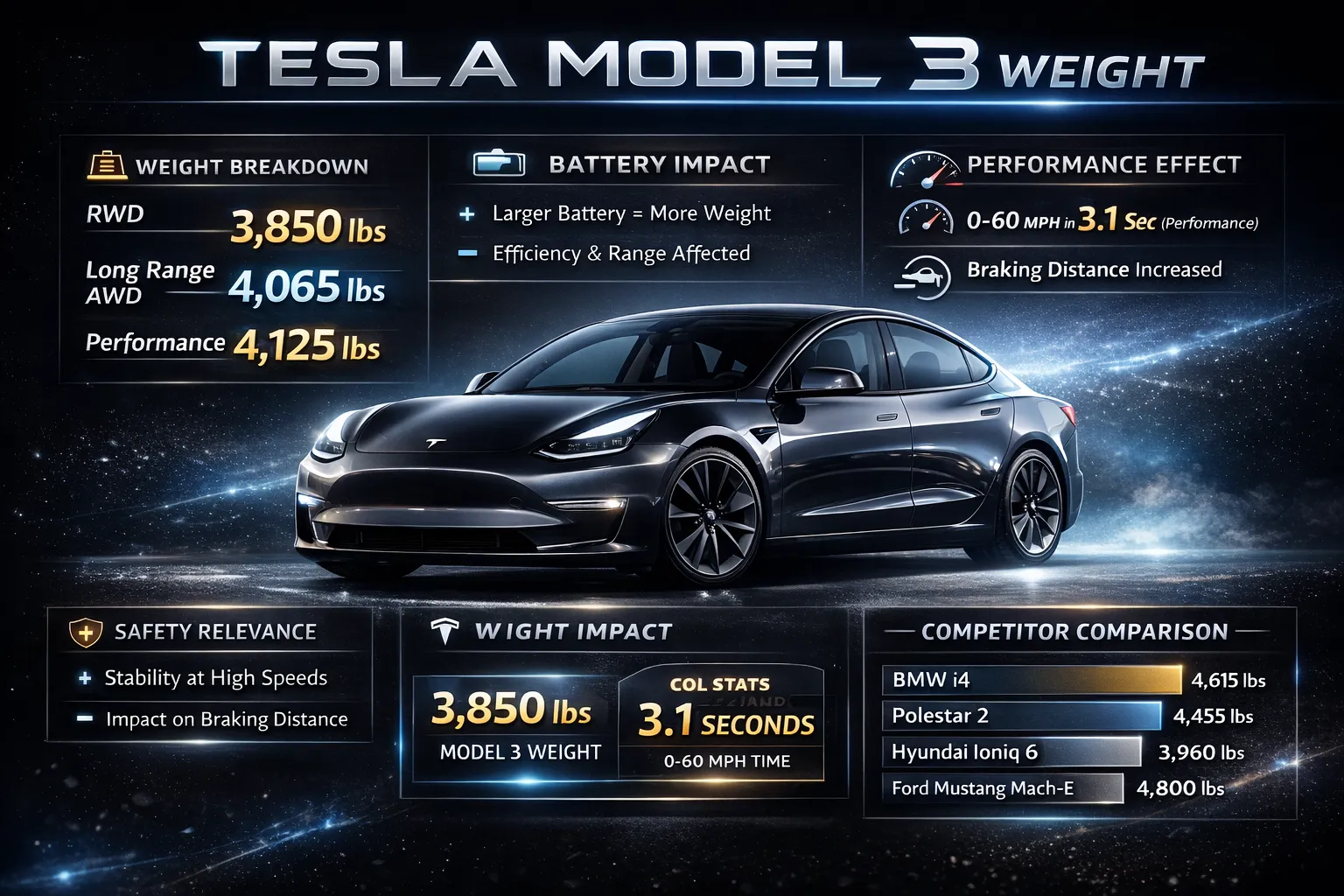
| Curb Weight | ~1,705 kg – 1,839 kg |
This table reflects the approximate mass range of the vehicle across trims.
Tesla Model 3 Weight by Trim
Each configuration differs in motor setup and battery Capacity.
Greater battery capacity = Increased vehicle mass.
Weight Comparison by Variant
| Trim | Motor Setup | Approx Weight | 0–100 km/h |
| Standard Range RWD | Single Motor | ~1,705 kg | ~6 sec |
| Long Range AWD | Dual Motor | ~1,828 kg | ~4.4 sec |
| Performance | Dual Motor High Output | ~1,839 kg | ~3.1 sec |
Why the Performance Version Has a Higher Weight
The Performance edition contains additional structural and mechanical upgrades:
- Larger capacity battery pack
- Enhanced motor output
- Upgraded braking system
- Performance-oriented wheel design
- Advanced thermal cooling components
These enhancements increase overall mass.
However, It Also Provides:
Faster acceleration
Track-oriented handling
Stronger torque delivery
Superior throttle response
Thus, a higher weight is compensated by increased output.
Exterior Engineering & Weight Optimization
Aerodynamic Design Reduces Drag Resistance
Tesla implements advanced aerodynamic engineering, including:
- Smooth exterior body panels
- Flush-mounted door handles
- Streamlined front fascia
- Optimized underbody protection
- Low drag coefficient design
These features reduce air resistance and Improve efficiency.
Material Composition Impact on Weight
Tesla uses:
- Aluminum body structure
- Steel reinforcement for safety
- Composite lightweight components
- High-strength alloys
This hybrid material approach minimizes unnecessary mass while preserving durability.
Key Insight:
Even though batteries add weight, structural innovation ensures balanced weight distribution.
Interior Design
The interior layout of Model 3 is minimalist.
This design philosophy reduces excessive component load.
Core Interior Features
- 15-inch central touchscreen
- Minimal dashboard layout
- Premium synthetic seating materials
- Spacious cabin design
- Integrated digital control interface
Does Interior Design Add Significant Weight?
No.
Interior components contribute relatively little compared to:
- Battery system
- Motor system
- Structural frame
Simplicity reduces unnecessary mass accumulation.
Engine Replacement With Electric Motor: Weight & Performance Relationship
Tesla Model 3 does not contain a traditional combustion engine.
Instead, it uses electric motor technology.
How Weight Influences Performance
In conventional vehicles:
Higher weight = Reduced acceleration
In electric vehicles:
Instant torque delivery offsets mass impact.
Performance Relationship Table
| Factor | Effect |
| Heavy Battery | Slightly higher inertia |
| Electric Torque | Immediate acceleration |
| Low Center of Gravity | Improved handling stability |
Even with approximately 1,800 kg mass, acceleration remains highly competitive.
Tesla Model 3 Weight & Driving Range Connection
Range is calculated based on energy consumption efficiency.
Does Increased Weight Reduce Range?
Yes — moderately.
Heavier mass requires:
- Greater energy output
- Increased propulsion force
- More battery discharge
Why Efficiency Remains Strong
Tesla integrates:
- Regenerative braking
- Intelligent power management
- Advanced thermal control systems
- AI-based energy optimization
Range Impact by Trim
| Trim | Weight Level | Range Efficiency |
| RWD | Lightest | Best efficiency |
| Long Range | Medium | Balanced performance |
| Performance | Heaviest | Slightly reduced efficiency |
Weight influences range — but Software reduces negative impact.
Safety Features & Weight Advantage
Tesla Model 3 holds strong crash test ratings.
Advanced Safety Systems
- Automatic emergency braking
- Collision detection technology
- Multiple airbag deployment system
- Adaptive cruise assistance
- Lane departure warning
- Driver monitoring system
Why Weight Improves Safety
The battery is positioned beneath the cabin floor.
This positioning:
Lowers the center of gravity
Reduces rollover probability
Absorbs impact energy efficiently
Heavier frame + structural reinforcement = Strong crash resistance.
Technology Integration & Weight Contribution
Technology enhances the driving experience without significantly increasing mass.
Smart Features Include
- 15-inch touchscreen interface
- Over-the-air software updates
- Voice command system
- Smartphone integration
- AI-based navigation
Does Technology Increase Weight?
Minimal impact.
Electronic modules contribute a small weight compared to the Battery pack.
Tesla Model 3 Weight Compared to Competitor Sedans
Let’s evaluate mass comparison with similar vehicles.
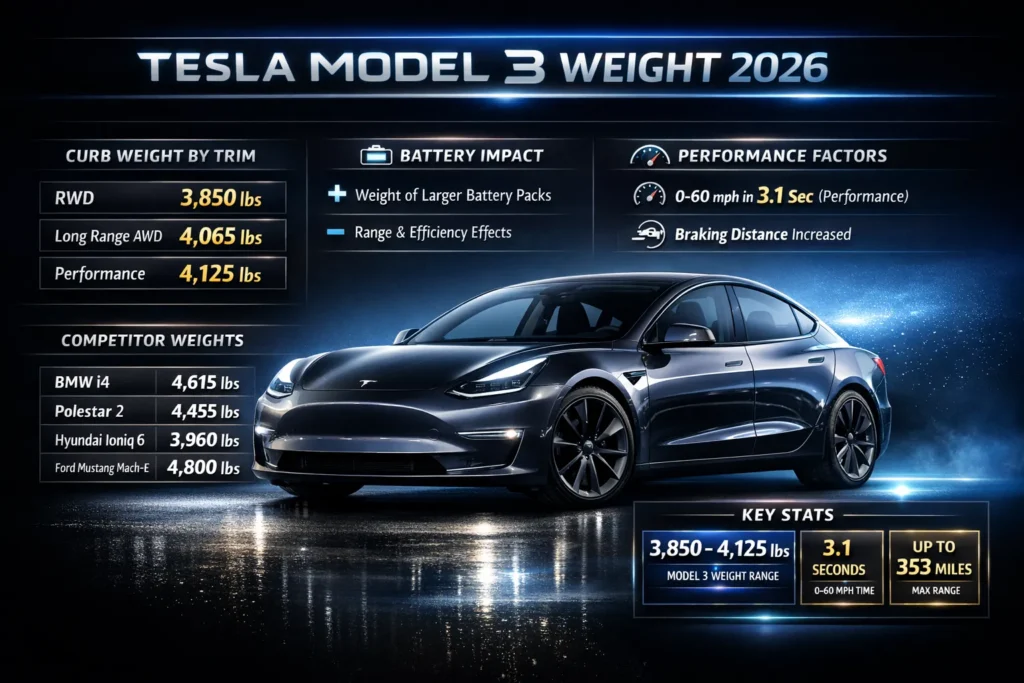
| Vehicle | Approx Weight |
| Tesla Model 3 | ~1,705 – 1,839 kg |
| BMW 3 Series | ~1,500 – 1,700 kg |
| Audi A4 | ~1,550 – 1,750 kg |
| Hyundai Ioniq 6 | ~1,850 kg |
Key Observation
Tesla is heavier than most petrol-powered sedans because of battery technology.
However:
- It may be lighter than some large EV competitors
- It delivers higher torque efficiency
Pros and Cons
Advantages
- Stable high-speed performance
- Strong crash protection
- Enhanced road grip
- Excellent handling balance
- Superior acceleration control
Disadvantages
- Increased tire wear
- Slight reduction in maximum efficiency
- Higher energy consumption under heavy load
- Increased transportation cost
Maintenance & Ownership Impact
Maintenance Advantages
No engine oil changes
Fewer mechanical parts
Reduced internal combustion wear
Lower engine-related repair needs
Resale Value Consideration
Few realize how much battery condition sways a car’s secondhand price – far beyond what its heft suggests.
Battery health in top shape? That drives buyer interest up. When power cells hold charge well, more people want what you’re selling.
FAQs
A: It weighs between approximately 1,705 kg and 1,839 kg, depending on trim configuration.
A: Yes.
Electric vehicles require large battery packs.
However, weight improves stability and safety.
A: Slightly.
But regenerative braking and smart power control improve efficiency.
A: Because it includes:
Larger battery system
High-output motors
Advanced braking setup
Performance hardware upgrades
A: Yes, but instant torque from electric motors compensates for additional mass.
Conclusion:
The Tesla Model 3’s weight directly influences:
Performance capability
Safety performance
Energy efficiency
Handling stability
Structural durability
Although heavier than conventional sedans, the mass is intelligently engineered to enhance road control and crash protection.
If you prioritize:
Speed
Electric efficiency
Sustainable technology
Strong safety design
Then the Model 3 remains one of the most balanced electric sedans in the Market.