Introduction
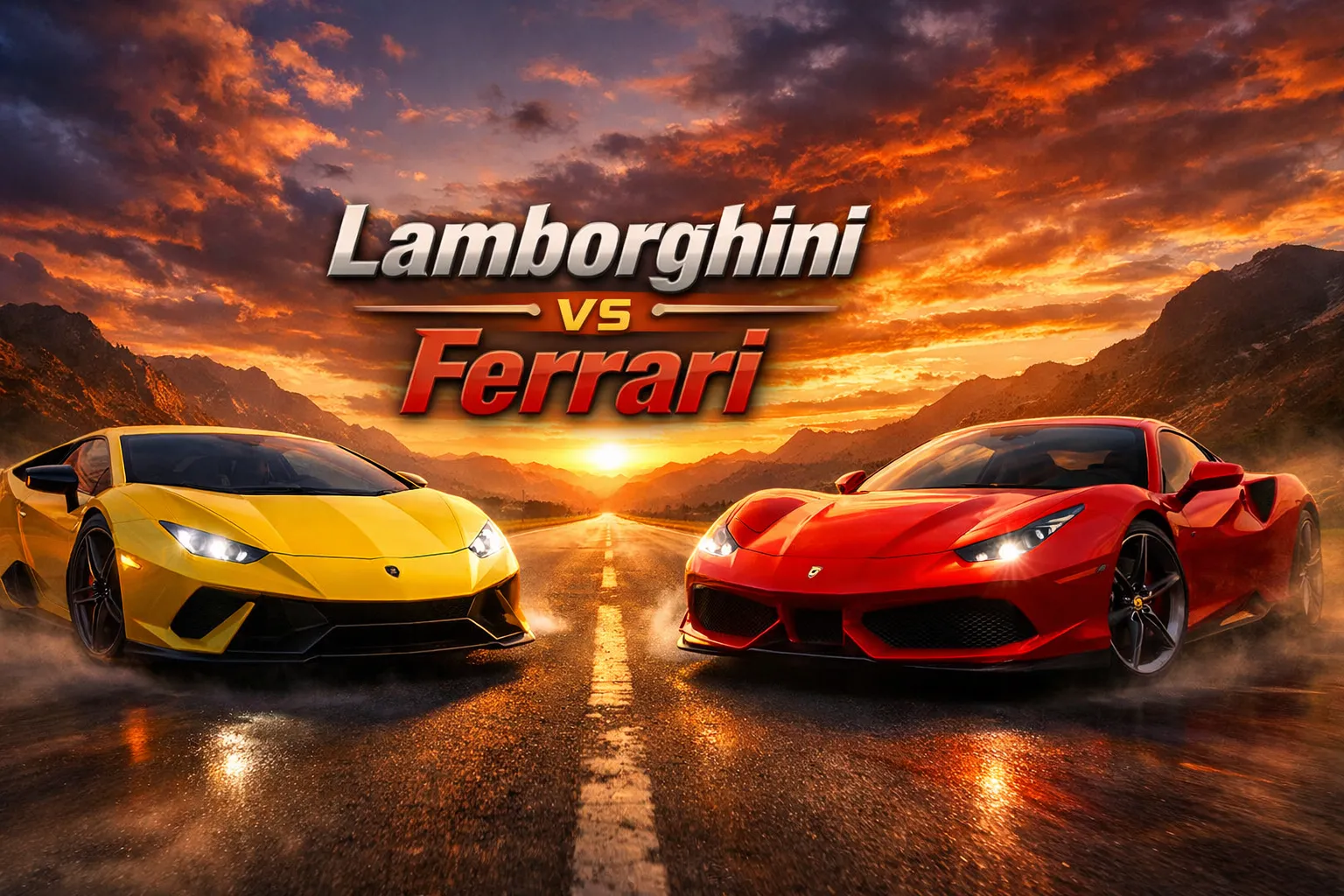
Fighting began long ago when a man walked away from a brand he helped build. Sixty years now stretch behind them both – two names shouting through roaring engines across winding roads. One crafts wild shapes that slice air like knives. The other builds lightning wrapped in curves that breathe fire at full throttle. Speed became their language, loud where words fail. Each machine born from stubborn pride speaks without sound.
One thing stands clear – these two brands sit at the top when it comes to car making, speed breakthroughs, and fine details. Still, how they shape each vehicle, what they stand for, feels worlds apart.
Faster than most think possible, Ferrari builds machines where every part has a purpose. Racing isn’t just history here – it shapes how each car moves, turns, and stops. From the start, speed has been shaped by real tracks, not test simulations. Design follows function, yet never forgets sound, feel, and weight. Formula One victories feed directly into what happens on regular roads. Engineering choices favor response over comfort, always. Each curve exists to manage air, nothing more. Heritage shows up in steering feedback, gear shifts, brake timing – not plaques or logos.
Lamborghini builds machines that shout through shape, their presence loud not by accident but by design. Instead of quiet grace, think sharp edges under sunlight, a stance like it’s mid-snarl. Where others whisper, these cars yell – lines slicing air, headlights glaring. Performance feels wilder here, less polished, more raw nerve than fine-tuning. You do not glide in one; you erupt across roads. While some favor subtlety, Lamborghini trades silence for roar, elegance for impact. Each model stands out not because it tries, but because it cannot help itself.
Digital technology and infotainment systems
Folks who love fast cars, those who gather them like treasures, even writers covering wheels – this one talk never fades among them
Built to impress, each maker turns out top-tier machines – yet one speaks to thrill-seekers while the other draws those who value legacy. Speed lovers might lean toward sharp handling, whereas tradition-minded drivers often favor timeless design cues. Some chase raw power numbers; others care more about how a car feels on quiet backroads. Enthusiasts collect them for different reasons – one brand stirs emotion through bold moves, the other builds loyalty via steady evolution. In the end, it’s less about specs and more about which story fits your own.
Luxury inside meets comfort shaped by how you sit. Yet every touch feels placed just right for your hands. Because driving connects through details that respond when needed
- Model lineup and market positioning
- Ownership costs and long-term maintenance
- Investment value and collector appeal
- The future of hybrid and electric supercars
When this thorough walkthrough wraps up, it’ll be clear how each marque fits your habits behind the wheel, daily routine, and long-term plans. Though packed with insight, the conclusion won’t shout answers – instead, clues build quietly, matching real-world needs to engineering intent. Because choices hinge on more than specs, emotions steer just as much as data
Quick Overview:
Before exploring the rivalry in depth, it helps to understand the fundamental differences between Ferrari and Lamborghini through a simplified comparison.
| Feature | Ferrari | Lamborghini |
| Engine Technology | Turbocharged V8 / Hybrid V6 / V12 | Naturally Aspirated V10 / V12 / Hybrid |
| Power Output | 600 – 986+ HP | 600 – 1001+ HP |
| Transmission | Dual-clutch automatic | Dual-clutch automatic |
| Fuel Type | Petrol / Hybrid | Petrol / Hybrid |
| Vehicle Segment | Supercar / Hypercar | Supercar / Hypercar |
| Seating Capacity | 2 | 2 |
| Top Speed | 330 – 350+ km/h | 325 – 350+ km/h |
| Acceleration (0–100 km/h) | 2.5 – 3.0 seconds | 2.5 – 3.0 seconds |
| Brand Identity | Motorsport heritage | Radical performance |
Funny how numbers can look nearly identical, yet one car feels alive while the other just moves. Each brand stirs a separate mood, even when speed or fuel figures match on paper. One grips your chest like a story worth remembering. The other passes through without leaving much behind.
Ferrum cars feel alive when they glide through curves, their shape slicing air with quiet purpose. Loud engines roar down highways inside Lambo machines, built to turn heads with bold lines and a stance that dares you to look away.
Lamborghini And Ferrari:
Ferruccio Lamborghini started building cars because he wanted something different from what existed. Back then, fast machines were loud, rough around the edges – Ferrari dominated that world. He wasn’t impressed by their clutch systems after buying several models. So instead of complaining forever, he decided to build his own version. That choice lit a spark that others would feel later. One man’s frustration became an entire brand’s foundation.
The Origin of Lamborghini
Ferruccio Lamborghini made his fortune building farm equipment long before he ever thought about sports cars. Tractors rolled off his production lines while dreams of fast vehicles stayed tucked away. Wealth came first through soil-stained Machines powered by diesel grit. Only later did roaring engines replace the hum of harvest tools. His hands shaped steel for plows prior to shaping legends on racetracks.
Ferrari ownership didn’t impress him much – mechanical hiccups, especially clutches, wore thin fast.
Folks say Ferruccio went straight to Enzo Ferrari to voice his concerns. That meeting? Supposedly didn’t go well – Enzo brushed him off, saying farming machines were more his speed.
Fueled by that remark, Ferruccio Lamborghini started building his own brand of sports cars in 1963, driven by one purpose
Ferrari classics
- Ferrari 250 GTO
- Ferrari Daytona
- Ferrari F40
- Lamborghini legends
- Lamborghini Miura
- Lamborghini Countach
- Lamborghini Diablo
Flying past old norms, these cars placed engines behind drivers instead of up front. Sleek shapes cut through the air like nothing before. Wild looks turned heads instantly. All together, they redefined what it meant to be a top-tier performance machine.
Exterior Design of Ferrari and Lamborghini
What shapes each car comes down to very different thinking when you look at Ferrari next to Lamborghini.
Ferrari Design Philosophy
Beauty that lasts decades defines Ferrari cars, yet their shape cuts through the air like a blade. Sculpted lines flow across each model, so form meets function without compromise. Smooth curves guide speed, while design speaks louder than words ever could.
Curved body lines, sharp headlights, low stance, wide grille, circular taillights
- Fluid aerodynamic curves
- Sleek, low-profile silhouettes
- Elegant Italian styling language
- Functional air intakes
- Distinctive Ferrari grille design
Examples of beautifully designed Ferrari models include:
- Ferrari 458 Italia
- Ferrari F8 Tributo
- Ferrari Roma
Fresh shapes stay fresh longer when they flow like air itself, which Ferrari gets right by keeping lines uncluttered. Instead of shouting with sharp edges, their Cars whisper through the wind with balanced curves that time forgets to fade.
Lamborghini Design Philosophy
From another angle entirely, Lamborghini sees car-making unlike anyone else.
Futuristic shapes define their vehicles, sharp edges standing out by design. Daring lines catch the eye, built that way on purpose. Drama in form comes through clearly, angles chosen to impress. Boldness runs throughout each model, never accidental.
signature Lamborghini design features
- Sharp geometric body lines
- Massive air intakes and vents
- Y-shaped LED lighting patterns
- Large rear diffusers
Opening like wings, the famous doors rise upward on top-tier cars powered by twelve cylinders
- modern Lamborghini vehicles like
- Lamborghini Aventador
Lamborghini Revuelto
- Flying machines turned street riders; they resemble jets on wheels.
- Folks who love cars usually point to an old phrase when explaining how design ideas differ
- “Ferrari is a tailored Italian suit, while Lamborghini is a spacecraft.”
Interior & Comfort
Even when speed takes center stage, how well the inside is built matters just as much. Comfort still shapes what a true high-end sports car feels like today.
Ferrari Interior Experience
Inside a Ferrari, every detail pulls toward the person behind the wheel. Comfort meets control without extra fuss.
Inside the cabin, shapes echo those seen on F1 machines, so vital buttons sit close at hand. What stands out is how reachability guides layout choices. Noticeable too – how every switch falls naturally under fingertips.
Ferrari interior highlights include:
- Steering wheel integrated controls
- Premium leather and Alcantara upholstery
- Carbon fiber decorative elements
- Minimalist dashboard layout
- Digital instrument cluster
Ferrari’s racing roots show clearly in a space built for speed. Sharp details stand out, not decoration. Every piece works toward motion, never clutter. Precision shapes the feel, not flash. Function leads, always.
Lamborghini Interior Experience
Futuristic flair shapes the feel inside Lamborghinis, where drama takes center stage instead of subtle design.
A cockpit shaped by sharp angles surprises with its intensity. Materials speak loudly, not softly, forming an environment edged with purpose.
Lamborghini Interior Highlights
- Hexagonal design motifs
- Aircraft-style start button
- Large digital instrument panel
- Aggressive carbon fiber accents
- Extensive color customization
Firing up a Lamborghini, plenty of drivers describe it less like turning a key and more like activating something built for speed. The moment hums with energy, not just motion.
Engine & Performance
Ferrari versus Lamborghini? That rivalry burns brightest in performance engineering.
Ferrari Performance Strategy
Fuel pressure surges forward when the engine breathes through twin-scroll housings. Electric torque arrives just before peak cylinder combustion, smoothing out delivery across mid-range revs.
Ferrari’s newer cars mix gasoline engines with electric drive units, boosting performance without wasting fuel.
Examples include:
- Ferrari 296 GTBHybrid V6 engineAround 819 horsepower
- Hybrid V6 engine
- Around 819 horsepower
- Ferrari SF90 StradaleHybrid V8 engineAround 986 Horsepower
- Hybrid V8 engine
- Around 986 horsepower
Ferrari focuses on:
- Lightweight construction
- Advanced aerodynamics
- Precision handling
- Track-optimized performance
Ferrari cars tend to handle fast motion with sharp reactions, steady control, one might say – smooth foresight when pushed hard.
Thunder rolled from Lamborghini’s old engines, built without turbos, alive with every rev. Their power surged straight, unfiltered, through open intakes, breathing hard at high speeds.
Examples include:
- Lamborghini Huracán
- Lamborghini Aventador
Fuel meets electric power inside today’s Lamborghini models. A new era rolls forward under one roof.
For example:
Lamborghini Revuelto
Over a thousand horsepower comes from a V12 engine mixed with electric drive tech.
Lamborghini engineering emphasizes:
- explosive acceleration
- dramatic engine sound
- emotional power delivery
Speeding in a Lamborghini hits hard – loud, fast, alive. Moments stretch when tires scream on pavement. A blur of color rushes past windows. Engines roar like something untamed waking up. Heads turn every time it stops.
Acceleration & Top Speed
Both brands build extremely fast production vehicles.
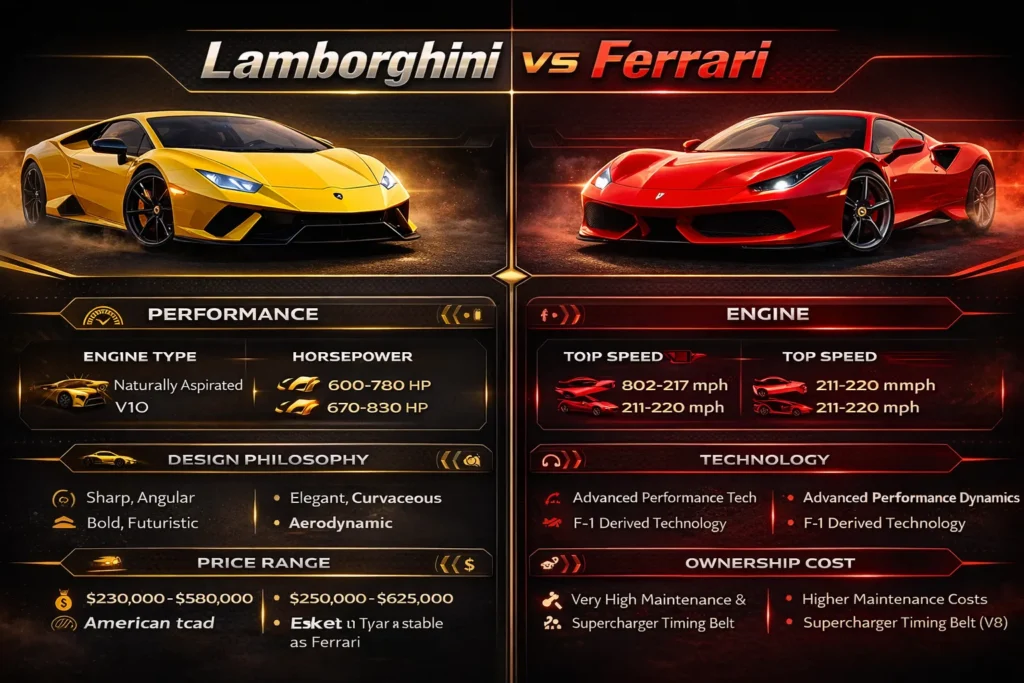
| Performance Metric | Ferrari | Lamborghini |
| 0–100 km/h | 2.5 – 3 seconds | 2.5 – 3 seconds |
| Top Speed | 330 – 350+ km/h | 325 – 350+ km/h |
| Maximum Horsepower | Up to 986+ HP | Up to 1001+ HP |
In real-world conditions, performance differences are minimal.
Instead, the distinction lies in driving character.
Ferrari delivers precision and control, while Lamborghini emphasizes drama and excitement.
Fuel Economy & Driving Range
Fuel efficiency rarely influences supercar purchasing decisions.
However, hybrid systems have improved efficiency in modern performance cars.
| Brand | Average Fuel Economy |
| Ferrari | 6–9 km/L |
| Lamborghini | 5–8 km/L |
Safety Features
Despite their extreme performance capabilities, modern supercars include advanced safety technologies.
Common safety features include:
- Multiple airbags
- Anti-lock braking system (ABS)
- Electronic stability control
- Traction management systems
- Carbon-ceramic braking systems
Advanced driver assistance technologies may include:
- Adaptive cruise control
- Parking sensors
- Lane monitoring systems
Technology & Infotainment
Modern supercars integrate sophisticated digital technology.
Ferrari Technology
Ferrari’s technology systems are primarily designed to enhance performance analytics and driving precision.
Key Ferrari technology features include:
- Digital instrument display
- Performance telemetry system
- Advanced traction control algorithms
- Apple CarPlay integration
These systems allow drivers to monitor vehicle performance in real time.
Lamborghini Technology
Lamborghini balances performance technology with modern entertainment systems.
Typical features include:
- Large touchscreen infotainment system
- Smartphone connectivity
- Digital driver display
- Multiple customizable driving modes
Lamborghini interiors, therefore, feel more futuristic and interactive.
Ferrari vs Lamborghini Model Range
Ferrari Model Range
offers a diverse lineup of high-performance vehicles.
Popular models include:
- Ferrari 296 GTB
- Ferrari Roma
- Ferrari SF90 Stradale
- Ferrari Purosangue
Ferrari also releases limited-production collector cars that often become extremely valuable.
Lamborghini Model Range
Lamborghini currently sells several high-performance models.
Key vehicles include:
- Lamborghini Huracán
- Lamborghini Revuelto
- Lamborghini Urus
The Urus SUV significantly increased Lamborghini’s global sales by expanding into the luxury SUV market.
Head-to-Head Comparison
| Feature | Ferrari | Lamborghini |
| Design Style | Elegant & aerodynamic | Aggressive & futuristic |
| Driving Feel | Precise & balanced | Powerful & dramatic |
| Engine Character | Turbocharged / Hybrid | Naturally aspirated / Hybrid |
| Motorsport Heritage | Strong Formula 1 legacy | Limited racing presence |
| Brand Image | Sophisticated luxury | Bold exotic performance |
Pros & Cons
Ferrari Pros
- Legendary Formula 1 heritage
- Exceptional handling dynamics
- Strong resale value
- Elegant timeless design
- Advanced hybrid engineering
Ferrari Cons
- Extremely expensive maintenance
- Limited production availability
- Less dramatic styling compared to Lamborghini
- Long waiting lists for certain models
Lamborghini pros and cons
pros
- Aggressive futuristic design
- Incredible engine sound
- Extreme road presence
- Emotional driving experience
Cons
- Lower resale value compared to the Ferrari
- Interior ergonomics is sometimes less refined
- Higher fuel consumption
lamborghini vs Ferrari:
Choose Ferrari if you want:
- racing heritage
- precise handling
- elegant design
- long-term collector value
Choose Lamborghini if you want:
- extreme styling
- loud naturally aspirated engines
- emotional driving experience
- maximum road presence
Both brands produce elite supercars, but they attract different personalities.
Other Supercar Competitors
Besides Ferrari and Lamborghini, several other manufacturers compete in the high-performance supercar market.
McLaren Automotive
Known for lightweight engineering, advanced aerodynamics, and track-focused performance.
Porsche
Especially models like the Porsche 911 Turbo.
Porsche emphasizes reliability and everyday usability.
Aston Martin
Offers elegant grand-touring supercars with powerful engines and sophisticated styling.
Maintenance & Ownership Costs
Owning a Ferrari or Lamborghini involves a significant financial commitment beyond the purchase price.
Service Costs
Annual maintenance expenses can reach thousands of dollars due to specialized parts and high-performance components.
Parts Availability
Both brands operate official service networks worldwide, but replacement parts remain extremely expensive.
Resale Value
Ferrari vehicles typically maintain stronger resale value because of:
- limited production numbers
- collector demand
- strong brand prestige
However, certain Lamborghini models, such as the Aventador SVJ, have also appreciated significantly.
The Future:
The future of the Ferrari vs Lamborghini rivalry will increasingly involve electrification.
Ferrari already offers hybrid supercars such as:
- Ferrari SF90 Stradale
- Ferrari 296 GTB
Lamborghini has also entered the hybrid era with the Revuelto.
Both companies are actively developing next-generation electric supercars that combine instant torque, advanced battery technology, and high-performance engineering.
The rivalry is therefore likely to continue for decades as both brands compete to define the next era of performance vehicles.
FAQs
A: Both brands produce extremely fast cars. Modern models from both companies can exceed 340 km/h, so the performance difference depends on the specific model.
A: Ferrari cars often have higher resale value and exclusivity, but the price depends on the model and rarity.
A: Lamborghini intentionally uses sharp lines and extreme shapes to create a dramatic visual impact.
A: Ferrari is often preferred by collectors because of its Formula 1 heritage and limited production models.
Final Verdict:
The Lamborghini vs Ferrari rivalry remains one of the most legendary competitions in the automotive industry.
Both brands constantly push each other to innovate, resulting in increasingly advanced supercars.
Ferrari emphasizes:
- racing heritage
- engineering precision
- elegant design
- collector value
Lamborghini emphasizes:
- dramatic styling
- emotional driving experiences
- extreme performance
- unmistakable road presence
Ultimately, choosing between Ferrari and Lamborghini comes down to personal preference.
Drivers who appreciate refined engineering and motorsport history often gravitate toward Ferrari.
Those who prefer theatrical design and adrenaline-filled Performance may favor Lamborghini.