Ferrari 348 Coupe
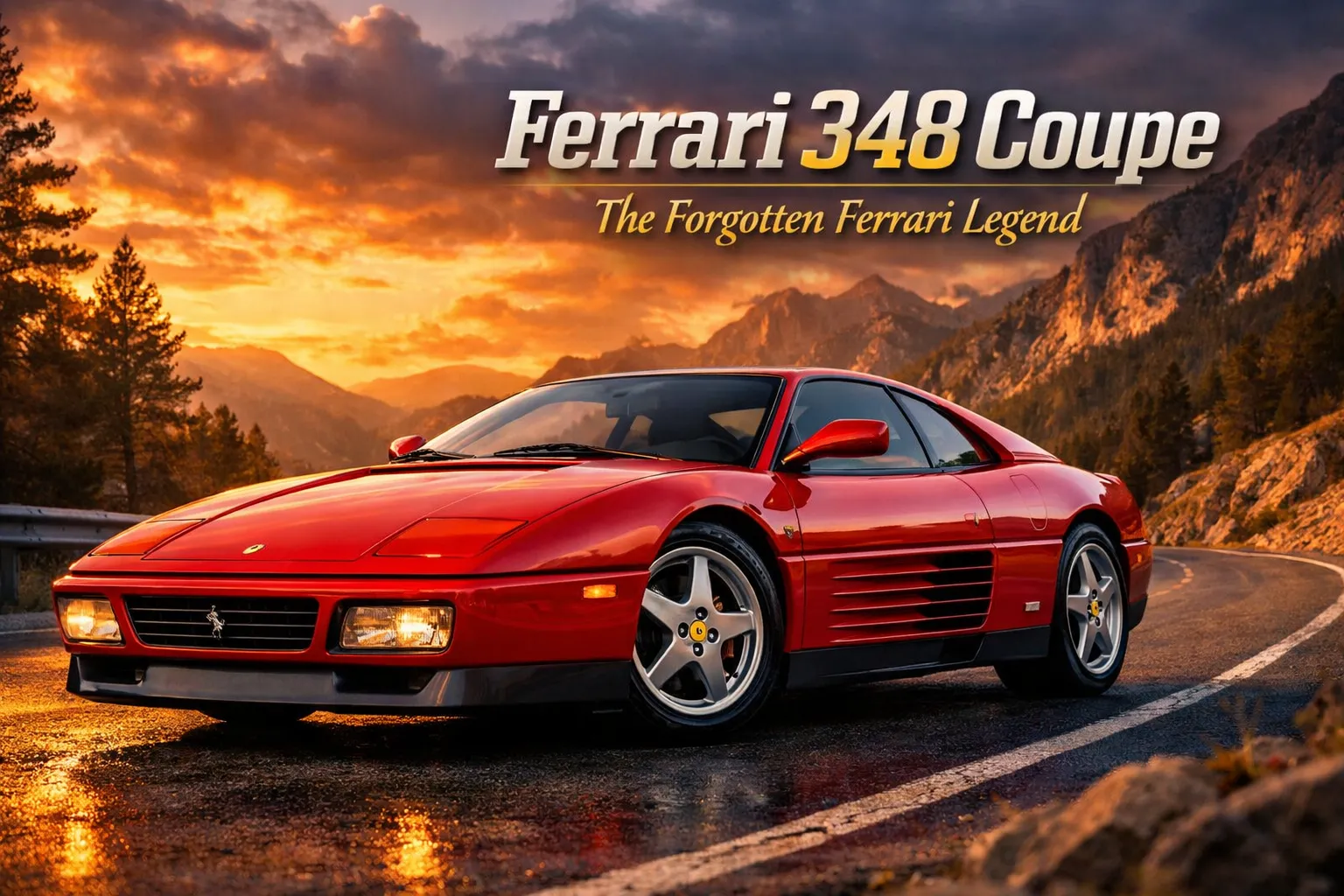
The Ferrari 348 Coupe captures a time when driving felt raw, mechanical, and deeply connected to the road. Beneath the surface, a V8 spins fast, its rhythm steady, channeled by a metal shifter that snaps precisely into position. Curves flow into hard lines, shaping the 348 Coupe with tension, as if it might lurch forward any second. Behind the wheel, you register every crack in the pavement, notice each shift, and experience the road without electronic filters softening the feedback. Built from the late 1980s into the early 1990s, the Ferrari 348 Coupe arrived in an era when performance revealed itself through sound, vibration, and pure mechanical response rather than screens and digital controls.
Ferrari 348 Coupe Quick Overview
Before examining the car in depth, here is a quick snapshot of the Ferrari 348 Coupe’s primary specifications.
| Specification | Ferrari 348 Coupe |
| Engine | 3.4L Naturally Aspirated V8 |
| Power | ~300 hp |
| Torque | ~324 Nm |
| Transmission | 5-Speed Manual |
| Drivetrain | Rear-Wheel Drive |
| Fuel Type | Petrol |
| Body Type | Two-Door Coupe |
| Seating Capacity | 2 Seats |
| Top Speed | ~275 km/h |
| 0–100 km/h | ~5.3 seconds |
| Production Years | 1989–1995 |
Speed like that put the Ferrari 348 Coupe ahead of most rivals when it launched in the early Nineties. Few cars matched its rush back then.
Still, numbers miss what makes the car real. It’s the raw feel behind the wheel that defines the Ferrari 348. Each move you make answers back through movement, building a tight link – hand, foot, engine, road. That bond isn’t built by data.
Ferrari 348 Coupe Through Time
The Next Ferrari After the 328
When the 1980s drew close, Ferrari began searching for a successor to the well-liked 328. Pushing ahead meant updating their mid-engine V8 lineup while still holding tight to racing origins.
Flying into view at the 1989 Frankfurt auto show, the 348 made its first public appearance through Ferrari’s unveiling. Looks might have echoed the past, yet beneath the surface, progress surged – leaving earlier models trailing well behind.
Key improvements included:
Power shows up differently now, thanks to a brand-new 3.4-liter V8 under the skin. Built from nothing, every piece fits this purpose. That kind of start changes how it moves. The engine breathes deep, responds quickly. Nothing carried over, only new solutions inside. This is where force begins – clean design, full intent
- Completely redesigned bodywork by Pininfarina
- Longitudinal engine configuration
- Enhanced aerodynamic efficiency
Firmly planted out there, the wider base keeps things steady. Moving ahead feels smoother because the space between wheels has grown
Faster laps? That happened after changes beneath the hood. Sharp edges along the body made it stand out more on busy roads. When speeds climbed high on long stretches, the stronger frame kept everything in check.
Ferrari In The Early Nineties
Midway through Ferrari’s journey, the 348 slipped into view. Not quite modern, yet not entirely old, it stood between eras. Behind its curves hid a design nearing its final form. Before computers took over every detail, engineers shaped cars like this by hand. The nineties would bring changes – faster systems, sharper precision – but until then, machines like the 348 ruled. Its time came just before everything shifted gears.
Ferrari built multiple versions of the 348 from 1989 to 1995, tweaking its mechanics along the way. Improvements came slowly, shaped by small changes under the hood. Each update refined how the vehicle performed. Engineering tweaks followed one after another, year by year. The model evolved without sudden leaps – just steady progress. By the end of that period, it ran better than before. Design shifts were subtle, never flashy. Most changes happened behind the scenes. Performance grew more polished over time. Details mattered most during those years.
One test Driver found the steering a bit off at first. Still, tweaks over time – softer shocks, grippier rubber – brought it into step. Motion felt sharper after those changes settled in.
Ferrari’s 348 stands out now – not back then – as the machine that bridged raw eighties speedsters and smoother models arriving by the mid-nineties. What came before felt wilder; what arrived after drove easier.
Exterior Design
Pininfarina Styling Philosophy
A sharp silhouette emerges under Pininfarina’s hand – this one belongs to the Ferrari 348 Coupe, shaped by a studio that defined decades of roaring Italian profiles. Though many names touched Ferrari’s legacy, few carved forms as lasting as this team, where sketches became spine-tingling machines on open roads.
From the start, building the car meant hitting three big goals. Each piece shaped another, like steps in a dance. Not just looks, but how it feels to drive mattered most. Power moved through the frame with purpose. Inside, space opened up without feeling empty. Every choice pointed back to those core ideas
Modernizing Ferrari’s sports car aesthetics
Improving aerodynamic performance
Preserving Ferrari’s aggressive supercar identity
Fresh shapes came straight from the Ferrari Testarossa – those wide side vents, that bold back end. From its shadowy profile rose cues that shaped both airflow paths and tail contours. Boldness wasn’t borrowed; it echoed through slatted openings along the flank. Instead of copying, details transformed into something familiar yet new. Deep cuts on the sides? They trace right back to that Italian classic. The rear didn’t mimic – it answered with presence. Lines spoke louder than homage ever could.
Distinctive Exterior Features
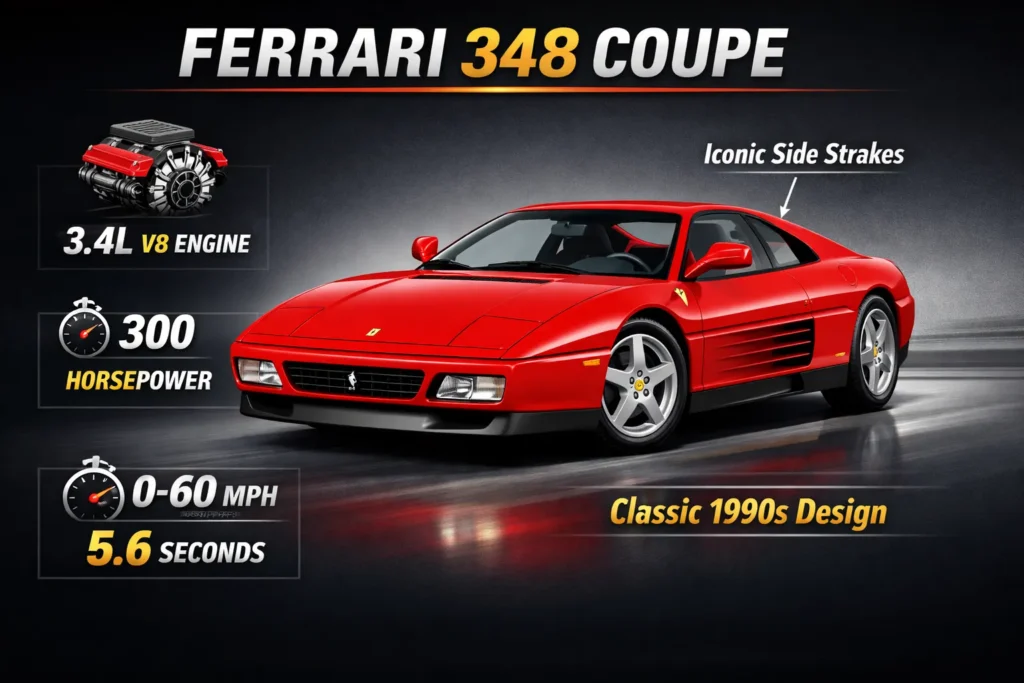
Out front, sharp lines slice through the air like a knife. Its pop-up headlights give the face a quiet intensity. Notice how the side strakes echo jet fighter intakes. The rear deck slopes just enough to suggest speed, even at rest. Round taillights glow without shouting. Panels fit tight, each curve speaking of precision. This shape talks before the engine fires up.
Among the standout visuals are
Fresh breezes funnel into flank scoops, rushing toward the center-set powerplant
Horizontal rear grille reminiscent of the Testarossa
Classic pop-up headlights
Wide rear stance for improved stability
Sharp wedge-shaped body silhouette
Over thirty years on, the look holds its punch – sharp choices back then now feel just as alive. A daring mix, built to last, lands differently today but hits just the same.
Wheels and Proportions
Unlike the Ferrari 328, the 348 took a different shape in key ways. Still, it kept the spirit of its predecessor while stretching into new dimensions.
Stability got a boost thanks to the broader stance, while ride smoothness benefited from extra length between wheels
- High-speed composure
- Cornering capability
Vehicle balance
Fitted with unique five-spoke alloy wheels, the car strikes a bold posture while amplifying its athletic look. Its stance gains presence through these custom rims, shaping a sharper profile on the road.
The Ferrari 348 Coupe still stands out now, decades later, as a shape people instantly link to Ferraris of the early nineties.
Interior and Driver Experience
Driver-Focused Cabin
The cockpit of the Ferrari 348 Coupe puts the person behind the wheel first. Every detail fits their reach, their view, their motion. Controls sit where fingers fall without thought. The seat holds tight through sharp turns. Instruments face only the driver, clear under bright sun or deep night. Even the sound wraps around them alone. This car speaks directly to those who drive.
Far from today’s cars packed with touchscreens and digital buttons, this one chooses clear layouts and fast responses. Inside, fewer gadgets mean quicker reactions when it matters most.
The cockpit focuses on:
- Clear instrument visibility
- Simple control layout
- Minimal distractions
- Direct driver engagement
Focusing only on what matters keeps attention where it should be – hands on the wheel, Eyes ahead. A clean setup means fewer distractions pull focus from the task at hand. Simplicity in design supports sharper awareness without clutter demanding notice. The idea is not about missing features but keeping mindspace clear. Driving becomes more direct when nothing competes for mental room.
Dashboard Layout
Out front, a few classic Ferrari touches make their way into the dashboard design.
Key highlights include:
- Large analog gauges
- The central tachometer dominates the instrument cluster
- Straightforward switchgear
- Compact center console
Filled with intent, the cockpit feels built around spirited drives. Every piece sits just right for someone eager to push through corners.
Legendary Gated Manual Gearbox
Ferrari 348’s cabin grabs attention fast – thanks to its exposed metal gear selector. Built without covers, the shift mechanism shows every movement. Metal bars frame each gate, guiding shifts by hand. This setup links the driver to the machine, raw and unfiltered. Few cars dare to show mechanics so openly inside. The design shouts precision, built for those who feel every change. Not hidden away, it stands out like art made to touch.
Every gear change brings a sharp metal click, built into how this Ferrari feels. The way it’s made makes that sound happen without fail.
Some fans say that clicking through gears by hand feels like driving Ferraris back when they meant something real. That raw connection? It came from a time before computers ran everything under the hood.
Seats and Materials
Ferrari wraps the 348’s cabin in soft Italian hide, while careful craftsmanship shapes each surface. Fine details appear throughout because material choices favor richness without flash. Every touchpoint feels deliberate, since function blends quietly with elegance.
Interior highlights include:
- Supportive bucket seats
- Hand-stitched leather upholstery
- Adjustable steering wheel
Driver-centric cockpit layout
Even with less Room inside, sitting here lets you steer sharply while seeing clearly on quick drives.
Engine & Performance
3.4 Liter Naturally Aspirated V8
In the middle of the Ferrari 348 Coupe lives a 3.4-liter naturally aspirated V8 motor.
Behind the driver sits the engine, placed lengthwise, linking directly to a sideways-facing transmission unit.
Curiously enough, the number “348” ties back to how the engine is built
3.4 liters
8 cylinders
A scream at the top of its lungs – that’s what this engine lets out when pushed hard, a note that echoes through decades of iconic Ferraris.
Performance Specifications
| Performance Metric | Ferrari 348 Coupe |
| Engine | 3.4L V8 |
| Horsepower | ~300 hp |
| Torque | ~324 Nm |
| 0–100 km/h | ~5.3 seconds |
| Top Speed | ~275 km/h |
During the early 1990s, these numbers positioned the Ferrari 348 among the fastest production sports cars available.
Real Driving Experience
Driving the Ferrari 348 Coupe feels dramatically different compared with modern supercars.
Key characteristics include:
- Immediate steering feedback
- High-revving engine soundtrack
- Lightweight chassis response
- Precise manual gear engagement
Because the car lacks extensive electronic assistance systems, the driver experiences the vehicle in its purest form.
For this reason, many enthusiasts consider the Ferrari 348 one of the last truly analog Ferraris.
Fuel Economy and Driving Range
Fuel efficiency was never a primary priority for Ferrari sports cars during the early 1990s.
Nevertheless, the Ferrari 348 Coupe Delivers reasonable efficiency for a high-performance V8 vehicle.
| Driving Condition | Fuel Economy |
| City | ~13–15 mpg |
| Highway | ~18–20 mpg |
| Combined | ~16 mpg |
Although fuel consumption may seem high compared with modern vehicles, it remains typical for naturally aspirated performance engines from this era.
Safety Features
Compared with modern vehicles, safety technology in the Ferrari 348 is relatively basic.
However, the car still included several important safety features for its time.
Key safety elements include:
- Anti-lock braking system (ABS)
- Reinforced steel chassis structure
- High-performance ventilated disc brakes
- Side-impact protection beams
- Strong passenger safety cell
Drivers should remember that the Ferrari 348 requires skill and concentration, as modern electronic stability systems are not present.
Technology & Infotainment
Technology inside the Ferrari 348 Coupe is minimal by contemporary standards.
Ironically, this simplicity is exactly what makes the car appealing to collectors.
Technology features include:
- Basic radio audio system
- Manual climate control
- Analog instrument cluster
- Traditional switches and knobs
There are no touchscreen displays, smartphone integrations, or digital driver-assistance technologies.
Instead, the focus remains entirely on the driving experience.
Ferrari 348 Variants and Production Versions
During its production run, Ferrari introduced several versions of the Ferrari 348 platform.
| Model | Description |
| 348 TB | Coupe (Berlinetta) |
| 348 TS | Targa version |
| 348 Spider | Convertible |
| 348 GTB | Improved coupe |
| 348 GTS | Updated targa |
The Ferrari 348 TB remains the traditional coupe version and is Especially popular among collectors.
Across all variants, Ferrari produced approximately 8,844 vehicles.
Ferrari 348 vs Ferrari 328
| Feature | Ferrari 328 | Ferrari 348 |
| Engine | 3.2L V8 | 3.4L V8 |
| Power | 270 hp | 300 hp |
| Design | Classic 1980s | Testarossa-inspired |
| Handling | Balanced | Wider and more aggressive |
| Production | 1985–1989 | 1989–1995 |
The Ferrari 348 represented a substantial modernization of Ferrari’s mid-engine V8 sports-car architecture.
Ferrari 348 vs Ferrari F355
| Feature | Ferrari 348 | Ferrari F355 |
| Power | 300 hp | 375 hp |
| Engine | 3.4L V8 | 3.5L V8 |
| Technology | Analog | More advanced |
| Handling | Raw | Refined |
| Market Value | Lower | Higher |
Although the Ferrari F355 delivered improved performance and technology, many collectors now appreciate the Ferrari 348 for its simpler mechanical character.
Pros & Cons
Pros
- Iconic Ferrari design
- Authentic analog driving experience
- High-revving naturally aspirated V8 engine
- Legendary gated manual gearbox
- Increasing collector interest
Cons
- Expensive maintenance costs
- Limited modern safety technology
- Early models received handling criticism
- Fuel consumption is relatively high
Maintenance & Ownership Costs
Owning a Ferrari 348 Coupe requires commitment and proper maintenance.
Like many classic Ferraris, service costs can be substantial.
| Service Type | Estimated Cost |
| Major Service | $6,000 – $12,000 |
| Clutch Replacement | $3,000 – $5,000 |
| Annual Maintenance | $2,000 – $4,000 |
Routine servicing is essential to keep the vehicle operating reliably and preserving its long-term value.
Reliability Considerations
Some commonly reported reliability issues include:
- Timing belt replacement requirements
- Aging electrical components
- Early suspension tuning limitations
Most of these concerns can be avoided by purchasing a well-maintained vehicle with complete service documentation.
Ferrari 348 Market Value & Investment Potential
During the past decade, Ferrari 348 prices have steadily increased.
Collectors increasingly recognize the car as an important modern classic Ferrari.
Several factors are driving its rising value:
- Limited production numbers
- Growing demand for analog sports cars
- Classic Ferrari styling
- Increasing collector interest
For many enthusiasts, the Ferrari 348 Coupe represents one of the most accessible entry points into Ferrari ownership.
Expert Buying Tips for Ferrari 348 Coupe
If you are considering buying a Ferrari 348 Coupe, keep these important tips in mind.
1. Check Service History
Always look for a car with complete maintenance records and documented servicing.
2. Inspect Timing Belt Service
Timing belt replacement is critical for Ferrari V8 engines and should be performed regularly.
3. Look for Later Models
Later versions, such as the 348 GTB, feature improved handling and mechanical refinements.
4. Professional Inspection
A pre-purchase inspection by a Ferrari specialist is highly recommended before buying.
Who Should Buy the Ferrari 348 Coupe?
The Ferrari 348 Coupe is ideal for:
- Classic car collectors
- Ferrari enthusiasts
- Drivers who appreciate analog sports cars
- Weekend performance car owners
- Investors seeking appreciating classic vehicles
However, it may not be ideal for buyers seeking modern luxury features or everyday practicality.
FAQs
A: Yes. Many collectors believe the Ferrari 348 is becoming a valuable classic Ferrari due to its analog driving experience and limited production.
A: The Ferrari 348 Coupe can reach approximately 275 km/h (171 mph) with a 0–100 km/h time of about 5.3 seconds.
A: Ferrari produced around 8,844 units of the 348 across all variants between 1989 and 1995.
A: “TB” stands for Transversale Berlinetta, referring to the coupe body style and engine layout.
Final Verdict
The Ferrari 348 Coupe remains one of the most intriguing classic Ferraris from the early 1990s.
Although it was once overshadowed by the Ferrari F355, enthusiasts today recognize the 348 as a genuine analog Ferrari sports car.
With its:
- Aggressive Pininfarina styling
- High-revving naturally aspirated V8 engine
- Legendary gated manual gearbox
The car delivers a driving experience that modern supercars rarely replicate.
For collectors and driving enthusiasts alike, the Ferrari 348 Coupe offers an exciting opportunity to own a distinctive piece of Ferrari history.
As interest in analog sports cars continues to grow, the Ferrari 348 is likely to remain a highly desirable and increasingly valuable classic Ferrari.