Introduction
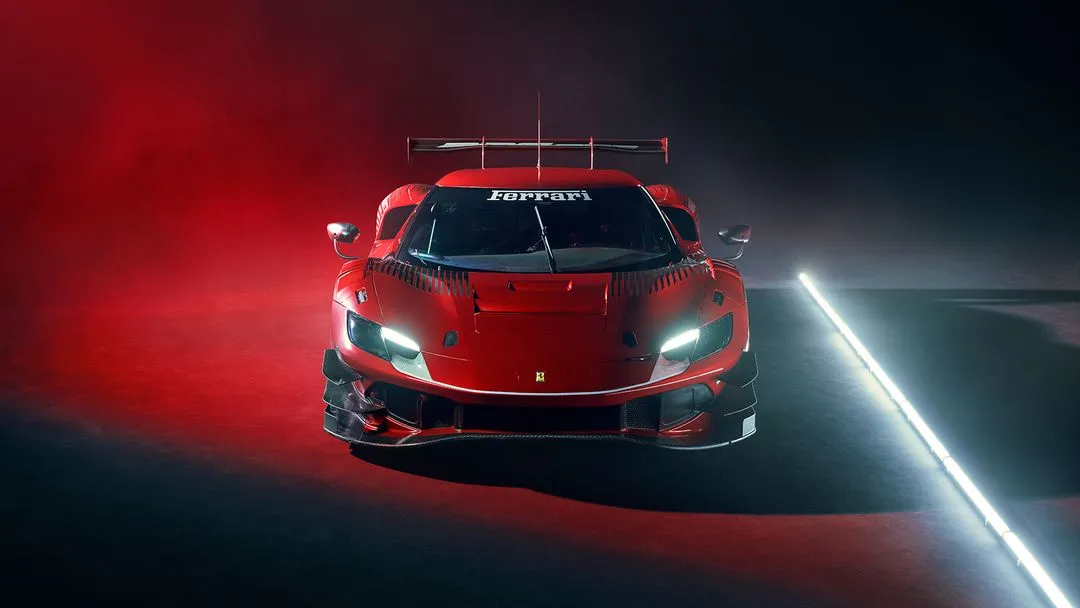
The Ferrari 296 GT3 is a track‑focused, racing‑spec version of Ferrari’s mid‑engine sports car engineered specifically for FIA competition. Unlike a regular road car, a GT3 machine is built for circuit racing — where aerodynamics, handling precision, and reliability under stress matter more than everyday usability.
This car is crafted for:
- Professional GT teams are competing in championships like the GT World Challenge and endurance races.
- Experienced racers seek power and agility in competitive environments.
- Wealthy enthusiasts (“gentleman drivers”) who want a high‑end race car with support from Ferrari.
offers an unmatched combination of Ferrari pedigree, engineering excellence, and racing performance that targets victory first, comfort second — with safety and telemetry systems to support serious racing operations.
Quick Overview Table
| Feature | Specification |
| Engine Type | 3.0 L Twin‑Turbo V6 (F163CE) |
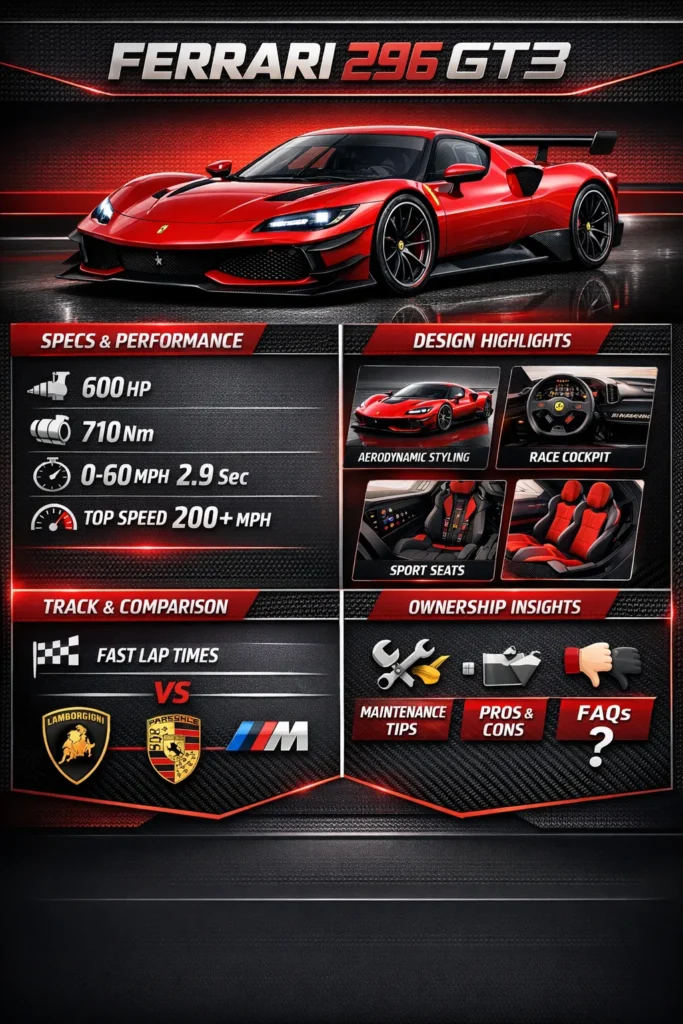
| Max Power | ~600 hp (BoP regulated) |
| Max Torque | ~710 Nm @ ~5500 rpm |
| Transmission | 6‑Speed Sequential (Race Gearbox) |
| Drivetrain | Rear‑Wheel Drive (GT3 spec) |
| Weight (Dry) | ~1250 kg |
| Wheelbase | 2660 mm |
| Width (No Mirrors) | 2050 mm |
| Front Suspension | Double Wishbone |
| Rear Suspension | Double Wishbone |
| Tyres | 18” Race Slicks |
| Brake System | 6‑piston front, 4‑piston rear calipers |
| Purpose | Professional GT Racing |
| Specifications may vary slightly based on the Balance of Performance (BoP) setup. |
Exterior Design
It has a body that looks like a real race car. It performs like one, too.
Every detail has been changed to make it better on the track. These changes help the handle. Get more downforce. The Ferrari being good on the track.
Some key features of the include:
It has a splitter that helps it stay balanced at speeds and generates more downforce.
Ferrari 296 GT3 has vents in the wheel arches to control airflow.
* The Ferrari 296 GT3 has a diffuser and wing that keep it stable.
The Ferrari 296 GT3 body is great at getting downforce. It gets twenty percent more downforce than the Ferrari 488 GT3. This means the Ferrari 296 GT3 can corner better and brake with confidence. You can drive the Ferrari 296 GT3 fast. It will still handle well.
Track-Focused Lighting & Details
The Ferrari 296 GT3 is a real race car, so it only has what it needs. The Ferrari 296 GT3 has lighting for long endurance races. To save weight, the Ferrari 296 GT3 has:
Headlights for racing at night.
ducts to cool the brakes.
racing wheels with tires.
The Ferrari 296 GT3 is about racing, so it does not have anything extra.
Wheels & Brake System
The Ferrari 296 GT3 comes with eighteen-inch racing wheels, big front brakes, and strong calipers to stop fast on the track. This is important for reliability when racing the Ferrari 296 GT3. You need to be able to stop the Ferrari 296 GT3 safely.
Interior & Comfort
The Ferrari 296 GT3 is all about the driver. Inside the Ferrari 296 GT3, Everything extra has been removed. You will not find leather or screens in the Ferrari 296 GT3. It has what you need to drive:
a racing seat with a harness.
a steering wheel with built-in controls.
* adjustable pedals to fit the driver.
The Ferrari 296 GT3 is made to help the driver focus on racing.
Safety First
Safety is really important when racing, and the Ferrari 296 GT3 has:
a roll cage.
* fire suppression systems.
data logging systems for the team.
The Ferrari 296 GT3 also has air conditioning to help the driver stay fresh. This is important for races.
Engine & Performance
The Ferrari 296 GT3 has a turbocharged V6 engine. The Ferrari 296 GT3 has a three-Point-zero-liter twin-turbo V6 engine that puts out six hundred horsepower. This engine is based on the one in the Ferrari 296 GTB. It has been changed for racing. The turbos are inside the cylinder to make the engine lighter and lower.
The Ferrari 296 GT3 has a transmission with a six-speed gearbox and paddle shifters on the steering wheel. This is necessary for fast and precise gear changes on the track.
Acceleration & Handling
The Ferrari 296 GT3 is really fast. It can. Brake really well, which is just what you need for racing on a track. It does it well.
Fuel Economy & Range
GT3 machines aren’t built for fuel efficiency — they are built for racing. Most teams plan fuel stops around race stint rules, not fuel ranges.
Understanding this is essential: GT3 cars don’t emphasize everyday mileage.
Safety Features
Safety compliance in racing is rigorous:
- FIA‑approved roll cage and reinforced chassis.
- Fire suppression system for full cockpit coverage.
- Race‑grade harnesses and seating.
- Telemetry and team radio systems for real‑time updates.
Technology & Infotainment
Unlike road cars, info‑entertainment is minimal . Technology focuses on:
- Race telemetry and data logging.
- Engine mapping and ECU settings (tuned for track).
- Driver feedback systems on wheel display or data interfaces.
This tech is designed to help teams analyze performance, not entertain passengers.
Variants & Pricing
The Ferrari 296 GT3 doesn’t come in traditional road car trims. Instead, variations depend on:
- Race series requirements (GT World Challenge, endurance specs).
- Optional packages like endurance brakes or telemetry upgrades.
- Evo upgrade kits that enhance aerodynamics and chassis for newer seasons are often sold after homologation for recent seasons.
While exact pricing changes by team configuration, expect the starting cost for a GT3 car to be in the €750,000 to €900,000 range or higher when fully prepared for Competition.
Pros & Cons
Pros
- World‑class race performance and handling.
- Advanced aerodynamics for high downforce.
- Track‑tested Ferrari race engineering.
- Driver‑centric cockpit with safety focus.
- Upgrade pathways (Evo kits) to stay competitive.
Cons
- Not street legal — track use only.
- High operating and maintenance costs.
- Limited comfort features.
- Fuel economy is irrelevant for road use.
- Requires a professional crew to extract maximum performance.
Best For
This car is ideal for:
- Professional racing teams in GT championships.
- Experienced amateur racers with budget and support.
- Collectors focused on track performance.
- Drivers seeking premium engineering and exclusivity.
If your focus is daily driving or comfort, a road‑legal Ferrari like the 296 GTB makes more sense.
Comparison Suggestions
Here are three cars that rival the Ferrari 296 GT3 in GT competition:
| Competitor | Key Strength |
| Porsche 911 GT3 R | Consistent handling and wide parts support |
| Lamborghini Huracán GT3 EVO | Brutal power and race-proven reliability |
| Aston Martin Vantage GT3 | Balanced chassis and strong endurance sales |
These rivals each bring unique advantages in build philosophy, handling, and race Support.
Maintenance & Ownership
Owning and running a GT3 racer involves:
- Routine track servicing — more frequent than road cars.
- Tyre and brake replacements after sessions or races.
- Telemetry support and setup adjustments.
- Spare parts logistics for high‑stress components.
Ferrari’s support network includes access to engineers and assistance, but competent team mechanics are essential
FAQs
A: No — the 296 GT3 is built exclusively for track competition under GT3 homologation rules.
A: It uses a 3.0 L twin‑turbo V6 (F163CE), producing around 600 hp under GT3 regulations.
A: Yes, many teams and gentleman drivers purchase GT3 cars for global racing series.
A: No — the racing version excludes hybrid systems for weight and regulation conformity.
A: The 296 GT3 offers 20 % more downforce and improved chassis balance compared to its predecessor.
Conclusion
stands as a milestone in GT racing — an expertly engineered competition machine with deep heritage and race‑ready performance. From its turbocharged V6 engine, advanced aerodynamics, and weight‑optimized chassis to its driver‑focused cockpit and safety systems, this car shows why Ferrari remains a top choice for teams and racers worldwide.
Whether you’re a seasoned professional or a dedicated enthusiast with resources to match your passion, the 296 GT3 delivers an exhilarating blend of speed, precision, and racing prestige. It may not be practical for the street, but on the track, it’s a formidable competitor destined for podiums and victories.
Ready to go deeper? Explore our comparison sections, read real owner insights, and learn track setup tips for this remarkable Ferrari racing weapon.
Tell us your thoughts — have you seen the 296 GT3 in action? Drop a Comment below, and share this review if you found it helpful!