Introduction
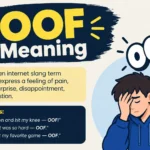
Have you ever received a text message saying “oof” and wondered what the sender meant? You’re not alone. OOF is a popular internet expression used in text messages, social media comments, gaming chats, and everyday online conversations.
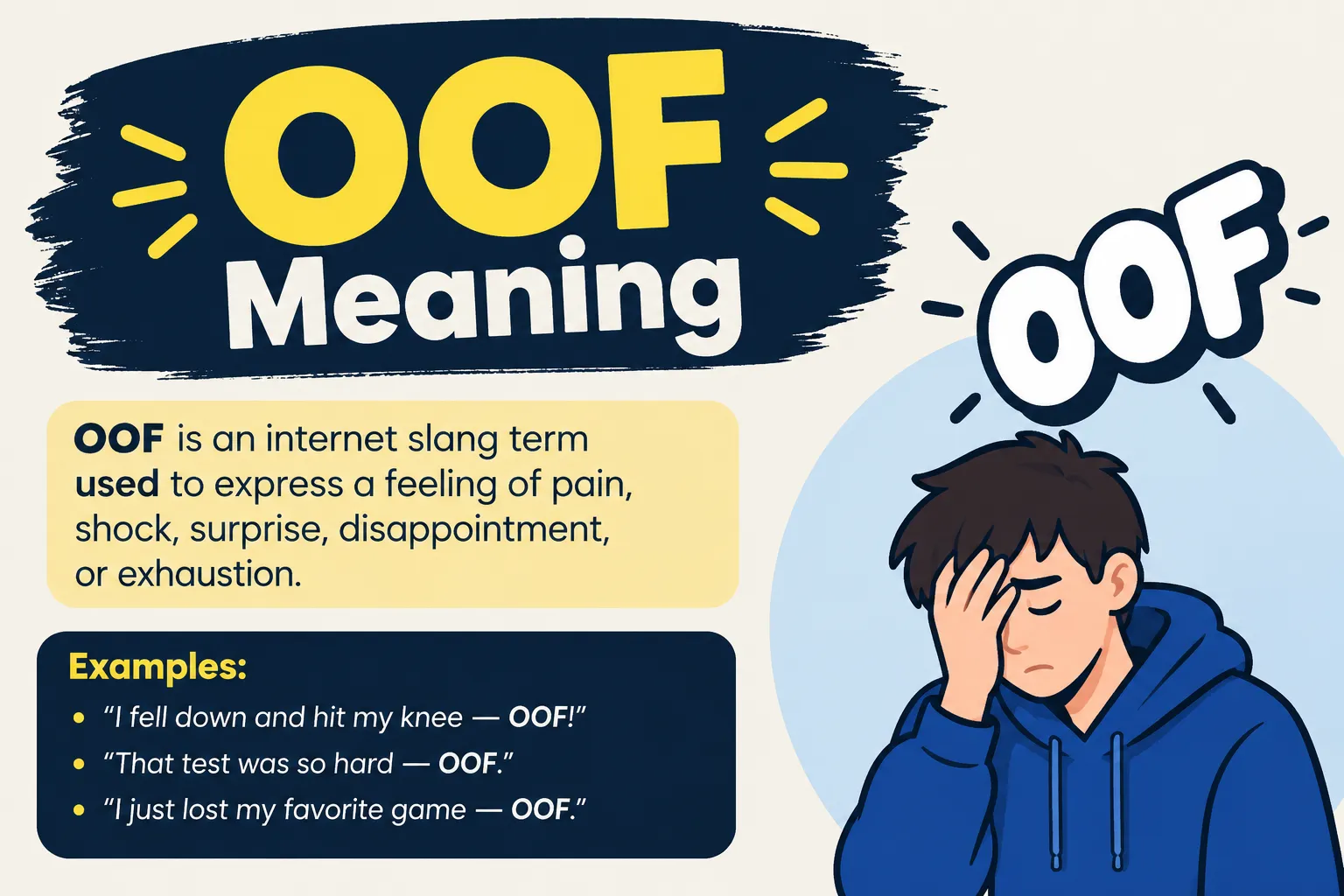
OOF usually means a reaction to pain, Embarrassment, disappointment, or an awkward situation. People use it to express sympathy, acknowledge a mistake, or respond to something unfortunate. For example, if your friend says they failed an important exam, replying “Oof, that’s rough” shows that you understand their disappointment.
The expression is also closely associated with Roblox, where the iconic “oof” sound became a recognizable part of gaming culture. However, OOF can have different meanings in professional or technical settings, depending on the context.
In this guide, you’ll discover what OOF means in texting, how people use it on social media, where the expression originated, what “big oof” means, and how to respond when someone sends it to you.
What Does OOF Mean?
OOF is an informal expression used to react to something painful, embarrassing, disappointing, or unfortunate. It is an interjection that imitates a short sound someone might make after experiencing an impact or encountering an uncomfortable situation.
In online conversations, OOF can communicate sympathy, surprise, secondhand embarrassment, or humor without requiring a long explanation.
For example:
- Pain: “Oof! I just hit my elbow.”
- Embarrassment: “Oof, that was awkward.”
- Disappointment: “Oof, I missed the last train.”
- Sympathy: “Oof, I’m sorry that happened to you.”
- Surprise: “Oof, I wasn’t expecting that.”
The exact meaning depends on the conversation. Someone might use OOF to show genuine concern after hearing bad news or to joke about a friend’s harmless mistake.
OOF Meaning in Texting: Quick Summary
If you want to understand the meaning quickly, the following table explains how OOF is commonly used.
| Feature | Meaning |
| Main definition | A reaction to pain, embarrassment, disappointment, or misfortune |
| Word type | Informal interjection |
| Common tone | Sympathetic, humorous, surprised, or sarcastic |
| Where it appears | Text messages, social media, gaming, and online chats |
| Is it a bad word? | No, it is generally harmless |
| Is it an acronym? | Not when used as an emotional reaction |
| Famous association | The Roblox character-death sound |
| Similar expressions | Ouch, oops, yikes, and that’s rough |
In simple terms, when someone replies “oof” to your message, they are usually acknowledging that something sounds difficult, awkward, painful, or unfortunate.
What Does OOF Mean in Text Messages?
In texting, OOF is a short reaction that helps people acknowledge an uncomfortable situation. Instead of writing a complete sentence, someone can simply type “oof” to communicate an immediate emotional response.
Here are the most common ways people use it.
1. OOF to Express Sympathy
People often use OOF when a friend shares disappointing news or describes a difficult experience.
Example:
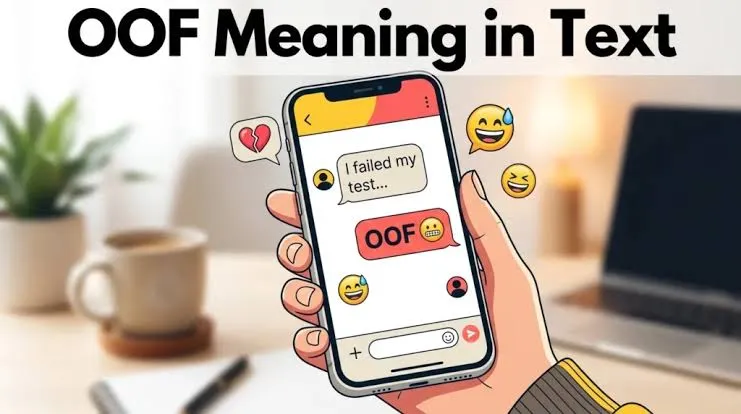
Person A: “I studied for three weeks, but I still failed my exam.”
Person B: “Oof, I’m sorry. That really sucks.”
In this conversation, OOF acknowledges the disappointment and expresses sympathy. It shows that the other person understands the situation is frustrating.
2. OOF to Show Embarrassment
OOF can also describe an awkward moment or secondhand embarrassment.
Example:
Person A: “I waved at someone who wasn’t waving at me.”
Person B: “Oof 😭”
The response recognizes the awkwardness. Depending on the relationship, it may communicate sympathy or playful amusement.
3. OOF After Making a Mistake
Someone might use OOF when a person makes an obvious mistake or experiences an unexpected setback.
Example:
Person A: “I accidentally sent my private message to the entire group chat.”
Person B: “Oof! Hopefully it wasn’t anything embarrassing.”
Here, OOF acknowledges the mistake and adds a conversational reaction without making the exchange overly formal.
4. OOF to React to Bad Luck
OOF is also common when something unfortunate happens unexpectedly.
Example:
Person A: “My flight was canceled, and now I have to wait eight hours.”
Person B: “Oof, that’s rough.”
The expression communicates that the situation sounds frustrating. A more supportive follow-up can make the response feel more empathetic.
5. OOF to Express Surprise
Although OOF is often associated with embarrassment and disappointment, it can also express surprise.
Example:
Person A: “He spent his entire savings on a car that stopped working the next day.”
Person B: “Oof, that’s unexpected.”
In this situation, OOF acknowledges an unfortunate outcome that the sender did not anticipate.
What Does OOF Mean on Social Media?
On social media, OOF is commonly used in comments, captions, direct messages, memes, and reaction videos. It helps people express an Immediate reaction without writing a detailed response.
For example:
- “Oof, that didn’t go as planned.”
- “Big oof in the comments.”
- “Oof 😬 that must have hurt.”
- “Oof, the timing couldn’t be worse.”
- “That was a risky move. Oof.”
The expression can sound sympathetic, sarcastic, playful, or humorous depending on the situation.
OOF Meaning on TikTok
On TikTok, OOF may appear in comments, gaming clips, funny videos, and reaction content. Users often write it when someone experiences an embarrassing moment, makes a mistake, or faces an unexpected outcome.
For example, someone might comment “Oof 😭” under a video showing an awkward social interaction.
The expression may communicate secondhand embarrassment or amusement, but its precise tone depends on the video and the surrounding comments.
OOF Meaning on Instagram
On Instagram, OOF can appear in comments, Stories, direct messages, and reactions to posts.
For example:
Friend: “I bought expensive concert tickets, but I just found out I can’t attend.”
You: “Oof, that’s unfortunate.”
In this situation, OOF acknowledges disappointment and shows that you understand why the situation is frustrating.
OOF Meaning on Snapchat
On Snapchat, OOF may be used in private conversations or replies to photos and Stories.
A friend might send “Oof 😂” after seeing a funny mistake or “Oof, I’m sorry” after hearing disappointing news.
Because Snapchat conversations are often brief, the surrounding messages help clarify whether the expression is playful or sympathetic.
OOF Meaning on Facebook
On Facebook, people may use OOF in comments under personal updates, funny videos, gaming posts, or discussions about unfortunate events.
For example, if someone shares a story about missing an important appointment, another person might comment, “Oof, that’s rough.”
OOF Meaning on Reddit
On Reddit, OOF is often used as a short reaction to awkward stories, unfortunate outcomes, and embarrassing mistakes.
Depending on the subreddit and discussion, it can express sympathy, irony, surprise, or humor.
OOF Meaning on Discord and X
On Discord, OOF is particularly recognizable in informal gaming chats, where it may describe a failed attempt or an unfortunate in-game outcome.
On X, formerly Twitter, it can appear in short replies to surprising news, personal stories, and memes.
Across these platforms, the central meaning remains similar: OOF expresses an immediate reaction to something uncomfortable, awkward, surprising, or unfortunate.
What Does OOF Mean in Roblox?
OOF has a famous association with Roblox, the online gaming platform.
For years, Roblox players heard a distinctive “oof” sound when their characters died. The sound became a memorable part of the gaming experience and inspired countless jokes, memes, reaction videos, and online references.
In Roblox conversations, OOF may refer to the familiar sound, a character’s defeat, or a humorous reaction to a mistake.
Example:
Player A: “I fell off the map again.”
Player B: “Oof 😂”
The response acknowledges the failure and adds a playful tone.
Did Roblox Invent the Word OOF?
No. The expression existed long before Roblox became popular.
OOF is an example of onomatopoeia, meaning that it imitates a sound. Its use as an interjection dates back centuries, while Roblox helped make a particular version of the sound widely recognizable among gamers.
The word and the famous game sound therefore have different histories.
What Happened to the Original Roblox OOF Sound?
Roblox removed its original death sound in July 2022 following a licensing dispute and replaced it with a different default sound.
However, the original sound later returned. In July 2025, Roblox announced that the classic OOF sound was once again the default death sound for experiences that had not customized it.
This update matters because older articles may incorrectly suggest that the original sound remains permanently removed.
For the official announcement, visit the Roblox Developer Forum.
Where Did the Word OOF Originate?
OOF is an example of onomatopoeia, a linguistic term for a word that imitates or represents a sound.
People may say “oof” after experiencing an impact, losing their breath, or reacting to discomfort. Over time, the expression also developed figurative meanings associated with embarrassment, disappointment, and uncomfortable situations.
Its development can be understood in three stages:
- Spoken expression: OOF imitates a short sound associated with impact or discomfort.
- Everyday language: People use it figuratively to react to mistakes, awkward moments, and bad news.
- Internet culture: Gaming, memes, and social media helped establish it as a recognizable online reaction.
According to Dictionary.com, the interjection was first recorded in the 1770s.
Its modern popularity in gaming and texting represents a later development rather than its original origin.
What Does Big OOF Mean?
Big oof is an intensified version of OOF. It generally describes a particularly embarrassing mistake, a major setback, or an unfortunate situation.
The word “big” emphasizes the Magnitude of the problem, often with a humorous or exaggerated tone.
Examples include:
- “You forgot your passport on the day of your flight? Big oof.”
- “I sent my private notes to the entire team. That was a big oof.”
- “He practiced for weeks and still missed the final shot. Big oof.”
A big oof does not necessarily mean something disastrous has happened. Friends may use the phrase jokingly for relatively minor mistakes.
What Does Oofed Mean?
Oofed is an informal form of the expression used as a verb. In gaming and internet conversations, it can describe being defeated, making a mistake, or experiencing an unfortunate outcome.
Examples:
- “I completely oofed that presentation.”
- “He got oofed in the final round.”
- “I oofed my chances by arriving late.”
The word is casual and playful rather than formal English. Its exact meaning depends on the situation.
Does OOF Have Other Meanings?
Yes. Although OOF commonly expresses an emotional reaction, the same letters can function as an abbreviation in certain workplaces or technical fields.
| Context | Possible meaning | Example |
| Texting and slang | Reaction to discomfort or misfortune | “Oof, that’s rough.” |
| Gaming | A reaction to defeat or a reference to the Roblox sound | “Oof, I lost again.” |
| Workplace | Out of Office, in some organizations | “I’m OOF on Friday.” |
| Photography | Out of Focus, in some technical discussions | “The background is OOF.” |
These meanings are context-dependent and should not be treated as interchangeable.
In workplace communication, OOF may be an organization-specific abbreviation for being away from work. OOO is a more widely recognized shorthand for “Out of Office.”
In photography, OOF may refer to an out-of-focus subject or image area. The abbreviation depends on the Terminology used by the photographer or community.
If someone uses OOF in a professional message and the meaning is unclear, ask for clarification rather than assuming it refers to internet slang.
How to Use OOF in a Sentence
OOF works best in informal conversations. It can stand alone as a reaction or appear at the beginning of a sentence.
Here are some natural examples.
To express physical pain:
“Oof! That ball hit me harder than I expected.”
To react to embarrassment:
“Oof, I can’t believe I said that in front of everyone.”
To show sympathy:
“Oof, I’m sorry you had such a difficult day.”
To acknowledge disappointment:
“Oof, the concert sold out before I could buy tickets.”
To react humorously:
“Oof 😂 that was a spectacular fail.”
To recognize a difficult situation:
“Oof, that’s going to be a tough conversation.”
People may also write “ooof” or “ooooof” to emphasize their reaction. Longer spellings can make the expression feel stronger, more dramatic, or more playful.
In formal reports, academic writing, and professional emails, a clear sentence is usually more appropriate than slang.
How Should You Respond When Someone Says OOF?
The best response depends on what the other person is reacting to. Humor may be appropriate for a minor mistake, while disappointing news deserves a more thoughtful response.
| Situation | Possible response |
| A friend shares bad news | “I’m sorry. That really sucks.” |
| Someone describes an awkward moment | “We’ve all been there!” |
| A friend makes a funny mistake | “It happens 😂” |
| Someone experiences disappointment | “Hopefully things get better.” |
| Someone reacts to your mistake | “Yeah, I definitely messed that up.” |
| A friend jokes about a minor setback | “The biggest oof of the day.” |
You do not always need to reply with another slang expression. If the person is dealing with something genuinely difficult, a supportive response may be more helpful than a joke.
Is OOF a Bad Word?
No. OOF is generally not considered a swear word or an inherently offensive expression.
It is an informal way to express discomfort, sympathy, surprise, or embarrassment. It is common in casual chats, gaming communities, and social media conversations.
However, context matters. Responding “oof” to someone’s serious problem without offering support may sound dismissive.
Similarly, using slang in a formal email or academic paper may appear overly casual. The expression itself is generally mild; how it is received depends on the situation and the speaker’s intention.
OOF vs. Oops vs. Ouch vs. Yikes
Oops, ouch, and yikes can overlap in meaning, but each expression tends to emphasize a different reaction.
| Expression | Typical meaning | Example |
| OOF | Pain, sympathy, embarrassment, or an unfortunate outcome | “Oof, that sounds stressful.” |
| Oops | A mistake or minor accident | “Oops, I forgot to attach the file.” |
| Ouch | Physical or emotional pain | “Ouch, that comment hurt.” |
| Yikes | Alarm, concern, or a strong reaction to something uncomfortable | “Yikes, that sounds dangerous.” |
These are general tendencies rather than strict rules. People sometimes use the expressions interchangeably, especially in humorous online conversations.
People Also Ask
When a girl texts “oof,” she may be expressing sympathy, embarrassment, disappointment, or surprise. The word alone does not reliably indicate romantic interest or a particular intention. Consider what she is responding to and the broader conversation.
A guy may use OOF to acknowledge an awkward moment, react to bad news, joke about a mistake, or show sympathy. As with anyone else, the meaning depends on the context rather than the sender’s gender.
It can. OOF is often used when someone experiences embarrassment or secondhand embarrassment. For example, “Oof, that was awkward” acknowledges an uncomfortable social moment.
On TikTok, OOF commonly expresses a reaction to a funny fail, an embarrassing situation, an unexpected revelation, or an unfortunate event. It may appear in comments, captions, and gaming-related videos.
In workplace communication, OOF may mean “Out of Office” or another organization-specific phrase. OOO is a more widely recognized abbreviation for “Out of Office.” If the intended meaning is unclear, check the surrounding message.
Conclusion
OOF is a short but versatile expression that communicates an immediate reaction to pain, embarrassment, disappointment, or an awkward situation.
The most reliable way to understand OOF is to consider the context in which it appears. A short “oof” after disappointing news may communicate sympathy, while the same expression after a funny mistake may be playful or sarcastic. Once you understand these distinctions, it becomes easier to interpret the Expression and use it naturally in everyday online conversations.