Introduction
If someone sends you “IGU” in a text, DM, Snapchat message, or social media comment, you may wonder what those three letters actually mean.
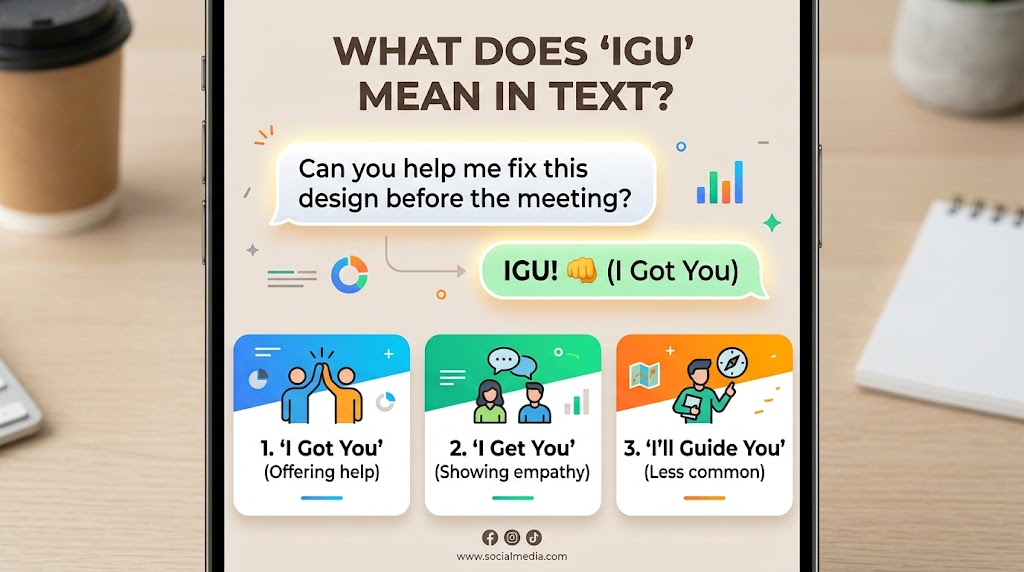
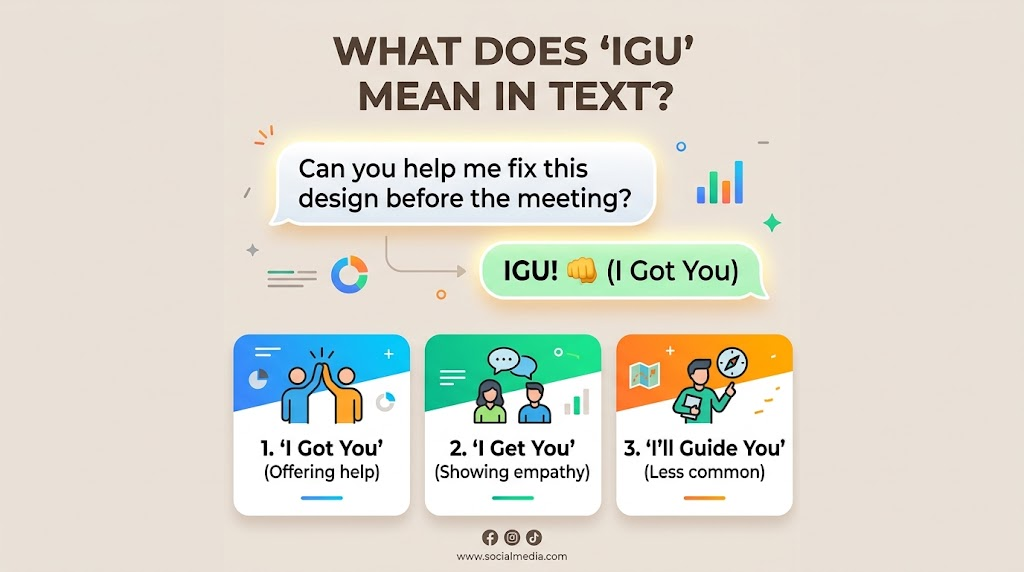
The tricky part is that IGU does not have one universal meaning in texting. Depending on the conversation, it can mean “I Give Up,” “I Got You,” or “I Get You.” Some texting references identify “I Give Up” as the established abbreviation, while newer slang-oriented usage also uses IGU for supportive meanings such as “I Got You” or “I Get You.”
So, what does IGU mean in your conversation?
The easiest answer is: look at the message immediately before it and the overall tone of the conversation.
What Does IGU Mean in Text?
In texting and online conversations, IGU can have several meanings:
| IGU Meaning | What It Expresses | Typical Context |
| I Give Up | Frustration, surrender, defeat | Arguments, puzzles, games, difficult tasks |
| I Got You | Support, agreement, or a promise to help | Requests, plans, favors |
| I Get You | Understanding or empathy | Emotional conversations and personal discussions |
“I Give Up” is a well-established texting interpretation of IGU. At the same time, several current slang pages use IGU for “I Got You” or “I Get You,” which makes context especially important.
IGU Meaning: I Give Up
One of the most established meanings of IGU in text is “I Give Up.”
Someone may use it when they are tired of trying, cannot solve a problem, have lost an argument, or are jokingly surrendering.
Example
Person 1: “Did you finally solve that puzzle?”
Person 2: “IGU 😭”
Here, IGU means “I Give Up.”
The sender is basically saying:
- I can’t figure it out.
- I’m done trying.
- You win.
- This is too difficult.
It does not necessarily indicate serious frustration. Friends often use it dramatically or humorously.
IGU in a frustrating situation
“I’ve explained this three times. IGU.”
Meaning:
“I give up. I’m done explaining.”
IGU in gaming
“This boss is impossible. IGU.”
Here, IGU means:
“I give up.”
The gaming context makes the meaning relatively easy to identify.
IGU Meaning: I Got You
Another interpretation of IGU is “I Got You.”
In this usage, the expression is supportive rather than frustrated.
Someone may use it when they agree to help, confirm that they understand a request, or reassure another person.
Example
Person 1: “Can you save me a seat?”
Person 2: “IGU.”
Meaning:
“I got you.”
In other words:
“Sure, I’ll take care of it.”
More examples
“Can you send me the notes later?”
“IGU.”
Meaning: “I got you.”
Or:
“Don’t worry, I’ll handle it.”
“IGU.”
Meaning: “I got you.”
This interpretation is particularly easy to recognize when the conversation involves help, plans, favors, or reassurance. Current slang pages commonly describe this supportive use.
IGU Meaning: I Get You
IGU can also be interpreted as “I Get You.”
Here, the speaker is saying that they understand another person’s feelings, opinion, situation, or point of view.
Example
Person 1: “I’m exhausted from dealing with everything this week.”
Person 2: “IGU.”
Meaning:
“I get you.”
The phrase communicates understanding or relatability.
It can be similar to:
- I understand you.
- I know what you mean.
- I understand how you feel.
- I feel you.
- I can relate.
Some current slang references specifically use “I Get You” as the primary interpretation, demonstrating why assuming there is only one meaning can lead to misunderstandings.
How to Tell Which IGU Meaning Someone Intended
Because IGU can represent different phrases, context is the most important clue.
Use the surrounding conversation to identify the intended meaning.
If the conversation involves a request
IGU probably means:
“I Got You.”
Example:
“Can you pick me up at 7?”
“IGU.”
The sender is agreeing to help.
If the conversation involves emotions
IGU may mean:
“I Get You.”
Example:
“Nobody understands why I’m upset.”
“IGU.”
The sender is expressing understanding.
If the conversation involves a difficult task
IGU may mean:
“I Give Up.”
Example:
“I’ve tried this level ten times. IGU.”
The person is surrendering.
If someone is arguing
Look at the tone.
“Okay, IGU 😂”
could mean:
“Fine, I give up.”
But:
“Don’t worry, IGU.”
could mean:
“I got you.”
The same three letters can therefore communicate completely different ideas.
IGU Meaning in Social Media
IGU may appear in comments, captions, DMs, group chats, and other forms of online communication.
On social media, people frequently shorten phrases because quick communication is part of the culture of messaging.
However, the meaning should still be determined from context rather than the platform alone.
For example:
TikTok comment:
“This challenge is Impossible 😭 IGU”
Here, IGU likely means “I Give Up.”
Instagram DM:
“Can you remind me tomorrow?”
“IGU ❤️”
Here, IGU could mean “I Got You.”
Snapchat conversation:
“I totally understand what you’re saying.”
“IGU.”
Here, it may mean “I Get You.”
IGU Meaning on Snapchat
If you see IGU on Snapchat, don’t automatically assume that it has one fixed definition.
Consider the conversation.
If someone sends:
“Don’t stress, IGU.”
it may mean “I Got You.”
If someone says:
“I’ve tried explaining this all night. IGU 😂”
it probably means “I Give Up.”
Snapchat’s casual messaging environment makes abbreviations particularly dependent on tone and context.
IGU Meaning on TikTok
On TikTok, IGU may appear in comments or replies.
For example:
“This trend makes no sense. IGU 😭”
Here, “I Give Up” is likely intended.
But:
“You need help with that? IGU.”
could mean “I Got You.”
The surrounding words and emojis can provide important clues.
IGU Meaning on Instagram
In Instagram DMs, IGU can function as casual shorthand.
For example:
“Can you send me that picture?”
“IGU.”
This sounds like “I Got You.”
Meanwhile:
“I’ve been trying to understand this for an hour. IGU.”
sounds like “I Give Up.”
Instagram does not give IGU a special platform-specific definition. The meaning comes from the conversation.
IGU Meaning in WhatsApp
WhatsApp conversations can use IGU in much the same way as ordinary texting.
A friend might say:
“Can you bring some snacks?”
You might respond:
“IGU.”
Here, IGU = I Got You.
Another person might say:
“This math problem is impossible. IGU.”
Here, IGU = I Give Up.
Therefore, WhatsApp context matters just as much as text-message context.
IGU Meaning in a Conversation With Friends
Among friends, IGU is usually casual and informal.
It can express:
- Support
- Understanding
- Agreement
- Frustration
- Playful surrender
- Relatability
The relationship between the people can also affect the tone.
For example:
“You need me to cover for you? IGU.”
means “I got you.”
But:
“You seriously expect me to solve this? IGU 😂”
means “I give up.”
IGU Meaning From a Guy
If a guy sends you IGU, don’t assume that it automatically has a romantic meaning.
Its interpretation depends on the conversation.
Example 1: Friendly
You: “Can you help me with this?”
Him: “IGU.”
This most likely means:
“I got you.”
Example 2: Emotional
You: “I feel like nobody understands me.”
Him: “IGU.”
This could mean:
“I get you.”
Example 3: Frustration
You: “You’re still arguing about this?”
Him: “IGU 😂”
This could mean:
“I give up.”
So, the abbreviation itself is not enough to determine someone’s feelings.
IGU Meaning From a Girl
The same principle applies when a girl sends IGU.
For example:
“Need anything from the store?”
“IGU.”
This could mean “I got you.”
Or:
“I’m so tired of explaining myself.”
“IGU ❤️”
This may mean “I get you.”
The relationship, conversation, punctuation, and emojis can all help determine the intended meaning.
Is IGU a Slang Word?
Yes. When used in casual digital conversations, IGU functions as an informal abbreviation or texting shorthand.
It is most appropriate in situations such as:
- Text messages
- Casual DMs
- Group chats
- Social media
- Online gaming
- Conversations with friends
It is generally better to avoid unexplained slang such as IGU in formal communication.
Instead of writing:
“IGU, I’ll take care of it.”
a professional message would be Clearer as:
“I understand. I’ll take care of it.”
Is IGU Formal or Informal?
IGU is informal.
You might use it when talking to:
- Friends
- Family
- Online friends
- Gaming teammates
- People you regularly message
You generally should not use it in:
- Business emails
- Academic writing
- Job applications
- Official documents
- Formal customer communication
The full phrase is safer when clarity matters.
IGU vs I Got You
Although IGU can mean “I Got You,” the abbreviated version can be ambiguous.
I Got You usually communicates:
- Help
- Support
- Agreement
- Reassurance
- Confirmation
Example:
“Can you cover my shift?”
“I got you.”
This means the person agrees to help.
IGU vs I Get You
“I Get You” is slightly different.
It focuses more on understanding someone.
Example:
“I don’t want to go because I’ve had a rough day.”
“I get you.”
Here, the speaker is showing empathy or understanding.
Therefore:
I Got You = I’ll help/support you.
I Get You = I understand you.
However, when someone writes only IGU, the exact interpretation may not be obvious.
IGU vs I Give Up
“I Give Up” has a completely different emotional direction.
Compare:
“IGU, I’ll take care of it.”
= I Got You
versus:
“IGU, this is impossible.”
= I Give Up
One expresses confidence or support, while the other expresses surrender or frustration.
Common IGU Examples in Texting
Here are some examples that show how context changes the meaning.
Example 1 — Offering Help
A: Can you send me the file?
B: IGU.
Meaning: I Got You.
Example 2 — Showing Understanding
A: I hate when people misunderstand me.
B: IGU.
Meaning: I Get You.
Example 3 — Giving Up
A: Did you solve the puzzle?
B: Nope. IGU.
Meaning: I Give Up.
Example 4 — Making Plans
A: Can you pick me up tonight?
B: IGU.
Meaning: I Got You.
Example 5 — Gaming
A: Did you beat the final level?
B: IGU 😭
Meaning: I Give Up.
Example 6 — Emotional Support
A: Nobody understands what I’m going through.
B: IGU ❤️
Meaning: I Get You.
What Does IGU Mean With an Emoji?
Emojis can make the intended meaning easier to understand.
IGU + 😭
Usually suggests:
I Give Up
Example:
“This homework is impossible. IGU 😭”
IGU + 😂
May indicate playful surrender.
“You win the argument. IGU 😂”
IGU + ❤️
May suggest support or understanding.
“I know you’ve been struggling. IGU ❤️”
IGU + 👍
May suggest:
I Got You.
“I’ll send it tonight. IGU 👍”
These aren’t absolute rules, but emojis provide useful contextual clues.
Can IGU Be Used in a Romantic Conversation?
Yes, but IGU itself is not inherently romantic.
For example:
“Don’t worry, IGU ❤️”
could sound caring or affectionate depending on the relationship.
But:
“This argument is going nowhere. IGU 😂”
has no romantic meaning.
If you’re trying to understand whether someone is flirting, look at the entire conversation, not just the abbreviation.
How Should You Reply to IGU?
Your response depends on what the sender appears to mean.
If IGU means “I Got You”
You can reply:
- “Thanks!”
- “Appreciate you.”
- “Perfect, Thank You.”
- “You’re the best.”
- “Awesome!”
If IGU means “I Get You”
You can respond:
- “Exactly!”
- “Thank you for understanding.”
- “That’s what I mean.”
- “Glad you understand.”
- “I appreciate that.”
If IGU means “I Give Up”
You can respond playfully:
- “Haha, don’t give up yet!”
- “One more try 😂”
- “I knew you’d surrender.”
- “You actually gave up?”
- “Fair enough 😭”
Should You Use IGU Yourself?
You can use IGU in casual conversations if the people you’re talking to understand the abbreviation.
However, because IGU has multiple possible meanings, it can sometimes create confusion.
If your message could be misunderstood, simply write the complete phrase.
Instead of:
“IGU.”
write:
“I got you.”
or:
“I get you.”
or:
“I give up.”
This removes ambiguity immediately.
Is IGU the Same as IKR?
No.
IKR usually means “I Know, Right?”
It is commonly used to strongly agree with someone’s statement.
Example:
“That movie was amazing.”
“IKR!”
By comparison, IGU can mean “I Give Up,” “I Got You,” or “I Get You,” depending on context.
Is IGU the Same as IDK?
No.
IDK means “I Don’t Know.”
Example:
“What time does the store close?”
“IDK.”
IGU has different meanings and should not be confused with IDK.
Other Meanings of IGU
Outside casual texting, IGU can represent other terms or abbreviations.
For example, IGU may appear in technical contexts where it has nothing to do with internet slang. Search results for broader acronym usage show that the abbreviation can have specialized meanings in areas outside everyday messaging.
Therefore, if you see IGU in a technical document, workplace setting, scientific discussion, or another specialized context, don’t automatically interpret it as texting slang.
Is IGU Appropriate for Formal Writing?
Usually, no.
IGU is best suited to informal digital communication.
For professional writing, use the complete expression:
- “I understand.”
- “I understand what you mean.”
- “I’ll take care of it.”
- “I agree.”
- “I give up.”
The complete phrase is clearer and avoids the ambiguity associated with IGU.
Why Context Matters So Much With IGU
IGU is a good example of why texting abbreviations cannot always be translated word-for-word.
Consider these two messages:
“Don’t worry about the tickets. IGU.”
and:
“I’ve tried everything. IGU.”
They contain exactly the same abbreviation.
Yet their meanings are completely different.
The first likely means:
I Got You.
The second likely means:
I Give Up.
This is why the best way to understand IGU is to consider:
- What was said before it?
- What is the topic?
- Is the person asking for help?
- Is the conversation emotional?
- Is someone struggling with something?
- Are there emojis?
- Is the tone serious or playful?
Once you answer these questions, the intended meaning usually becomes much clearer.
Quick IGU Meaning Cheat Sheet
| If the conversation is about… | IGU probably means… |
| Asking for help | I Got You |
| Making plans | I Got You |
| Reassurance | I Got You |
| Understanding feelings | I Get You |
| Relating to someone’s experience | I Get You |
| A difficult puzzle | I Give Up |
| An argument | I Give Up |
| A difficult game | I Give Up |
| Repeated frustration | I Give Up |
Remember that these are contextual clues, not absolute rules.
People Also Ask
A: IGU can mean “I Give Up,” “I Got You,” or “I Get You.” The intended meaning depends on the conversation and tone.
A: “I Give Up” is a well-established definition in texting references. However, current online slang usage also uses IGU for “I Got You” and “I Get You,” so context is essential.
A: Yes. Some people use IGU as a shortened form of “I Got You,” especially when offering help, agreeing to something, or reassuring someone.
A: Yes. In some online conversations, IGU means “I Get You,” expressing understanding or empathy.
A: It depends on the context. It can mean “I Got You,” “I Get You,” or “I Give Up.” The abbreviation alone does not prove romantic interest.
Conclusion
IGU is a context-dependent texting abbreviation.
The three important interpretations are:
Give Up — surrender, frustration, or playful defeat.
I Got You — support, agreement, help, or reassurance.
I Get You — understanding, empathy, or relatability.
Because current online sources use all three interpretations, the safest approach is not to assume that IGU always means one particular phrase. Instead, examine the conversation around it.






2 thoughts on “IGU Meaning in Text: What Does IGU Mean?”